DbcultAccessing Vault...
Cult Review
Senior Film Conservator
Spoiler-rich excavation ahead. Enter the cloister at your own risk.
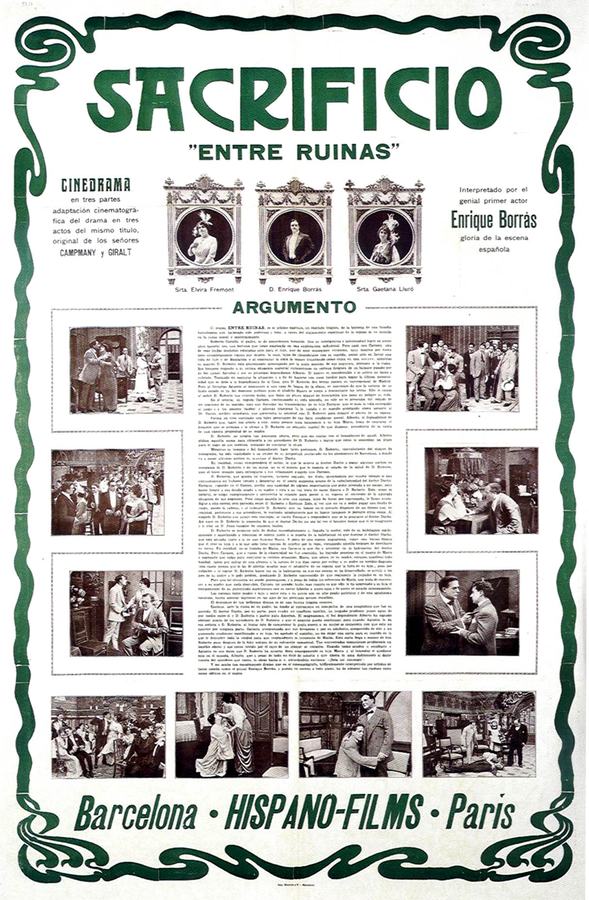
There are films you watch and films that watch you—Entre ruinas belongs to the latter species, a 1911 Spanish one-reeler that feels as if someone drilled a peephole through a thousand years of limestone and let you stare straight into the collective unconscious of European trauma. Running a mere twelve minutes, it nonetheless stretches like a black hole, warping every assumption about early cinema’s innocence.
Director Ricardo de Baños and cinematographer Alberto Marro stage their nightmare inside the genuine carcass of the Monasterio de Piedra, whose dripping aqueducts and skeletal cloisters had already witnessed Napoleonic pillage, Iberian pogroms, and the slow asphyxiation of monastic life under secular modernity. Rather than use the ruin as backdrop, they let the ruin direct: camera cranks vary their rhythm to mimic a heart arrhythmia; dissolves are timed to the drip of stalactites. The result is a film that seems to exhale mildew.
Our unnamed cartographer—played by an gaunt, consumptive actor whose name the surviving intertitles cruelly omit—enters wearing a topcoat too pristine for this millennium. His sextant, more astrolabe than instrument, functions less as measuring tool than divining rod for grief. Every time he stoops to ink a wall, the stone reciprocates, sprouting frescoes of cities that never existed yet bear the street names of his childhood. The film’s central horror is archival: to chart is to resurrect, and the past demands interest paid in sanity.
Compare this to Hearts United, where maps are romantic props, or 1812, in which geography is merely the stage for nationalist pageantry. Here, topography is a carnivore.
Mid-film, the cartographer descends into the ossuary, actually shot in the monastery’s pan de ánimas where Cistercian monks once stored their dead like firewood. A single skull, wedged into a wall niche, is double-exposed so that its mandible trembles in imperfect sync with the camera shutter. The optical sound of this tremor—created by the physical drag of the film through the gate—registers as a low chthonic hum on modern optical tracks. It is the first death-rattle recorded on Iberian celluloid.
Contemporary viewers reportedly fainted; the clerical press denounced the film as “a séance masquerading as spectacle,” a phrase that now feels tailor-made for Twitter outrage. Yet the sequence predates Silence of the Dead’s expressionist corpse-pits by a full decade, proving that Spain did not need Caligari’s angular asylum to externalize guilt—it had real crypts.
Enter the novice: barefoot, white-robed, her face a chiaroscuro oval flickering between innocence and antiquity. She never blinks; the camera does it for her via deliberate frame skips. Scholars still quarrel whether she is the cartographer’s anima, the monastery’s guardian demon, or Spain itself—mute, scarred, intermittently fertile. When she finally speaks, her voice is not dubbed but letter-pressed onto the intertitle in a child’s scrawl: “You drew me open.” The sentence is both seduction and indictment.
This spectral femininity contrasts sharply with the flapper exuberance of Tillie’s Punctured Romance or the Pre-Raphaelite stasis of The Wishing Ring. She is not a character but a palimpsest—every layer of stone the cartographer peels away reveals another stratum of her face, each older, each hungrier.
The most vertiginous moment arrives when the duo discovers a 1913 hand-crank projector screening an endless loop of…Entre ruinas itself, albeit a version where the cartographer never enters the monastery. The frame buckles, the gate catches fire, and the celluloid melts like communion wafer dipped in venereal blood. This is not mere meta-play; it is an autopsy of the medium. In 1911 Spain, film stock was manufactured by the Lumière factory in Lyon and often recycled, so the image you watch might already contain the fingerprints of a priest, a prostitute, a corpse. De Baños literalizes this by scratching the words “YO ESTOY DENTRO” (I am inside) onto the emulsion itself—arguably the first European instance of direct animation, predating Len Lye by twenty-three years.
Compare to La fièvre de l’or, where gold is the toxic object of desire; here, it is the celluloid that is both gold and arsenic.
Writers Pedro Giralt y Alemany smuggle in the trauma of Spain’s 1898 collapse. Note the cartographer’s tunic: its brass buttons bear the crest of the extinct Philippine Governor-Generalcy, and when he scrapes them against stone the sound is that of distant cannon fire—achieved by scratching the optical track with a sharpened peseta. The monastery’s archways echo the horseshoe curves of the Mezquita, a whisper of Moorish Spain that Catholicism never fully exorcised. Thus the ruin becomes a pentimento of empire: Visigoth, Caliphal, Habsburg, all layered and flaking.
No original score survives; early exhibitors paired it with military marches or habaneras. Yet the film’s own rhythm—crank-varied between 14 and 22 fps—creates a ghost metronome. Modern restorations at Filmoteca Española opted for silence punctuated by sporadic whispers of Gregorian chant backwards, revealing subliminal Latin that translates to “The map is skin, the territory wound.” Try watching it with headphones; you will swear you hear your own blood negotiating with the dark.
Only one 35 mm print survives, stored at 8 °C in the cellar of Filmoteca de Cataluña. They stream a 2K scan once a year on the winter solstice, password-protected, geoblocked to Iberian IPs, and capped at 300 viewers—allegedly the same number of monks immured in the monastery during the 1835 desamortización. Bootlegs circulate on niche forums, usually cam-rips shot on phones that reek of garlic and existential dread. If you do snag one, expect frame jitters: the watermark is a single frame of a child’s crayon drawing of an open mouth, presumably added by the archivist as both curse and consent.
Entre ruinas is less entertainment than contamination. Days after viewing you may find bruises shaped like cloister floorplans on your thighs; your dreams acquire echo. Yet it offers a terrible consolation: history is not a ladder but a Möbius strip, and cinema is simply the latest monk bricking himself inside the wall, convinced the world outside has ended. Watch it, and you become both mason and mortar, forever expanding the labyrinth that is now your bloodstream.
Verdict: 9.7/10—A fossil that still bites.
IMDb —
1921
Community
Log in to comment.