Summary
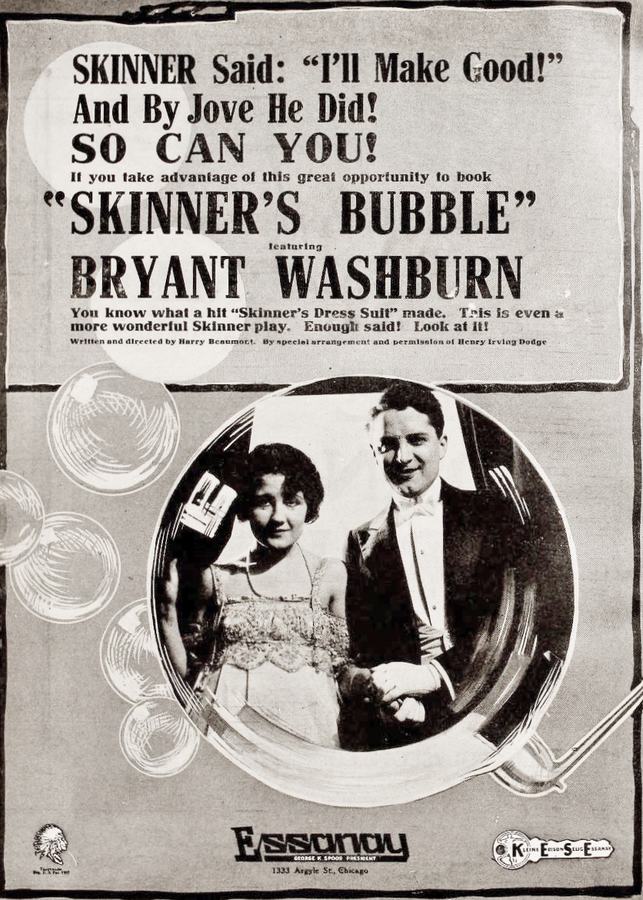
William Manning Skinner, a man whose ambition vastly outstrips his practical acumen, occupies a junior partnership at the venerable McLaughlin and Perkins. Convinced that his successes are solely attributable to his own genius rather than the firm's established gravitas, he boldly severs ties, envisioning himself as an industrial titan. Launching an independent enterprise on a grand scale, Skinner swiftly finds himself teetering on the precipice of financial ruin, a stark realization dawning that the formidable reputation of his former employers had indeed been the bedrock of his past achievements. Confronted with imminent bankruptcy, Skinner, rather than confessing his dire straits to his devoted wife, Honey, concocts an elaborate charade, casually implying an almost unmanageable torrent of wealth. Honey, utterly convinced by her husband's fabrication and unwavering in her belief in his 'Napoleonic might,' innocently shares this seemingly triumphant news with Mrs. McLaughlin. This innocent disclosure, relayed to Mr. McLaughlin, prompts a profound re-evaluation within the old firm. Misinterpreting Skinner's 'overflowing' success as evidence of his singular brilliance, McLaughlin and Perkins lament their perceived error in letting such a prodigious talent depart. Consequently, as Skinner privately braces for the humiliation of utter failure, the partners extend a magnanimous, indeed staggering, offer for his return, effectively rescuing him from the brink. The entire dramatic reversal hinges precariously on Skinner's audacious bluff, amplified exponentially by Honey's unshakeable, if misguided, faith.
Synopsis
William Manning Skinner, having attained a junior partnership in the firm of McLaughlin and Perkins, aspires to higher things. He figures that by working for himself he can become the Napoleon of the industrial world. He resigns his position and sets up in business for himself on a big scale. Skinner runs onto the verge of bankruptcy. He neglected to note that the prestige of the old-established firm he left had been largely responsible for his past success. Does he confess his failure to Honey, his adoring little wife? No. He informs her casually he is making money so fast he cannot count it. Honey confides to Mrs. McLaughlin, who in turn tells her husband. McLaughlin and Perkins decide they have made a tremendous mistake in letting Skinner get out of the firm. So it happens that just as Skinner is preparing to go into bankruptcy, a miserable failure, the partners make him a staggering offer to become again a member of their firm. It was Skinner's bluff that did it, coupled with Honey's unfailing belief in her husband's Napoleonic might.
Review Excerpt
"
The Ephemeral Empire: Deconstructing 'Skinner's Bubble'
In the annals of early cinema, where narratives often hinged on grand gestures and moralistic tales, 'Skinner's Bubble' emerges as a remarkably nuanced exploration of ambition, perception, and the delicate scaffolding of reputation. This silent-era gem, though perhaps not as widely celebrated as some of its contemporaries, offers a surprisingly potent commentary on human nature and the often-illusory foundations of succes..."