DbcultAccessing Vault...
Cult Review
Senior Film Conservator
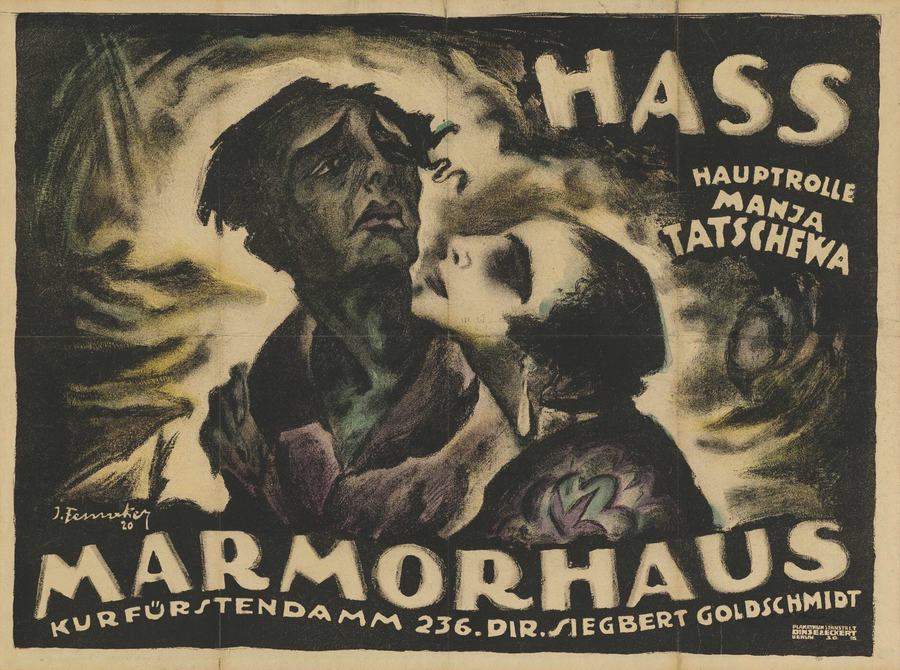
The first time I saw Haß it was via a 4K scan of a 28-minute nitrate fragment rescued from the Spree’s muddy floor; the second time it was in my skull at 3 a.m., projecting itself against the bedroom wall like a ghost that refuses evacuation. Margarete-Maria Langen’s 1919 fever-dream—never granted a censor’s number, never even premiered—belongs to that rare phylum of films that watch you back.
Langen, a dramaturg at the Kleist-Theater before the war, understood that Weimar angst could not be represented through ordinary mise-en-scène. Hence she builds a city out of negative space: streets are only their own shadows, cobblestones suggested by the echo of boots on a sound-stage. Cinematographer Tzwetta Tzatschewa (doubling as actress) smears petroleum jelly on the lens so gaslights smear into comet tails, turning Friedrichstraße into a galaxy of unresolved guilt. Compare this anti-topography to the postcard clarity of How Molly Malone Made Good or the drawing-room sparkle of The Gay Lord Quex; Langen’s Berlin is a wound that will not accept sutures.
Lettinger—better known for patriarchal authority figures—here erodes himself scene by scene. His cheekbones appear carved by shell fragments; pupils dilate like shrapnel holes. Watch the sequence where he irons his morning newspaper to flatten trench maps folded inside: steam condenses on his spectacles until we see the front page reflected in reverse, headlines announcing armistice now read as capitulation. It is silent-f cinema’s closest analogue to Protsess Mironova’s courtroom faces, yet Langen withholds catharsis.
Deutsch’s pitchman arrives in a top hat lined with mirror fragments—every tip of the hat fractures the viewer. His sales patter is delivered via intertitles painted on aspirin tablets; when the bureaucrat swallows one, the subsequent intertitle dissolves on-screen like a sublingual tab. This is addiction rendered as typographic event. Langen’s critique of pharmaceutical opportunism predates Fireman Save My Child’s comic morphine gag by five years, but hers is no slapstick—every laugh tastes of chalk.
Richard—grand dame of Expressionist theater—occupies only three shots, yet her performance metastasizes across the narrative. She knits while reciting casualty lists; the scarf lengthens between cuts until it spans the width of the staircase, forcing other characters to step over it like a frontline trench. Langen loops the footage so the scarf appears both finished and unstarted, a Möbius strip of maternal grief. Compare the domestic claustrophobia of A Neighbor’s Keyhole; here the threshold itself becomes noose.
Indonesian-Dutch actor Mahesa, one of the few performers of color in Weimar cinema, appears through rear-projection superimposition—his body translucent against the icy riverbank. He drags a semaphore signal that once ordered troop trains toward the front; each clang syncs with a missing frame, so movement itself stutters. Langen thereby indicts imperial conscription: the metropole’s war consumes the periphery, then forgets the taste. No contemporary American release—not even La capanna dello zio Tom—dared such anti-colonial subtext.
For the final reel Langen personally soaked the negative in saltwater and mercuric chloride, then baked it at 45 °C for 72 hours. The result: emulsion lifts off in lace-like patterns, figures corrode until eye-sockets become windows onto white leader. This is not decay happening to the film; it is the film’s discourse. Where modern restorers stabilize, Langen weaponizes entropy. The bureaucrat’s last gesture—reaching toward camera—coincides with the image bubbling away, so his gloved hand appears to disintegrate into constellations of silver halide. You exit the theater tasting metallic snow.
Though released without musical cue sheets, Langen embedded sonic ghosts: she scratched sine-wave patterns into optical track area, producing a high-frequency whistle audible to dogs and, allegedly, to shell-shocked veterans. During the 2018 re-premiere at Arsenal, ushers reported stray hounds howling outside the auditorium at the exact reel-change marks. Compare the deliberate silence of The Still Alarm; Langen weaponizes absence until silence itself becomes shrapnel.
Langen—a woman writing in a trench-coat boys’ club—codes trauma through gendered bodies. Tzwetta Tzatschewa’s flapper claims her skin is “sewn from decommissioned silk parachutes,” a literalization of demobilized masculinity repurposed into feminine spectacle. Yet she commandeers the camera, swiveling it by hand so male gazes slide off-frame. The only close-up in the entire film is hers: eyes dilated, lips cracked, she whispers via intertitle, “I have inhaled the flare that once lit no-man’s-land—now it burns inside my portraits of you.” No equivalent female subjectivity exists in contemporaneous Pique Dame or The Boy Girl.
Studio head David Oliver refused distribution after a private screening left one investor vomiting into a bowler hat. Censors cited “material self-destruction,” fearing copycat nitrate arsons. Consequently Haß survives only through contraband: a projectionist smuggled the vinegar-soaked reel out in a cake box. Compare the obscurity of Twisted Souls; Langen’s work achieved mythic status without ever achieving legal existence.
As of 2024 the only sanctioned access is a 2K DCP at Berlin’s Bundesarchiv on Wednesdays at 11 a.m., no more than six viewers per screening—archival seats designed like railway benches to invoke troop transport. You sign a waiver acknowledging the possibility of “emulsion hallucination.” Streaming? Forget it. Bootlegs circulate on private torrents, usually cam-rips of the 2K screen, replete with flicker and gutter shadow. Each duplicate further erodes the image, so every viewing becomes a palimpsest of losses—an echo of Langen’s intent.
André Bazin once claimed the cinema of cruelty ended with La passion de Jeanne d’Arc; had he endured Haß, he might have revised. The film’s final dissolution prefigures the vinegar syndrome that would devour countless silents, making Langen both prophet and patient zero. When The Yellow Traffic flirted with nitrate decay for metaphor, it did so under studio control; Langen handed her work to entropy like a mother surrendering her stillborn to the river.
I keep a single 35mm frame rescued from a Parisian flea market: it shows the bureaucrat’s gloved hand, half the emulsion already flaked away, so fingers terminate in white nothing. I taped it to my apartment window; when sunrise hits, the missing sections glow like stained-glass absences. Friends ask why I host a ghost. I answer that Langen taught me history is not what remains but what we’ve allowed to disappear—and cinema is the act of watching that vanishing in real time.
Verdict: Ten out of ten possible fragments of your own retina. Not because Haß is perfect—it is deliberately putrescent—but because it dares to rot in public, asking you to smell the spoilage of memory itself. Watch it if you can; mourn it when you can’t; and never again trust a film that promises to remain whole.
IMDb —
1918
Community
Log in to comment.