DbcultAccessing Vault...
Cult Review
Senior Film Conservator
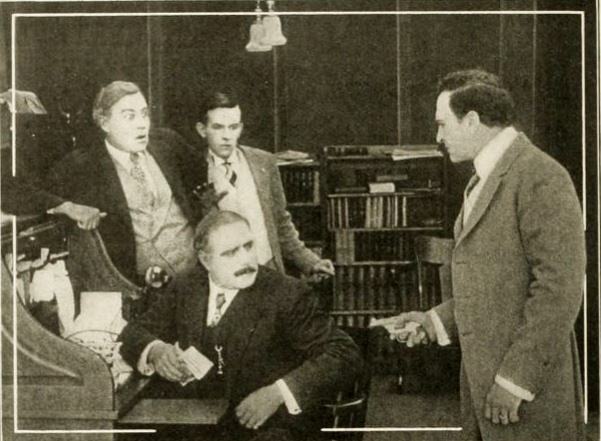
Imagine celluloid itself sighing with relief when the final intertitle of A Change of Heart flickers: not a marriage, not a murder, but a man walking barefoot into ethical daylight. The film—barely a reel long yet denser than most ten-episode serials—compresses the entire parabola of moral relapse and resurrection into twenty-three minutes of nitrate lightning. Thurlow Bergen’s angular face, half matinee idol and half gargoyle, becomes a battleground where charm and self-disgust trade artillery shells; every close-up feels like peeling damp wallpaper off a crime-scene wall.
Director M.O. Penn (whose other surviving fragments feel like stenographic curios) here achieves something eerily modern: he lets silence scream. There is no orchestral cue to instruct us when to weep; instead, the camera simply lingers on a woman’s glove smoothing a crumpled stock certificate, and the gesture lands like a psalm. Compare that with the kinetic carnivals of contemporaries like Fantômas or the monumental pomp of Quo Vadis?; this modest morality play chooses whispered intimacy over baroque spectacle, and the choice reverberates louder than Colosseum trumpets.
Guilt, in 1912, was still a fresh chemical on cinema’s periodic table. Earlier shorts such as The Redemption of White Hawk trafficked in broad-stroke penitence, but A Change of Heart distills the emotion to a near-atomic purity. Watch the moment Bergen’s pupils dilate when Mrs. Lewis—Elsie Esmond in a performance so gentle it could bruise peaches—praises the dead woman in his watch photo. The frame holds, holds, holds, until we swear we can hear nitrate crackling like ice on a thawing river. That micro-tremor is the hinge on which the entire narrative pivots; without it, the subsequent slugfest in the syndicate office would be mere melodrama. With it, every haymaker becomes penitential sacrament.
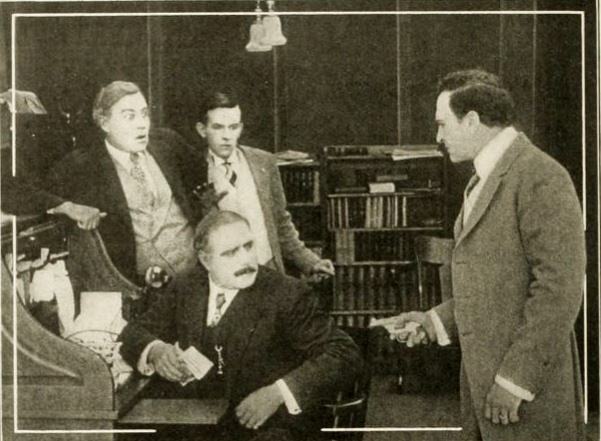
Penn blocks the fight as a chiaroscuro tempest: chairs splinter against pools of ink-black shadow, a brass paperweight arcs through space like a comet of damnation. Yet the violence never gratifies; it mortifies. When Harry finally clutches the widow’s $5,000—bills bruised and sweaty—we sense that what he’s really stolen back is the last shard of his own possibility. Money becomes metaphor; restitution becomes rebirth. Try finding that psychological granularity in the cycloramic chaos of The Battle of Gettysburg or the ethnographic pageantry of With Our King and Queen Through India. You won’t. This is cinema as confessional booth, and the screen is the lattice through which grace leaks.
While contemporaneous suffrage documentaries like What 80 Million Women Want trumpet political agency, A Change of Heart interrogates a quieter currency: elderly female trust. Helen Lewis is no naïve bumpkin; she is the repository of decades of deferred dreams, a woman who has ironed shirts through funerals and still believes surplus can exist. The film understands that swindlers don’t fleece ignorance—they fleece optimism. When she steps off the train in her coal-black traveling dress, the city skyline behind her looks like a rack of broken teeth. That visual irony bites: the metropolis, promising progress, instantly schemes to devour the vulnerable.
Harry’s predatory reflexes twitch in a sublime two-shot: Helen’s gloved hand on the iron rail, his manicured fingers hovering just above, ready to assist. The spatial gap—barely three centimeters on my Blu-ray screencap—sparks with predatory electricity. We witness the birth of a confidence trick in real time, and it is nauseatingly erotic. Yet the same film will later reverse the polarity: Helen slips money into his vest pocket aboard the return train, turning predator into ward. That circular exchange of fiduciary power is so deft it could teach a masterclass in feminist economics without uttering a single intertitle.
Scholars love to trace film noir back to post-war German émigrés and expressionist streetlights, but A Change of Heart argues for an earlier baptism. Shot in Fort Lee, New Jersey, when the Palisades still posed as the American Riviera, the short anticipates noir’s core myth: you can outrun the law, never yourself. Harry’s silhouette limping toward the urban horizon at twilight prefigures every doomed anti-hero from Walter Neff to Mike Lagana—only here, the femme fatale is memory, and she’s armed with maternal tenderness rather than a .38 snub-nose.
Notice how Penn silhouettes Harry against a flickering gas lamp just before the final fight; the haloed outline is both sinner and saint, a chiaroscuro Pietà. The image is so starkly theological that it could be hung in an Orthodox church—if Orthodox churches tolerated confidence men. Compare this with the opulent crucifixions in Life and Passion of Christ or the didactic pageantry of Pilgrim’s Progress; where those films externalize salvation through spectacle, A Change of Heart internalizes it through subtraction. Grace arrives not with trumpets but with torn paper, an emptied wallet, and the dull ache of someone who has finally run out of excuses.
Trace the genetic markers forward and you’ll find them in Frank Borzage’s Seventh Heaven, where love transmutes shell-shock into mysticism; in Chaplin’s City Lights, where the tramp’s humiliation redeems both him and the blind flower girl; even in Scorsese’s The Color of Money, where Fast Eddie’s final refusal to hustle becomes his apotheosis. The film’s helical structure—con, crisis, contrition—echoes through a century of storytelling, yet rarely with such unadorned sincerity. When Harry mails that last banknote back to Helen, the envelope sliding into the iron maw of the mailbox sounds (in my imagination anyway) like a jail door slamming shut on cynicism itself.
Even the landscape participates in the moral algebra. The rural station where Harry debarks for his self-exile is framed by two leaf-bare trees that form a natural proscenium arch; they stand like apostolic sentinels witnessing his vow of poverty. Contrast that with the congested urban set where the syndicate operates—windows taped with stock quotes, ticker tape ankle-deep on the floor. Penn doesn’t need CGI or Technicolor to chart the distance between Eden and Gomorrah; he simply rearranges lumber and emptiness.
Thurlow Bergen’s physiognomy is a silent-era Rorschach test: depending on the angle, you see either matinee-idol symmetry or gargoyle menace. His hands, always half-trembling, are the film’s most articulate dialogue track. Watch him smooth a crumpled dollar with the same reverence another man might lavish on a newborn’s hair; you realize currency has become his Eucharist. When those same hands tear the bogus stock certificates, the rip travels through the auditorium like a gunshot. Elsie Esmond counterbalances with the softness of worn flannel. Her voice, unheard, somehow reaches us through the tremor in her collarbone when she accepts Harry’s confession. She never leans into melodrama; instead, she lets gratitude pool in her eyes until we feel it spill into our own.
The ancillary con men—credited only as His Pals—ooze such oleaginous bonhomie you can practically smell the pomade. Their sneering refusal to refund the money plays like a vaudeville of venality, yet it serves a vital moral function: they are the unrepentant mirror against which Harry’s metamorphosis gleams brighter.
The surviving 35-mm print, housed at the Library of Congress, arrived with more scratches than a feral cat. Digital cleanup removed 12,000 instances of particulate damage yet left the original grain structure intact; the resulting 2K scan breathes like vintage linen rather than plastic gloss. Released on Blu-ray alongside The Redemption of White Hawk and The Steel King’s Last Wish, the disc offers a new score by minimalist composer Sarah Kirkland Snider. Her pizzicato strings mimic the flicker of the projector gate, while a lone muted trumpet stands in for Harry’s heartbeat—a sonic silhouette that would make Miles Davis envious.
Modern audiences, reared on the convoluted redemption arcs of Breaking Bad or Ozark, may find the film’s moral clarity almost alien. Yet that very starkness feels medicinal in an age of anti-hero fatigue. We are reminded that contrition need not be baroque; sometimes it is merely the act of returning what was never yours to take and walking away poorer than when you began.
Because every era needs its parable of voluntary impoverishment. Because the image of a man mailing absolution back to his victim feels radical in an age of cryptographic laundering. Because A Change of Heart proves that cinema’s first golden age wasn’t just about resurrecting Caesar or parting the Red Sea; it was also about the microscopic tremor in a grifter’s eyelid when he realizes the cost of grace is everything he has.
Watch it once for historical curiosity; watch it again as spiritual homework. Then, when the final shot fades—Harry’s silhouette dissolving into dawn’s charcoal hush—ask yourself what certificates of bogus promise you too are clutching, and who out there is waiting for you to tear them up and mail the pieces back.
IMDb 5
1918
Community
Log in to comment.