DbcultAccessing Vault...
Cult Review
Senior Film Conservator
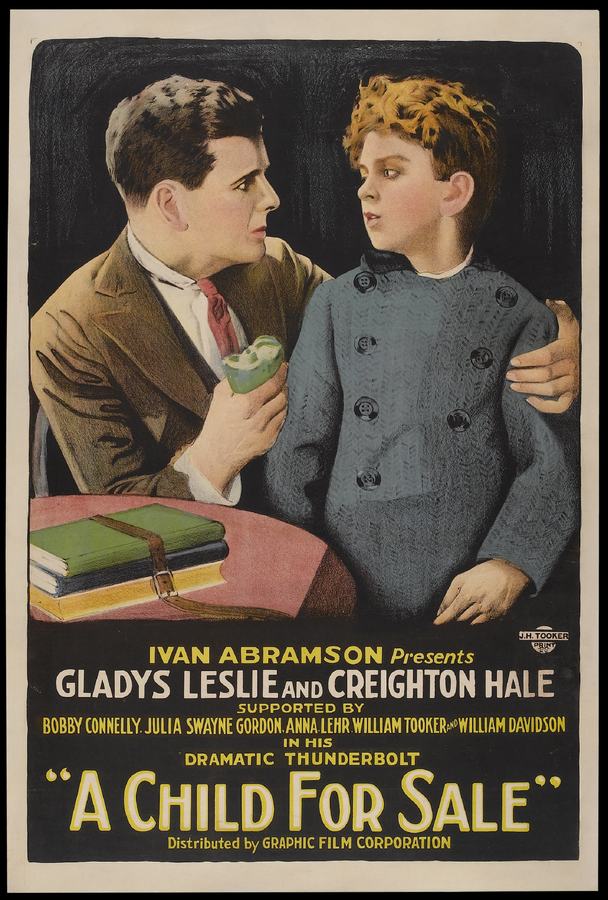
In the annals of silent cinema, few directors wielded the sledgehammer of social morality with as much unvarnished fervor as Ivan Abramson. His 1920 opus, A Child for Sale, remains a startling artifact of early 20th-century melodrama, capturing a zeitgeist where the lines between art, poverty, and ethics were frequently blurred by the desperation of the urban experience. While contemporary audiences might view the premise as histrionic, the film operates with a raw, almost primitive emotional honesty that transcends its era.
The film’s setting is not merely a geographic location but a character in its own right. Greenwich Village, before it became a playground for the elite, was a crucible of starving brilliance and crushing squalor. Our protagonist, a struggling artist, is portrayed with a frantic vulnerability that mirrors the erratic brushstrokes of his own canvases. When his wife passes away, leaving him with two small children and a pocketbook as hollow as his grief-stricken heart, the film pivots from a domestic tragedy into a profound philosophical inquiry into the value of human life.
Unlike the more whimsical portrayals of childhood found in Huck and Tom, Abramson’s vision is devoid of pastoral nostalgia. Here, children are not just vessels of joy but also mouths to feed in an economy that has no use for the aesthetics of a painter. The desperation is palpable, rendered through high-contrast cinematography that anticipates the noir sensibilities of later decades.
The crux of the narrative—the titular sale—is handled with a jarring lack of sentimentality that forces the viewer to confront the protagonist's internal collapse. The wealthy, childless couple who purchase the child are not depicted as cartoonish villains, but rather as the sterile personification of capital. They represent a world where everything, including the sacred bond of fatherhood, has a price tag. This thematic preoccupation with the corrupting influence of wealth is a recurring motif in Abramson’s filmography, echoing the social critiques found in The Right to Happiness.
The performance of Creighton Hale as the artist is a masterclass in silent-era pathos. His face becomes a topography of anguish, shifting from the initial numbness of loss to the manic realization of his transgression. When he decides to undo the deal, the film shifts gears into a suspenseful race against the finality of legal and social structures that favor the affluent over the indigent.
When analyzing A Child for Sale, one cannot help but draw parallels to other contemporary works that grappled with the fallout of parental failure. For instance, Sins of the Parents explores the intergenerational trauma caused by moral lapses, yet Abramson’s film feels more immediate, more visceral in its focus on the 'now.' It lacks the sprawling epic feel of Les Vampires, opting instead for a claustrophobic intimacy that heightens the stakes of the artist’s personal redemption.
The supporting cast, including Gladys Leslie and Julia Swayne Gordon, provides a sturdy framework for the central drama. Gordon, in particular, brings a chilling elegance to her role, embodying the cold comfort that money provides. This juxtaposition between the vibrant, albeit chaotic, life of the artist and the manicured, lifeless halls of the wealthy couple creates a visual dialectic that drives the film’s message home.
Technically, the film utilizes the limitations of its time to its advantage. The indoor sets are cluttered and heavy, emphasizing the burden of the protagonist's existence. In contrast, the scenes involving the wealthy couple are characterized by an expansive, yet vacuous, architecture. This use of space to define class is as effective here as it is in The Mainspring or Father and Son.
The pacing is deliberate, allowing the weight of the artist’s decision to settle over the audience like a thick fog. Abramson doesn't rush the emotional beats; he lingers on the empty chair at the dinner table, the lingering touch of a child’s hand, and the frantic scribbling of a man who has lost his muse and his soul simultaneously. It is this commitment to the 'small moments' that elevates the film above mere exploitation.
The final act of the film is a breathless pursuit of atonement. It avoids the easy resolutions found in lighter fare like Come Out of the Kitchen or the rugged individualism of Gun Law. Instead, it posits that redemption is a grueling process of confrontation. The artist must not only fight the couple who 'bought' his child but also the social perception of his own worthlessness. In this regard, the film shares a thematic DNA with The Hostage, where characters are trapped by circumstances of their own making.
Ultimately, A Child for Sale is a haunting reminder of the fragility of the human condition. It asks uncomfortable questions: What is the price of survival? Can a mistake of such magnitude ever truly be rectified? While the film concludes with a sense of resolution, the shadows it casts are long and persistent. It stands as a testament to the power of silent cinema to communicate complex psychological states through nothing more than light, shadow, and the incredible expressive capacity of the human face.
For those interested in the evolution of the social drama, this film is essential viewing. It lacks the polish of modern cinema but possesses a soul that is often missing from today's over-sanitized productions. It is a gritty, uncompromising look at the dark side of the American dream, where the pursuit of happiness is often derailed by the simple, brutal need to stay alive. Whether compared to the sports-centric narrative of Headin' Home or the romantic entanglements of Maharadjahens yndlingshustru I, Abramson’s work remains uniquely focused on the intersection of the domestic and the economic.
In a world where we still struggle with the ethics of inequality, A Child for Sale remains as relevant—and as heart-wrenching—as it was a century ago.

IMDb 7
1930
Community
Log in to comment.