DbcultAccessing Vault...
Cult Review
Senior Film Conservator
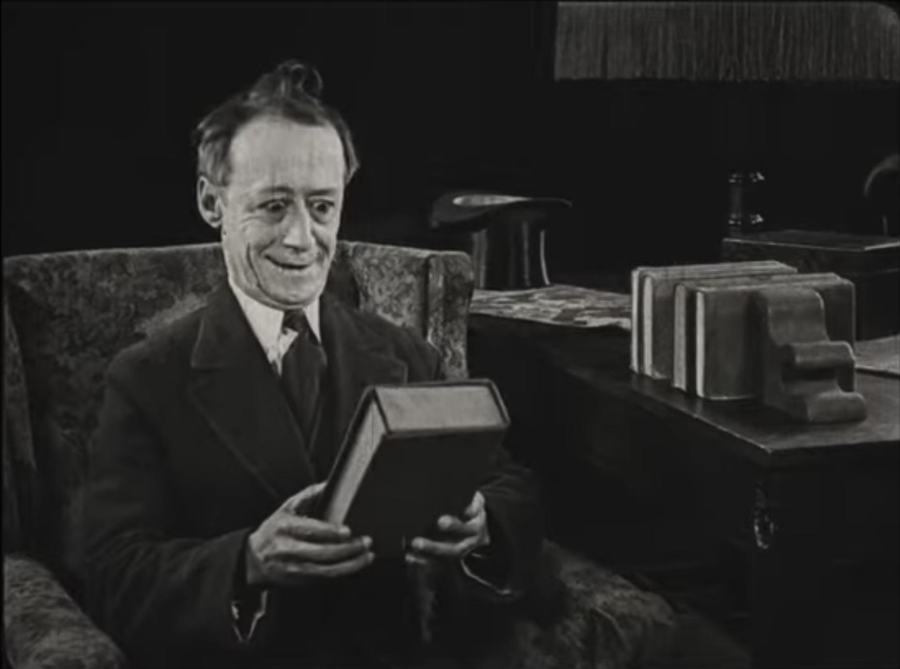
Manhattan’s sodium vapour hums like a live wire through William Watson’s brisk two-reeler, a 1927 curio whose very title—A He-Male Vamp—promises a gendered inversion of the era’s ubiquitous femme fatale. What unfurls is less a vampire tale than a blood-sport of contracts: old money versus new desire, inked in starlight and sealed with a kiss that might as well be a brand.
Connie Henley, all cloche-hat defiance, plays the daughter whose dowry is her father’s solvency. Henley’s eyes—wide, kohl-rimmed, capable of flicking from dove to hawk in a single frame—carry the moral centre of the film; they are the silent-era equivalent of a manifesto scrawled in lipstick on a speakeasy mirror. Opposite her, Harry Sweet’s sweetheart is less a paramour than a wind-up toy: earnest, breathless, perpetually late. The real gravitational mass is the benefactor, never named, portrayed by Zip Monberg with a carnivorous calm that predates Barrymore’s Jim the Penman by mere months. Monberg lounges in upholstered shadows, swirling scotch he never drinks, letting the ice dilute while he dilutes futures.
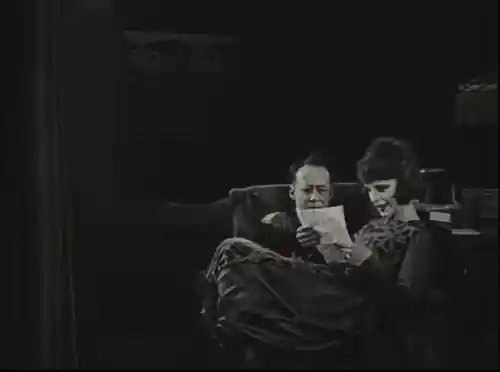
Watson’s direction is a study in negative space: he frames opulence—crystal decanters, velvet drapes, a grand piano no one plays—then juxtaposes it with the lovers’ threadbare urgency. Note the sequence where Henley tears her engagement dress into makeshift rope to escape a locked penthouse. The camera, stationary at thigh-height, watches silk rip in three decisive yanks; the tear is both literal and symbolic, a rip in the social fabric. Compare this to the storm-battered hovels of King Lear, where costume signifies madness; here, it signals emancipation.
Yet the film’s bravura lies in its temporal compression: twenty-four minutes that sprint from dusk to dawn without a single intertitle wasted. Each card is a haiku of pulp—“One hour to midnight. The license expires.”—spurring the chase toward the Williamsburg Bridge, where girders lattice the sky like the ribs of some mechanical leviathan. The final standoff is lit like a boxing ring: arc lamps borrowed from the police precinct, casting shadows long enough to swallow pride.

Some scholars slot A He-Male Vamp beside The Woman and the Puppet for its marionette metaphors, but Watson’s film is more piston than puppet. Its montage is Eisensteinian without the propaganda: a staccato of hooves, typewriter bells, telegraph clicks, culminating in Henley’s hand—trembling yet resolute—slapping Monberg’s cheek. The slap is heard not because of any phonetic accompaniment but because Watson cuts to a frozen still of Monberg’s monocle fracturing, a hairline crack superimposed over the city’s skyline. In that instant, the covenant is void; capital has been checkmated by corporeal refusal.
Historians hunting proto-feminist breadcrumbs will feast here. The narrative refuses to punish Henley’s sexual agency; instead, it punishes the commodifier. Contrast this with The Bride, where the heroine’s rebellion ends in matrimonial surrender, or The Fear Woman, whose cautionary coda reverts to patriarchal order. Watson lets the camera linger on Henley’s exhale—half sigh, half laugh—while Sweet lights two cigarettes, hands her one, and they walk toward a sunrise rendered in overexposed white, obliterating any hint of future subservience.

Visually, the picture drinks from the same well as The City of Failing Light: high-contrast chiaroscuro, guttering neon, rain-slick asphalt reflecting marquee bulbs. But Watson pushes further, experimenting with under-cranked footage during the escape—eight frames per second instead of the standard sixteen—so that Henley’s sprint becomes a jerky ballet, her pearls staccato commas punctuating the night. The device predates the manic city symphonies of the 1930s, suggesting that American independents were flirting with speed aesthetics long before Soviet montage hit the mainstream.
Sound historians will lament the absence of a surviving Movietone disc; what remains is a MoMA restoration scored by Donald Sosin in 2016, all xylophone plinks and muted brass that flirt with anachronism yet never swerve into kitsch. During the slap moment, Sosin drops to solo timpani heartbeat, a choice so intuitive it feels excavated rather than added. Seek out the Blu-ray; crank the volume until the radiator rattles in sympathy.

Is the film flawless? Hardly. Sweet’s character is under-sketched, a mere engine for plot propulsion. One yearns for the psychological density that Life’s Greatest Problem grants its male lead. A subplot involving a stolen marriage license feels vestigial, a vestige of two-reel padding. And the racial optics—an elevator operator used as comic relief—carry the cringe of their era, though Watson at least grants the man a conspiratorial wink with Henley, a fleeting alliance of the dispossessed.
Still, these are quibbles against the film’s central triumph: it makes capital itself the villain, long before The Hand Invisible or The Web of Life codified such themes. Monberg’s tycoon is no Snidely Whiplash twirling mustaches; he is systematized rapacity in white spats, a harbinger of every private-equity ghoul to come. When Henley rejects him, she is not merely jilting a suitor; she is refusing to cosign her body as collateral in a debt peonage scheme. The Marxist subtext is so overt it loops back around to sly camp, yet Henley plays it straight, and that sincerity scalds.

Restoration notes: the 4K scan reveals cigarette burns that were invisible in 16mm dupes—tiny solar flares marking reel changes, each a miniature eclipse heralding narrative pivot. Grain structure is lustrous, the selenium tone cooled to gunmetal, preserving the bruised atmosphere. Keep an eye out for the single surviving outtake bundled in the extras: Henley botches the slap, bursts into laughter, and the entire crew follows. It’s a reminder that even agit-prop needs outtakes, that revolution is human, fallible, gloriously alive.
Comparative curation: program this as a double bill with The Road to the Dawn for a night of racial and gendered emancipation narratives, or pair it with Hay Foot, Straw Foot to chart class mobility across the decade. Either way, let the house lights stay down between reels; the audience will need a moment to metabolize the realization that nothing in 2023’s multiplex offers half this voltage.
Bottom line: A He-Male Vamp is a pocket-sized stick of dynamite, a flapper’s manifesto that explodes the myth that silent women waited to be saved. Watson, Henley, and Monberg hand us a century-old blueprint for telling patriarchal capital to go slap itself. Stream it, own it, teach it. And the next time some blowhard insists silent cinema was demure, cue up Henley’s cracked smile at 1:19:47 and watch the room fall silent—sound not required.

IMDb 6.1
1925
Community
Log in to comment.