DbcultAccessing Vault...
Cult Review
Senior Film Conservator
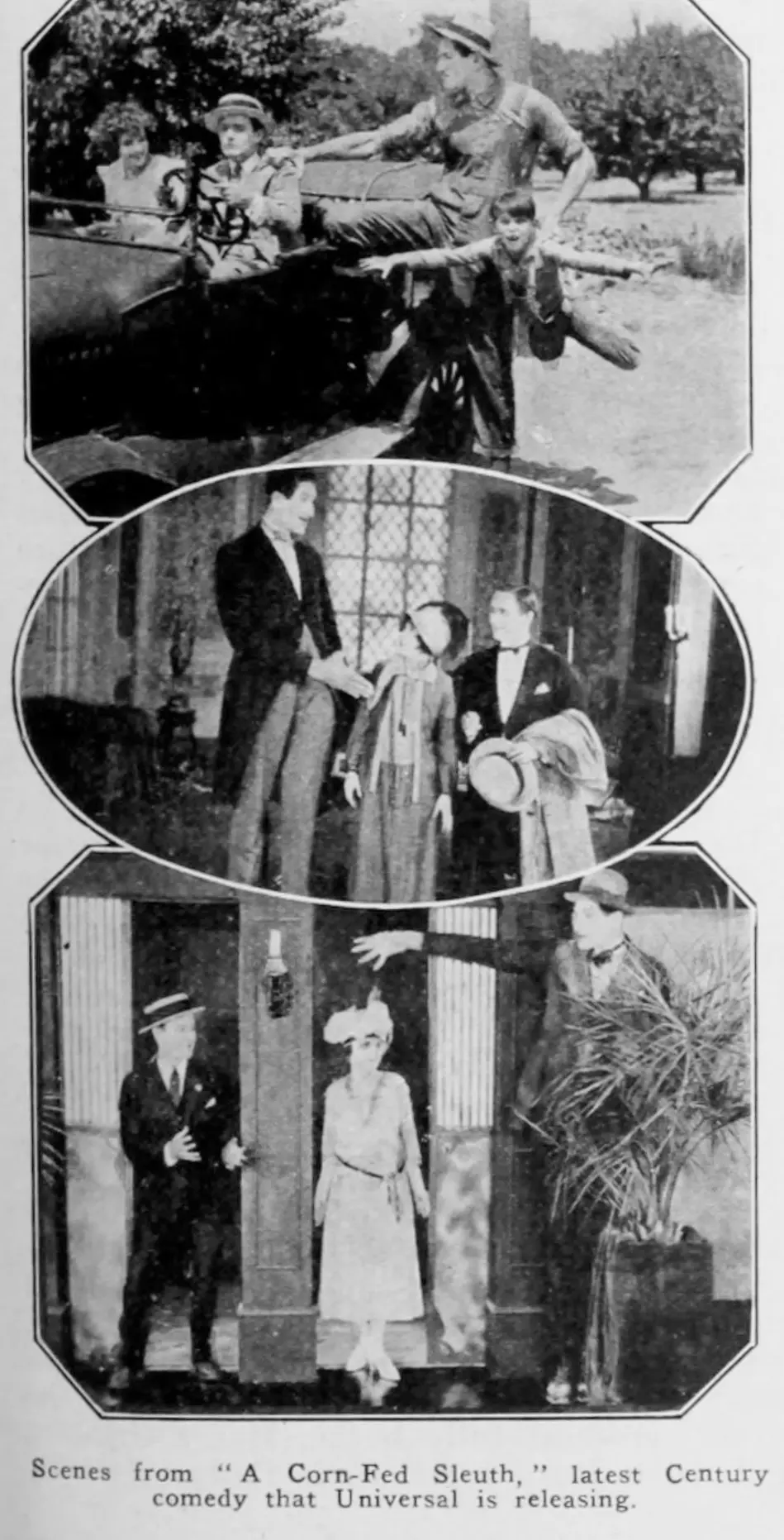
The cinematic landscape of the 1920s was frequently populated by the archetype of the 'rube'—the wide-eyed provincial wandering into the neon-lit maw of the metropolis. Yet, in Albert Herman’s 1923 curiosity, A Corn-Fed Sleuth, this trope is elevated through the singular presence of Jack Earle. Standing as a literal giant of the silent era, Earle’s physicality transforms a standard fish-out-of-water narrative into a surrealist exploration of scale and social ineptitude. The film functions not merely as a comedy of errors but as a satirical deconstruction of the American dream of self-improvement via correspondence, a theme that resonates with the same desperate optimism found in the characters of The Peddler.
Our protagonist begins his journey amidst the haystacks and horizons of a nameless farm, his imagination ignited by the pulp fiction of detective manuals. This initial setting mirrors the tranquility of Sunday Calm, yet there is a restless energy in Earle’s performance. The correspondence school, a ubiquitous fixture of early 20th-century Americana, promised that any man, regardless of his station, could master the arcane arts of criminology. Herman uses this as a springboard for a broader critique of institutionalized naivety. When the farm boy eventually migrates to the city, his 'education' serves only to make him more vulnerable to the very elements he believes he can master.
The city, as depicted here, is a labyrinth of predatory intent. Unlike the stark industrialism seen in Gas, the urban environment in A Corn-Fed Sleuth is a stage for theatrical villainy. The gang of crooks who descend upon our hero recognize his height and his heart as tools for their own gain. There is a palpable tension in watching a man of Earle’s stature—traditionally a figure of power—being manipulated into a position of subservience. It is a subversion of the 'gentle giant' motif, rendering him an unwitting The Accomplice in a scheme that strikes at the heart of his own familial bonds.
The central conflict revolves around the theft of his brother-in-law’s furniture. While this may seem like a trivial MacGuffin by modern standards, in the context of the era, the domestic interior represented the ultimate sanctuary of middle-class respectability. To violate this space is to commit a sin of significant social magnitude, a theme echoed in the moral complexities of Her Body in Bond. The heist itself is choreographed with a frantic precision that rivals the best work of the Hal Roach studios. Roscoe Karns provides a brilliant counterpoint to Earle, his quick-silver movements highlighting the giant’s more deliberate, often clumsy, attempts at stealth.
As the plot thickens, the film transitions from a satirical character study into a full-bore physical comedy. The recovery of the furniture involves a series of escalating mishaps that utilize the verticality of the frame. Earle’s height becomes the film’s most potent visual gag; his attempts to hide or blend in are inherently doomed, creating a sense of inevitability that is both hilarious and strangely poignant. This is not the refined humor of The Gentle Intruder, but a raw, vaudevillian energy that seeks to overwhelm the viewer through sheer kinetic force.
Albert Herman’s direction is surprisingly sophisticated for a short of this nature. He employs deep focus in the farmhouse scenes to emphasize the isolation of the rural life, while the city scenes are shot with a claustrophobic tightness that mirrors the protagonist's growing anxiety. The lighting during the nighttime heist sequence utilizes high-contrast shadows, hinting at the noir aesthetics that would eventually dominate the genre, albeit here they are used for comedic rather than dramatic effect. One can see a lineage from this visual style to the more somber tones of The Eternal Sin.
The editing is brisk, maintaining a tempo that prevents the thinness of the plot from becoming apparent. There is a rhythmic quality to the way the furniture is moved—a literal and metaphorical shifting of weight that reflects the hero’s internal struggle to reclaim his dignity. This fluidity is reminiscent of the comedic timing found in All Wet, where the environment itself becomes an antagonist to the hero’s intentions.
What distinguishes A Corn-Fed Sleuth from its contemporaries is the resolution of its hero's arc. He does not become a master detective through the application of his correspondence lessons; rather, he succeeds through a return to his primal, rural instincts. His 'sophistication' is a failure, but his inherent goodness—and his massive physical strength—is what saves the day. This suggests a skepticism toward the 'new' world of the 1920s, a sentiment shared by the creators of Little Miss Grown-Up, which also explores the awkward transition between life stages and social classes.
The film also touches upon the fragility of the family unit when faced with external economic pressures. The furniture is not just wood and fabric; it is the currency of the brother-in-law’s status. By recovering it, the sleuth restores the social order, much like the resolution of a frontier conflict in LaRue of Phantom Valley. However, the victory is bittersweet, as the hero remains fundamentally unchanged, perhaps destined to return to the farm, his dreams of urban glory dampened by the reality of city life.
Jack Earle’s performance is a masterclass in utilizing one's physical limitations as a narrative asset. He does not play the giant as a monster or a miracle, but as a man whose very existence is an inconvenience to a world built for smaller people. This creates a unique brand of empathy. We laugh at his predicament, but we also feel the weight of his alienation. In the broader pantheon of silent comedy, this film stands as a testament to the diversity of the 'rube' narrative, offering a more physically imposing take on the themes explored in Clown Charly.
While it lacks the epic scale of historical dramas like The Battle and Fall of Przemysl, its focus on the micro-tragedies of a misplaced individual gives it a timeless quality. The film’s exploration of the 'get rich quick' culture and the predatory nature of the city remains relevant in an age of digital scams and gig-economy exploitation. It serves as a reminder that the tools of our self-improvement are often the very instruments of our downfall.
In the final analysis, A Corn-Fed Sleuth is a vibrant, if overlooked, piece of silent cinema. It captures a specific moment in American history where the lines between the rural and the urban were blurring, and where the promise of the 'self-made man' was being tested against the harsh realities of a modernizing world. It is a film that demands to be seen not just for its laughs, but for its astute observations on the human condition, delivered by a man who stood head and shoulders above his peers, in every sense of the word. It avoids the cynicism of S.M il Danaro, opting instead for a hopeful, if chaotic, conclusion that celebrates the triumph of the spirit over the schemes of the wicked.
Review by the Cinephile Collective - Exploring the shadows and heights of cinema history.

IMDb —
1935
Community
Log in to comment.