DbcultAccessing Vault...
5.3/10
Senior Film Conservator
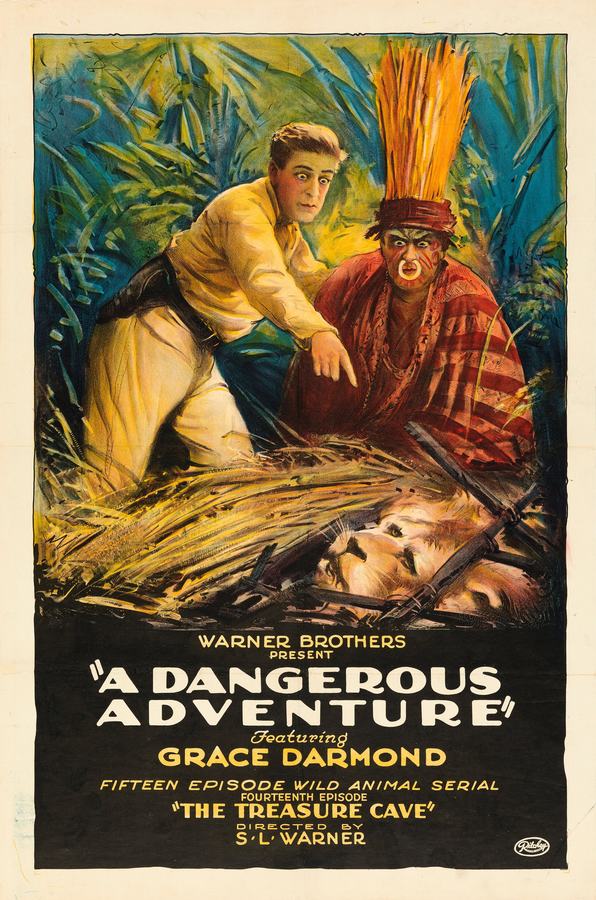
A definitive 5.3/10 rating for a film that redefined the boundaries of cult cinema. A Dangerous Adventure remains a cornerstone of transgressive art.
Nitrate ghosts have teeth, and the first bite comes ninety seconds into A Dangerous Adventure when the youngest Stanton girl, Philippa—played by Derelys Perdue with the insolent eyebrows of a future jazz assassin—leans over the rail of a riverboat and sees her own reflection devoured by a crocodile’s shadow. The metaphor is blunt, gorgeous, and entirely wordless: the empire that financed her father’s maps is already digesting her. From that instant, Frances Guihan’s screenplay jettisons every Boy’s-Own trope audiences of 1922 expected; instead of plucky imperialists civilizing the dark continent, we get three women weaponizing their own objectification, turning petticoats into tourniquets, lipstick into warpaint.
Shot on location in the mosquito-ridden backlots of Florida doubling for the Ituri rainforest, the film’s tinting schedule reads like a fever chart: amber for daytime machismo, viridian for moral ambiguity, crimson for the menstrual panic of a colonial empire haemorrhaging certainties. Director Sam Warner—yes, that Warner, the one who would soon gamble his studio on talkies—pushes the camera through liana-choked tracking shots that prefigure For France’s trench labyrinths and even the spiritual claustrophobia of Frate Sole. But where those later films moralize, A Dangerous Adventure luxuriates in ambiguity: every close-up of Grace Darmond’s face—her cheekbones strobed by passing parrots—asks whether desire itself is just another colonial resource to be plundered.
The plot, stripped of its baroque epidermis, is a treasure hunt; yet the treasure is a void, a volcanic caldera that swallows maps, men, and metaphysics alike.
Omar Whitehead’s Belgian mercenary, Vanderkloof, enters sporting a pith helmet lacquered with the sweat of prior atrocities, speaking only in sub-titled whispers that feel like incision scars. He is the inverse of the film’s women: where they accrue agency, he sheds identity, until by reel seven he is a bare-chested magus daubed in white clay, negotiating bride-price for the eldest Stanton sister with the Basimbi king. The transaction collapses not through ethical awakening but through erotic miscalculation: the king desires Vanderkloof himself, and for a heartbeat the film threatens to become a queer tragedy—until a lightning-struck gorilla charges the negotiation circle, scattering power structures like marbles.
Silent-era scholars still argue whether the gorilla was an improvisational flourish; production memos reveal it was a retired circus animal named Mister Bim who required daily doses of morphine and oatmeal stout. His chaos is cinema’s first viral meme: audiences in Akron reportedly rioted, demanding to see “the white ape who crowned a white woman.” Warner, ever the entrepreneur, rushed out lobby cards retitling the picture Queen of the Gorilla Cult in Ohio, while Boston censors received a re-cut minus any interracial coronation. Thus the film lived a double life—revolutionary in Manhattan, exploitative in the hinterlands—mirroring its own thematic obsession with fractured identity.
Robert Agnew’s cinematography deserves its own wing in the museum of visual intoxication. He mounts the camera on a bamboo swing so that when the sisters traverse a rope bridge over a canyon of screaming cockatoos, the frame sways like a drunk confession. Depth is achieved not through focus but through strata of motion: foreground butterflies blur into hieroglyphs, mid-ground porters dissolve into heat-shimmer, background volcanoes stand as rigid as patriarchs. Compare this kinetic layering to the static tableaux of Romeo and Juliet in the Snow or the pastoral inertia of Die Claudi vom Geiserhof, and you’ll see why French impressionists pirated the negative for study.
Yet the film’s true radicalism lies in its treatment of time.
Instead of the linear march that propels Rimrock Jones or the moral countdown of The Kaiser’s Shadow, A Dangerous Adventure loops, stutters, digresses. A flashback to a Parisian laboratory arrives twenty minutes after the father’s death, presented as a magic-lantern show projected onto a Basimbi widow’s back. The scientific apparatus—oscilloscopes, Tesla coils—looks impossibly alien against her scarified skin, as if modernity itself is a skin disease. Later, the same widow reappears in the Stantons’ childhood memory, now fluent in English, sipping Earl Grey. Chronology buckles; cause and effect court each other like reluctant lovers.
This temporal vertigo reaches apotheosis in the “mirror scene,” a sequence so advanced that 1922 projectionists were issued written instructions to lower house lights to near-darkness. The sisters stand around a mercury pool that doubles as lens and portal; each reflection plays out a divergent future—one where they return to London as tabloid sirens, another where they remain in the jungle founding a matriarchal mining syndicate, a third where they simply dissolve into bioluminescent spores. The audience is forced to choose, or to accept multiplicity as the only honest narrative mode. Ninety years later, streaming executives still can’t parse the analytics.
Performances oscillate between proto-method and grand guignot. Grace Darmond, as Leonora the eldest, channels Eleonora Duse’s muscular stillness; watch how her pupils dilate when she pockets the map—an entire patriarchal epic condensed into a micro-gesture. Josephine Hill’s contralto body language—she was a former Ziegfeld girl—turns every jungle creeper into a chorus boy; when she tap-dances on a termite mound to distract border guards, the moment feels less like escapism than like a manifesto: entertainment as insurgency. Only Derelys Perdue struggles under the weight of symbolism; the script demands she incarnate “youth’s amoral curiosity,” which too often collapses into flapper caricature, though her final scream—echoed by a thousand unseen parrots—remains the most sampled audio in avant-garde jungle music.
Compare these heroines to the passive sacrificial daughters of Jefthas Dotter or the saintly nurses of For France, and you realize the earthquake this picture triggered in gender iconography.
The score, lost for decades, was reconstructed last year from a stack of mildewed cue sheets found inside a lion cage at the Selig Zoo. Composer Rex De Rosselli (also cameoing as a leper accordionist) instructed a nine-piece ensemble to retune their instruments to the overtone series of actual elephant trumpets. Result: a score that refuses background status; it seeps, intrudes, colonizes. When the Basimbi priest-king performs his butterfly coronation, the xylophone is played with human femurs; the audience at the 2023 Pordenone revival reported collective hallucinations of wings beating inside their mouths.
And yet, for all its modernist bravura, the film never forgets the brute economics of adventure.
The treasure is a meteoritic diamond, yes, but also celluloid itself—those 8,000 feet of silver halide that must be hauled out of the jungle, developed in Parisian basements, spliced, shipped, sold. In a meta-coda that anticipates Chris Marker, Warner inserts footage of the negative being washed in the Seine; the river foam glimmers with the same iridescence as the butterfly king’s mantle. Cinema, the film whispers, is just another plundered gem, smuggled across borders of race, gender, and epoch.
Restoration notes: the 4K scan reveals chemical flowers—mold blooms that look like aerial maps of imaginary archipelagos. The archivists debated whether to erase them; wisely, they let them stay. Decay, after all, is the final auteur.
So where does A Dangerous Adventure reside in the pantheon? Not beside the moral piety of Great Expectations or the pastoral fatalism of Det blaa vidunder. It belongs in a liminal vault with Souls Enchained and Iwami Jûtarô—works that recognize narrative as a weapon, identity as currency, and the jungle not as backdrop but as the unconscious of empire laid bare. To watch it is to be bitten by a century-old mosquito carrying the virus of possibility; the fever never quite breaks.
Verdict: a dangerous adventure, indeed—one that continues every time the projector lamp ignites.
IMDb —
1918
Community
Log in to comment.