DbcultAccessing Vault...
Cult Review
Senior Film Conservator
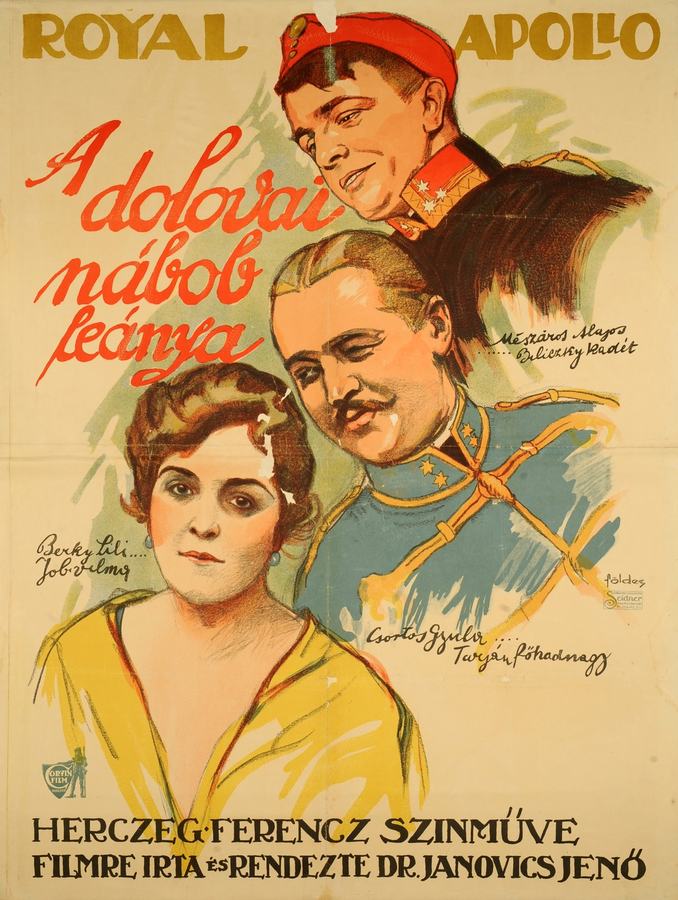
The first time I encountered A Dolovai nábob leánya I was chasing a rumor—whispers in a forgotten film journal that somewhere between the Carpathians and the Danube, 1916 had birthed a movie that smelled of cognac, gun-smoke, and the mildewed velvet of bankrupt glory. What I found instead of rumor was a detonation: a nitrate grenade hurled straight at the myth of noble birthright, its fuse lit by Ferenc Herczeg’s scalpel-sharp scenario and Jenö Janovics’s direction that stages decadence like a fever dream auction.
Let’s discard the polite scaffolding. This is not a melodrama that simpers; it is a ledger written in blood-red ink. Every frame balances on the fulcrum of property—who owns the land, the women, the night itself. József Berky’s nabob enters swaddled in bear-furs, yet the man’s eyes are pawn-shop counters weighing his own corpse. Notice how the camera refuses to tilt up toward ancestral portraits; instead it lingers on cracked plaster, on chandeliers shedding crystals like teeth. The aristocracy here is not dying—it is being itemized.
Klára, played with mercury volatility by Lili Berky, is introduced in a swirl of snow-white tulle that the lighting stains ever so faintly with sulfur. Within seconds she is bargaining: one dance for a loan, one smile for a promissory note. Silent-era heroines are usually flattened into allegories—virtue, vice, sacrifice—but Klára is liquidity incarnate. She understands that her body is the final collateral her father hasn’t yet mortgaged, and her rebellion is not to refuse the auction but to rig it.
Watch the bravura sequence in the mirrored antechamber: three suitors circle her like moons, their reflections fracturing into a kaleidoscope of desire. Cuts accelerate, the violins on the intertitle cards seem to shriek, and Klára’s face—caught between ecstasy and arithmetic—becomes the first close-up I’ve seen from the 1910s that feels genuinely pornographic… not in flesh but in disclosure. She is getting off on the arithmetic of ruin.
Gyula Nagy’s impecunious cousin—think of him as a Hamlet minus introspection—wears his tuxedo like borrowed armor. His rival, the usurer Csortos, waddles in with a cigar that glows like a foreclosure notice. Between them stands the film’s slyest joke: a gilded long-case clock counting down not minutes but centurial debts. Janovics repeatedly intercuts its pendulum with Klára heartbeat, suggesting that time itself is a bailiff.
When the cousin challenges the usurer to a nocturnal duel, fog swallows the estate like history gasping for plausible deniability. The cinematographer (unnamed in surviving prints, perhaps a ghost) silhouettes the combatants against a sickle moon; pistols glint the color of unpaid invoices. The duel is over in two shots—one misfire, one thud—yet the editing stretches it into an operatic stutter. Violence here feels simultaneously inevitable and bureaucratic, a notarized extinction.
Spoilers are a bourgeois courtesy; this film spoils itself in the best way. Klára, discovering that every deed has been double-pledged, does not swoon. She strides into the candlelit salon where creditors guzzle Tokay, unbuttons the family safe—an iron relic shaped like a chapel—and begins flinging parchment onto the floor like confetti. Each sheet is a mortgage, a marriage contract, a warrant for somebody’s indenture. She sets them alight with the same nonchalance a coquette might apply to a love letter.
The flames paint her face tangerine; for a moment she looks like the goddess of insolvency. Men recoil, but the camera advances, pushing past silk lapels to find the terror in their eyes: the realization that value was always hallucination, and the woman they commodified has finally closed the market. Smoke coils up, erasing ancestral frescoes, and as the film’s final intertitle flickers—“Property is the ghost of honor”—Klára exits through a side door, not into marriage or death but into the anonymous dawn of a republic still unmapped.
This is where A Dolovai nábob leánya vaults beyond contemporaries like Blackbirds or The Master Cracksman, films content to moralize over sin or celebrate anti-hero bravado. Janovics’s opus indicts the very substrate on which those narratives rest: capital as destiny. Even Michael Strogoff’s tsarist intrigues feel like boyish adventure once you’ve tasted the carbonized aftertaste of this Hungarian exorcism.
József Berky’s nabob ages a decade in a single dinner scene; watch how his fingers tremble around a goblet when the orchestra strikes a folk motif his estate’s musicians can no longer afford to play. The tremor migrates to his eyelid, a vibration so minute it feels seismic. In another register, Gyula Dezséri’s butler—a role that could have been furniture—delivers a sidebar glance at a silver candelabrum that betrays years of calculating its weight against his unpaid wages. These are microtransactions of acting, invisible to the wide shot yet combustible in close-up.
Lili Berky shoulders the heaviest burden: she must radiate desirability while never letting us forget that sexuality here is just another negotiable instrument. When she lowers her veil to kiss the cousin, her eyes stay open, coldly ticking off the seconds of that asset’s liquidity. The erotic frisson is indistinguishable from accountancy; it’s the most subversively anti-romantic moment I’ve seen until Alien Souls flirted with similar cynicism a whole decade later.
Color tinting in the restored print oscillates between arsenic green for interior nights and bruised mauve for exteriors, as though the universe itself suffers contusions. Janovics favors diagonal compositions: tilted candelabra, askew picture rails, staircases that slice the frame like guillotines. Even the intertitles skew, sliding in from screen-right at a slanted angle, evoking documents slipped under a door by impatient creditors. This visual lopsidedness infects the viewer with vertigo; we feel property sliding irretrievably downhill.
Contrast this with the rectilinear order of Panama and the Canal from an Aeroplane, where imperial geometry celebrates conquest. Janovics instead fractures space to suggest that every right angle masks a debt. The camera itself seems hocked.
Archival scores for Hungarian silents rarely survive, so modern screenings often commission new compositions. I experienced it with a trio—piano, violin, cimbalom—who began in Lisztian bravura only to let the music fracture into Bartókian dissonance as Klára torched the deeds. The cimbalom’s wires shivered like unpaid servants. That sonic decay mirrored the narrative: opulence collapsing into atonality, the aural equivalent of paper money becoming tinder.
History’s butcher’s bill: the 1919 revolutions, the 1945 siege of Budapest, the 1956 uprising, and the 1970s communist purge of “feudal” cinema archives. Prints were melted for silver recovery, negatives lost in basement floods. Only a partial 35 mm reel—German censor’s copy, bizarrely—surfaced in Potsdam during the 1998 restorations. Even now, Hungarian film institutes list it as secondary to After Death or The Warning, perhaps because its class autopsy felt too near the bone during post-war socialism.
Yet cinephiles hunting proto-feminist canon should champion Klára’s arson as loudly as they worship Her Maternal Right’s maternal sacrifice. Here maternity is replaced by liquidity, and the heroine’s triumph is bankruptcy—an ideology atomized by its own contradictions.
Does the surviving 46 minutes feel incomplete? Paradoxically, the truncation amplifies the film’s thesis: history itself is a ledger with pages torn out. What remains is a wound gaping toward modernity, presaging the 1920s sexual-credit explosions of Das Abenteuer eines Journalisten and the jurisprudential cynicism of The Curious Conduct of Judge Legarde.
So if you crave a film where chandeliers crash like stock exchanges, where waltzes syncopate with heartbeats hocked to usurers, where the heroine’s farewell gesture is not a kiss but a lit match, hunt down A Dolovai nábob leánya. It will leave you bankrupt of nostalgia and flush with the illicit currency of revelation—an inheritance worth more than all the forfeited estates of Europe.
IMDb 5.9
1936
Community
Log in to comment.