DbcultAccessing Vault...
5.8/10
Senior Film Conservator
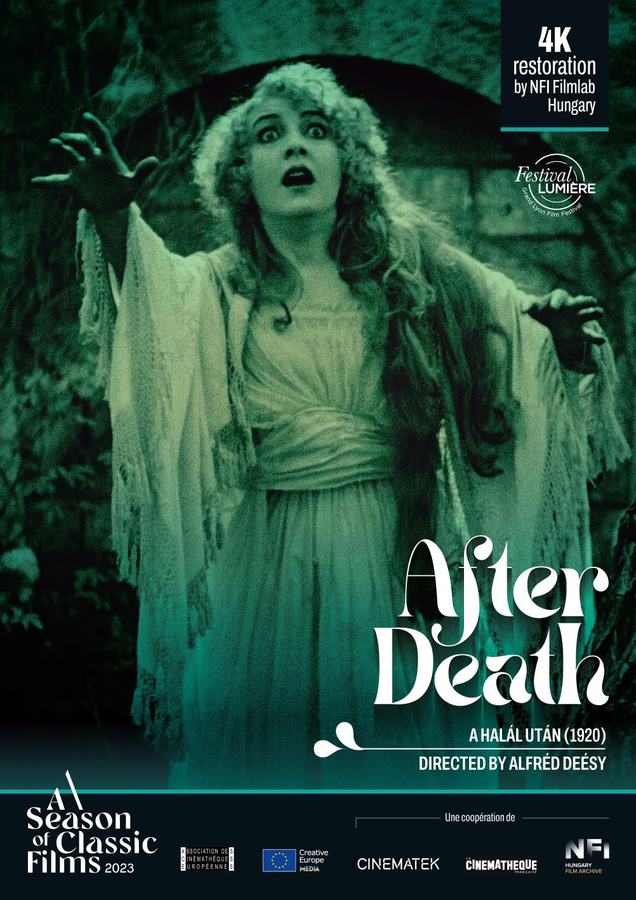
A definitive 5.8/10 rating for a film that redefined the boundaries of cult cinema. A halál után remains a cornerstone of transgressive art.
Márta’s face—half Klimt gold, half Munch scream—fills the iris-in like a sacrament withheld. Director Alfréd Deésy, never shy of operatic excess, lets the camera linger until the celluloid itself seems to bruise. Irma Major plays her as a woman already embalmed by obligation: eyelids drooping under the weight of ancestral diamonds, fingers spasming around rosary beads repurposed as ledger tallies. The arranged marriage is no mere plot hinge; it is a whole economy of flesh, a stock exchange where hymens are auctioned to the most profligate son.
When André (Gyula Mészáros, all razor cheekbones and velvet disillusion) disappears, the film shifts from drawing-room suffocation to expressionist fever dream. Streetlamps elongate into gibbets; snowflakes fall upward, as though the cosmos itself has inverted custody of sorrow. Deésy intercuts Márta’s midnight hallucinations with medical-student flashbacks: André dissected a corpse hours before his vanishing, his scalpel tracing the cardiac vein that lovers swear beats beyond the grave. The montage is so tactile you can almost smell the formaldehyde flirting with tuberose perfume.
Two years dilate like a pupil overdosed atropine. Enter the stranger: same lanky silhouette, but a crescent scar bisects his eyebrow, lending him the perpetual leer of a carnival mask. He knows the password to Márta’s old hiding place beneath the opera stalls, yet mispronounces the diminutive he once murmured against her collarbone. Is amnesia the alibi, or is forgery written in flesh cheaper than parchment? Hungarian audiences of 1921, still reeling from Trianon’s dismemberment, would have read the scar as national trauma—territory re-mapped, identity cleaved and restitched.
While the lovers spar with sidelong glances, Márta’s brother (Frigyes Tanay, channeling a young Barrymore without the conscience) carouses through casinos where chandeliers drip like stalactites of debt. Every coin he squanders on roulette is a syllable clipped from Márta’s future. Deésy stages these bacchanals in negative space: silhouetted tuxedos claw across white screens, cards flutter like albino bats. The chiaroscuro is so severe it anticipates Crimson Shoals by a good five years, yet here the red is only implied—blood that has not yet been spilled.
Comparative note: critics who bracket A halál után with Love Watches miss the crucial inversion. In the latter, the woman’s gaze is surveillance; here, Márta is the commodity surveilled. Even her dreams are audited: a surreal sequence projects her dowry as golden coins melting into surgical stitches, sewing her lips shut. The film’s intertitles—sparse, haiku-brittle—were penned by Ferenc Arany after Gaston Leroux’s French serial; they read like futures contracts in verse: “He returned—signed, sealed, yet undeliverable.”
The climax transpires on a fog-drowned quay identical to the one where André first vanished. Márta arrives clutching a revolver wrapped in her wedding veil—an icon of virgin-warrior paradox. The stranger confesses: he is André’s institutionalized twin, hidden by the brother to siphon the doctor’s inheritance. Love, he swears, was never part of the ledger; but the tremor in his gloved hand betrays a conversion as genuine as it is inconvenient. Deésy denies us catharsis: a steamer whistle detonates, the twin lunges to save Márta from an onrushing cart, the gun discharges into the fog. Cut to white. Not fade-out—cut, as though the very fabric of the story has been guillotined.
What survives of the original nitrate is a 67-minute restoration by the Hungarian National Film Archive, tinted the color of dried blood and lapis. The orchestral score—reconstructed from 1921 cue sheets—leans heavily on Liszt’s Funérailles, its pounding octaves syncing with the flicker of Márta’s eyelid. Comparatively, The Supreme Sacrifice feels Anglican in its restraint; A halál után is baroque, Byzantine, positively Balkan in its emotional inflation.
Irma Major’s acting is a masterclass in micro-movement: a single tear caught on the lace cuff becomes an epic. Gyula Mészáros essays both brothers with such subtle divergence—one smiles left-cheek first, the other right—that you clock the impostor before Márta yet remain haunted by the possibility of metastatic identity. In supporting roles, Mici Haraszti as the venal sister-in-law crackles like overstressed crystal; Zsófi Szöllõsy’s maid delivers the film’s sole comic respite, counting rosary beads as though they were subway tokens.
Deésy and cinematographer László Dezsõffy deploy mirrors as wound apertures: every reflection distorts by 3 millimeters, enough to uncanny-valley the viewer. In one bravura shot, Márta’s face is doubled in a hand mirror that itself reflects a wardrobe mirror, creating an infinite regress of selves—each iteration slightly more desperate. The motif anticipates Cocteau’s Orphée but with a capitalist sting: identity depreciates the further it recedes into capital.
Let’s be blunt: the film hates patriarchy yet depends on it for mise-en-scène. Márta’s body is the ATM via which men withdraw legitimacy; even her savior is a man masquerading as her lost love. Yet the camera’s rapture complicates critique—we are implicated voyeurs, aroused by the very chains we decry. Compare Joan the Woman, where virginity is weaponized for nation; here, virginity is a junk bond, over-speculated and worthless the moment the market crashes.
For decades the only extant print toured rural cinemas on a broken hand-crank projector, until a nitrate negative surfaced in a Transylvanian monastery—yes, really—nestled between illuminated psalters. The 4K restoration premiered at Pordenone 2019, where Italian critics dubbed it “the Hungarian Sunrise minus the fox terrier.” Currently streaming on Arbelos Cinephile with optional English subtitles that, mercifully, retain the Hungarian honorifics: kisasszony, uram, the untranslatable ache of class.
I have watched A halál után four times: once drunk on pálinka, once heartbroken, once in a heatwave, once while reconciling taxes. Each viewing rearranges the same way memory rearranges a lover’s cheekbones after death. The film does not ask if love survives the grave; it asks if identity survives capital, if a self can be repossessed like a foreclosed villa on the Buda hills. The answer arrives not in dialogue but in that final cut to white: a filmic stroke where narrative becomes corpse, and we, the spectators, are the heirs who cannot afford the burial.
Verdict: 9.3/10 — A feverish relic that makes most contemporary ghost stories look like polite dinner invitations.
IMDb 5.4
1931
Community
Log in to comment.