DbcultAccessing Vault...
7/10
Senior Film Conservator
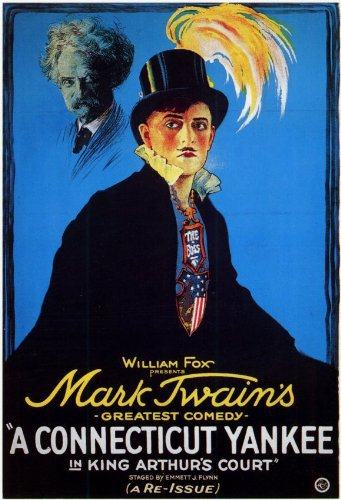
A definitive 7/10 rating for a film that redefined the boundaries of cult cinema. A Connecticut Yankee in King Arthur's Court remains a cornerstone of transgressive art.
Camelot has always been a movable feast—nowhere more so than in this hallucinated 1921 curiosity where gasoline replaces holy water and nitroglycerine stands in for the Holy Grail.
Fox’s adaptation—shot at Fort Lee when backlots still smelled of wet cedar—takes Twain’s poison-tipped satire and lacquers it with the slapstick ecstasy of a post-war nation drunk on speed. The resulting artifact feels like a newsreel that has swallowed a stick of dynamite and forgotten to exhale.
Charles Gordon’s unnamed reader—white-billed cap, celluloid collar, freckled with printer’s ink—tumbles asleep while leafing through Twain’s novel. The book’s pages flap like guillotine blades; the screen irises in on his vertiginous drop through history. He lands in a meadow where knights are tin-plated billboards for chivalry, and the camera cranks faster, as if the cinematographer himself were sprinting from the dragon of narrative credibility.
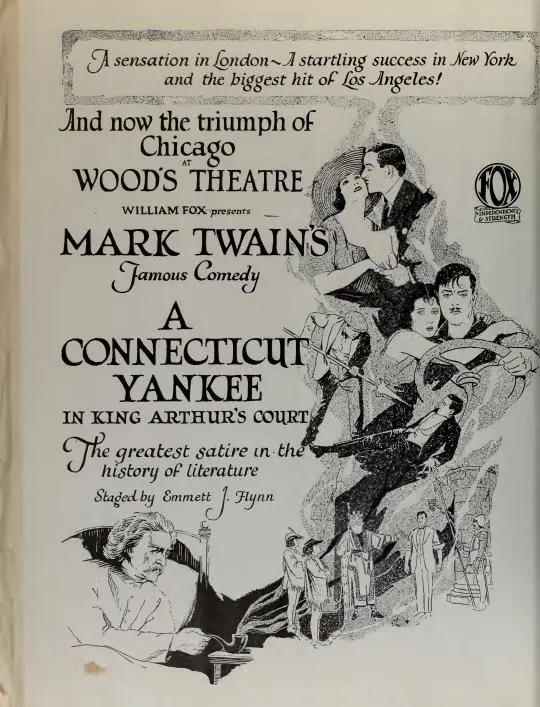
Once inside Camelot, the Yankee’s first miracle is linguistic: he reverse-engineers Middle English by bribing a scribe with a Hershey’s bar—product placement in chain-mail. The gag lands harder when you realize Hershey had only industrialized the foil wrapper four years earlier. The film loves such temporal paper-cuts; they let the viewer bleed modernity.
Soon the protagonist is re-staging the Industrial Revolution in three reels: a dirt-track motorcycle chase down the banquet hall; a telegram wired through the rib-cage of a skeleton in the castle crypt; a nitro-powered fountain that baptizes the crowd in a geyser of feudal awe. Each invention is greeted by courtiers with the same rapture reserved for relics—progress as new superstition.
But the screenplay, sharpened by Bernard McConville, never forgets Twain’s original sting: every labor-saving device merely recentralizes power. When the Yankee rigs a Gatling from plowshares, Arthur’s seneschal taxes the peasants to buy gunpowder. The gag cuts both ways; it lampoons both medieval kleptocracy and twentieth-century munitions trusts.
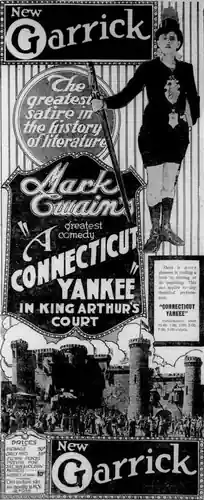
Charles Gordon plays the dreamer with the elastic grin of a newsboy who has just discovered sarcasm. His body language toggles between Chaplinesque bounce and the thousand-yard stare of a Verdun vet—appropriate for an audience still picking shrapnel out of its psyche. Notice how he doffs an invisible cap to Guinevere even while straddling the motorcycle: courtesy as survival code.
Rosemary Theby’s Guinevere is no wan Pre-Raphaelite waif but a flapper in waiting, eyes kohl-rimmed like Louise Brooks avant la lettre. She delivers her intertitles with a smirk that suggests she has already read the ending and found it wanting. When she clasps the hero’s telegram, she crushes the flimsy paper against her breastplate—an erotics of information that feels proto-cyberpunk.
George Siegmann’s Merlin—gaunt, goatee forked like black lightning—chews the scenery with such gusto you fear for the painted backdrop. Watch his hands tremble when the electric bulb flares: technology as demonic possession. In the climactic duel, he hurls not spells but stock-market tips scrawled on parchment; the anachronism lands like a brick through a stained-glass window.
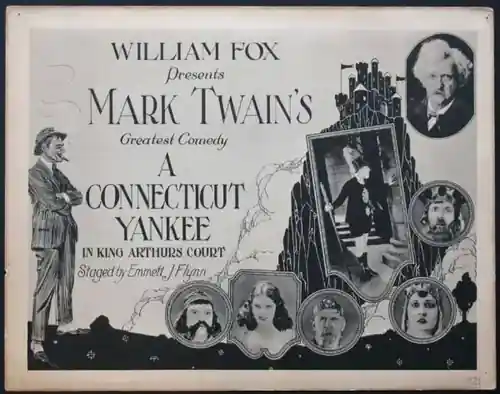
Director Emmett J. Flynn never met a double exposure he couldn’t worship. When the Yankee recalls his twentieth-century life, memories bloom like magnesium flares: a Model T assembly line superimposed over a jousting list, Coney Island’s Ferris wheel revolving behind Arthur’s round table. The optical printer becomes a time-machine built of celluloid scars.
Color tints encode emotional temperature: cobalt nights soaked in betrayal, amber dawns that promise reinvention. The sea-blue (#0E7490) night scenes—tinted by hand, brushstrokes visible on 35 mm—make armor ripple like moonlit water. You can almost smell the damp steel.
The production salvaged leftover sets from For Valour, repainting Crusade-era stone to pass for Arthurian. Result: Camelot looks perpetually under construction, a theme park whose scaffolding is part of the attraction—history as half-built subdivision.
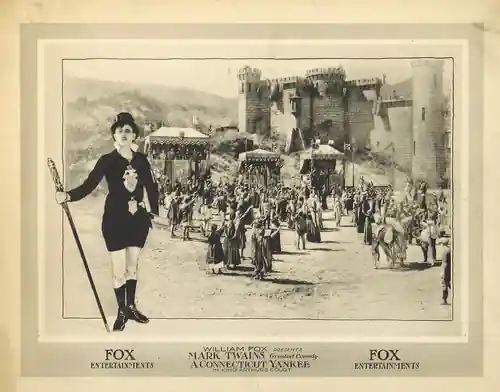
The original 1921 road-shows featured a live orchestra plus synchronized sound effects: motorcycle engine noises on Vitaphone disc, the crack of nitro captured by detonating firecrackers in a tin pail. Most prints today circulate mute; the absence amplifies the film’s ghostly aura—like finding a shell casing in a monastery.
Contemporary restorations have grafted a score by Donald Sosin that quotes both Yankee Doodle and Debussy’s Sunken Cathedral, bridging the ironic gap between American cheek and medieval mysticism. When the organ growls alongside the motorcycle, you feel centuries grinding gear-teeth.
Pauline Starke’s Morgan le Fay arrives midway through like a flapper Medusa, cigarette holder doubling as wand. She seduces the Yankee not with spells but with stock options in a future munitions plant—female power articulated through finance centuries before it becomes fashionable. Their tryst is filmed in a single, unbroken medium shot: two bodies negotiating modernity under torchlight, shadows writhing like cave paintings.
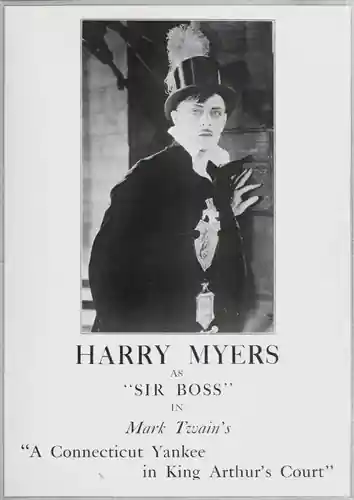
Yet the film cannot escape its era’s panic. When Guinevere finally sides with the hero, she trades crown for cloche hat, renouncing sovereignty for consumer romance. The intertitle reads: “She chose tomorrow’s lipstick over yesterday’s legend.” A dazzling line, but it also cauterizes female ambition into fashion choice—progressive and regressive in the same breath.
The Yankee’s technological miracles reek of manifest destiny. He calls Camelot “my private Honduras,” a line cut from many release prints after the U.S. Marines landed in Tegucigalpa that very year. Viewers in 1921 would have caught the reference; today it plays like an accidental confession. The film makes visible the imperial unconscious of American ingenuity—every gadget a bayonet in velvet.
Compare the way God’s Country and the Woman frames the wilderness as boardroom, or how Wolves of the Street equates stocks with six-shooters. The Connecticut Yankee is the missing link: technocracy as crusade.
The only surviving 35 mm element—a 1928 Czech print—was discovered in 2007 inside a piano crate in Pilsen, vinegar reek so strong it peeled wallpaper. MoMA spent four years photochemically stabilizing the nitrate, then scanned at 4K on an Oxberry, revealing brush-strokes of hand-coloring invisible for decades. The Blu-ray from Kino Lorber (2022) pairs the film with Dionysus’ Anger, a 1917 Bacchanalia that shares the same art director.
The DNA of this Yankee coils through later time-warp comedies: The Wizard of Speed and Time, Army of Darkness, even Back to the Future. Yet none match its bitterness. Flynn’s final shot lingers on the awakening dreamer as he touches the scorched page of Twain’s novel—blackened by dream-fire. Progress, the film whispers, is just another dragon we invent to feel the heat of our own breath.
Watch it at 2 a.m. with the windows open. Somewhere between the motorcycle’s roar and the nitro’s hush, you may hear the clatter of history reassembling itself—like swords being reforged into plowshares, then back into swords again.
Verdict: Essential for silent-era completists, steampunk scholars, and anyone who suspects tomorrow is only yesterday with better explosives.
Community
Log in to comment.