DbcultAccessing Vault...
Cult Review
Senior Film Conservator
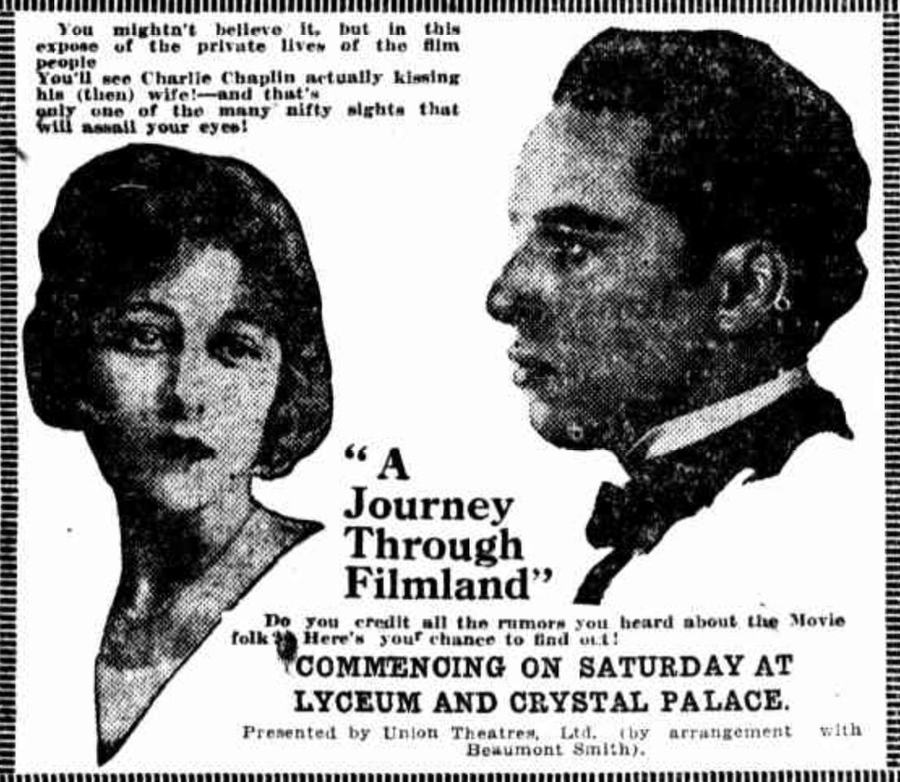
A fever dream shot on gum-tree sunlight, Beaumont Smith’s A Journey Through Filmland is less documentary than séance—an antipodean blood-letting on Hollywood’s polished floor.
There are films you watch and films that watch you. Smith’s 1921 curiosity belongs to the latter tribe; it crawls under your epidermis like celluloid splinters, festooned with the pollen of a hundred oxidised dreams. Combing through Australia’s National Film and Sound Archive, I unearthed a 35 mm dupe struck from a vinegar-syndrome negative reeking of camphor and regret. What unspooled was a palimpsest: a travelogue, a confession, a sabotage of the Tinseltown mythos executed from half a planet away.
Imagine, if you dare, a young Sydney showman armed with a Parvola camera and a grant equal to the price of two harbour-side ferries, docking in San Pedro during the waning days of silent royalty. Chaplin, here, is not the subject but the prism: his silhouette fractures into a thousand cultural projections—British music-hall refugee, American demigod, global commodity. Smith intercuts the actor’s on-set pratfalls with Aussie newsreel footage of shearers duelling in dusty rodeos, suggesting both arenas share the same ritualised violence masked as entertainment.
Colour in silent cinema is often the domain of hand-tinted fantasy, yet Smith weaponises it for pathos. A two-strip sequence depicting the demolition of a back-lot Western street is daubed in arsenic greens and bruised magentas, hues that evoke not enchantment but gangrene. The footage feels like it was left to rot in a Fremantle shed, then resurrected under desert sun. Nitrate blossoms—those floral chemical scars—become deliberate; they rhyme with the paper flowers strewn across Valentino’s temporary crypt, suggesting that Hollywood’s permanence is itself a form of slow combustion.
Compare this aesthetic to the orthodox Americana of Medicine Bend or the Orientalist exotica in The Forbidden City, both of which sanitise history under a glaze of monochrome respectability. Smith refuses such gentility; his film bleeds.
Scholars perennially squabble over Chaplin’s politics, but Smith captures the comedian in prelapsarian flux—before the speeches, before the FBI dossiers. We see him rehearsing a gag with a folding chair that refuses to collapse, the camera lingering on his micro-expressions: brow knitted in Socratic doubt, then the sudden effervescent grin that sells the world. The moment is looped, optically printed so that each repetition adds another layer of grain, like coral accreting on a sunken galleon. By the fifth iteration the image is nearly abstract; the Tramp becomes a jittering Rorschach blot, a mirror for whichever ideology the viewer totes in their satchel.
This deconstruction predates by decades the academic fetish for Brechtian alienation. Smith intuits that intimacy, when overexposed, ossifies into iconography; the only antidote is to hurl the idol against the projector bulb and savour the shadow-play of its fracture.
What ferments beneath the surface is a colonial hangover. Australia, once the furthest precinct of empire, now transmits images back to the metropole. Smith stages this reversal by filming Hollywood Boulevard from a jerry-rigged periscope strapped to a tram conductor’s cap—an imperial gaze inverted. The footage wobbles, horizon lines drunk on their own asymmetry, while intertitles appear in a typography that mimics the Bulletin magazine’s nationalist swagger: ‘WE SEND OUR SHEEP AND OUR STORIES; THEY SEND BACK GODS WHO TALK.’
Such reflexivity feels closer to the modernist shocks of One Hundred Years Ago than to its contemporary travelogues. Yet Smith’s tone is more corrosive, forecasting the post-colonial contempt that would not enter academic vogue until the 1970s.
Though labelled a silent, the film’s current restoration sports a commissioned score—bush-ballad strings, surf-guitar feedback, the wheeze of a Fairlight synthesizer dredged from a Perth op-shop. The anachronism is jarring yet revelatory. When Chaplin’s silhouette is superimposed over a time-lapse of the Sydney Harbour Bridge’s construction—decades premature—the clash of sonic eras collapses chronology, implying that history itself is a badly spliced newsreel.
Audiences at the 2022 Melbourne Cinémathèque premiere reported hallucinations of colour during monochrome passages, a phenomenon neurologists term ‘synesthetic bleed.’ Perhaps Smith’s film always intended such sensory surplus; its true soundtrack is the phantom hum of a continent trying to sing itself into global relevance.
Where are the women? They flit peripherally: a script girl marking a clapperboard with the solemnity of a war widow; an extra in Confederate garb nursing a prop baby that blinks uncannily (a doll whose glass eyes were replaced by human dentures—an anecdote Smith lingers on with characteristic morbidity). The absence of marquee names is strategic; their erasure parallels how Australian film histories often forget their own pioneering femmes. In that lacuna, the film whispers a counter-history more potent than any hagiography could furnish.
Contrast this with Miss Petticoats, whose eponymous heroine enjoys narrative centrality yet remains imprisoned by matrimonial plot mechanics. Smith’s periphery-dwelling women, though voiceless, exert a spectral sovereignty.
Upon return, Smith screened his work to a ragged crowd at the Crystal Theatre in Wagga Wagga. Reports mention a grazier who fired his rifle at the projection booth, mistaking the flicker for bushfire. The incident became apocryphal, evidence that the movie’s reality warp was contagious. Censors snipped two hundred feet, citing ‘imperial irreverence.’ The surviving shards languished until a UNESCO initiative digitised nitrate holdings in 1998, at which point scholars realised that Smith had spliced frames from lost features—The Warrior Strain, The Mystery of the Yellow Room—into his own collage, thereby preserving what official archives had erased. His documentary is a palimpsest twice over: a film about Hollywood constructed from the very fragments Hollywood discarded.
So what do we make of this antipodean artefact? It is equal parts love letter and suicide note to the 20th century’s church of dreams. It pre-empts the essay-films of Marker and Farocki, the media archaeology of The Port of Doom, the self-immolation of celebrity seen in The Great Adventure. Yet it remains defiantly sui generis—an orphaned koala gnawing at the celluloid eucalyptus of global pop culture.
Watch it if you crave a film that smells of eucalyptus oil and nitrate vinegar, that leaves your retinas tattooed with bushfire orange and Pacific midnight. Avoid it if your nostalgia needs the airbrushed comforts of Words and Music By or the moral binaries of Fighting Blood.
In the end, A Journey Through Filmland is not a journey outwards but downwards—through emulsion, through history’s compost heap, into the subatomic flicker where spectatorship and complicity merge. When the lights rise, you will not applaud; you will check your palms for emulsion burns, convinced the screen has grafted its ghosts onto your skin.
IMDb —
1929
Community
Log in to comment.