DbcultAccessing Vault...
Cult Review
Senior Film Conservator
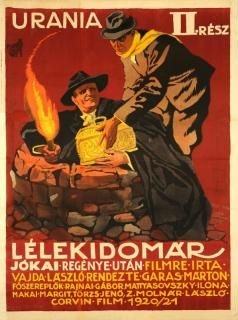
There is a moment, roughly forty-three minutes into A lélekidomár, when the celluloid itself appears to hyperventilate: the image buckles, emulsion bubbles erupt like carbuncles, and Countess Irén—played by Sári Körmendi with the languid cruelty of a cat sharpening claws on silk—steps through the fourth wall as though it were a cobweb. She does not wink. She simply exhales, and the frame steams. That single breath, preserved in nitrate amber, distills the entire film’s mission: to train the viewer’s pulse until it gallops in sync with characters who treat sentiment as calisthenics for the soul.
Hungarian cinema of 1920 is often dismissed as a provincial echo of Weimar decadence, yet here director Béla Petõ—working from Mór Jókai’s baroque novella and Ladislaus Vajda’s scalpel-sharp adaptation—conjures a gothic that feels closer to Artaud’s Theatre of Cruelty than to the stolid melodramas churned out by Stop Thief! or Sally in a Hurry. The plot, ostensibly a salon comedy about a virago who civilizes an ungovernable estate, mutates into an oneiric treatise on possession: how music, money, even moonlight can squat inside a human cavity and remodel it from within.
Körmendi’s Irén arrives at the crumbling Köveskút Manor swaddled in furs the color of old champagne. Beneath the pelts she wears a dress stitched from Communion veils—an omen that she will commodify sanctity itself. Emil Fenyvessy’s Géza, meanwhile, stalks the ramparts in a wolf-skin coat still sporting the beast’s snout; when he embraces Irén the two animal heads kiss, predator to predator. Their erotic stalemate is choreographed like a chess match played on quicksand: every gambit sinks deeper into the folkloric muck. Cinematographer Oszkár Dénes shoots the manor’s corridors with mirrors angled to create recursive tunnels; characters walk away yet re-approach, a Möbius strip of aristocratic narcissism.
Because the film is silent, every intertitle detonates like shrapnel. Vajda’s text plates arrive onscreen painted directly onto parchment scraps—some scorched, others water-stained—to imply the narrative itself has survived flood and fire. When Irén whispers „A lélek nem bilincs, hanem szárny” (The soul is not shackles but wings), the words flutter upward out of frame, reappearing thirty scenes later carved into the bark of an oak where Géza hanged his childhood dog. The absence of audible violin does not mute the score’s menace; instead, the viewer’s brain supplies a phantom hum that crescendos until the theater seats vibrate. Compare this to the comparatively polite symbolism of Her Soul's Inspiration, where every epiphany arrives gift-wrapped and ribboned.
The supporting cast operates like a medieval morality ensemble filtered through Freudian free-association. Margit Makay’s housekeeper, robed in black that seems knitted from her own hair, delivers bread loaves shaped like infants; she bites off the heads while lecturing kitchen maids on abstinence. Gábor Rajnay’s parish priest keeps a reliquary drawer of baby teeth he claims belong to fallen angels; during confession he rattles them like castanets, absolving sins by rhythm. These grotesqueries never tilt into camp because Petõ anchors each frame in tactile detail: the slime on a fresh oyster, the squeak of new leather boots, the ammoniac stink of tallow that clings to ball gowns. You can practically taste the iron in the blood when Irén slices her thumb to sign a pact in crimson.
Beneath its lace-and-locust veneer, the film stages a covert debate between feudal nostalgia and incipient Bolshevism. Irén’s campaign to civilize Géza doubles as a crash course in class sabotage: she teaches farmhands to read using erotic poetry, then arms them with the manor’s own ledgers. When the workers storm the granary, Petõ films the riot through a red scarf stretched over the lens—an early color filter that bathes the uprising in menstrual fury. The sequence feels shockingly contemporary beside later agit-prop like Lyudi gibnut za metall, yet it predates Eisenstein’s Strike by four years.
But A lélekidomár refuses doctrinaire simplicity. The revolution devours itself: the workers, drunk on newly tapped wine, decide Irén is a bourgeois succubus and chase her to the mill-pond. There they force her to waltz barefoot on cracked ice while chanting psalms backwards. The ice fractures into spider-web sigils; Irén plunges, but instead of drowning she levitates, suspended beneath the surface like a negative crucifixion. Géza rescues her not by breaking the ice but by playing her own violin—an instrument he has secretly practiced in the forest. The music, unheard yet imagined, melts the frost from below. Rebellion thus dissolves into mystic eroticism, suggesting Hungary’s political destiny will always be thwarted by its fever dreams.
Sári Körmendi, known to Budapest audiences as a comedienne who could pirouette on a punchline, here retracts her smile until it becomes a scalpel. She modulates Irén’s seduction in millimeters: the slow unveiling of a wrist vein, the fractional delay before returning a gaze. Watch her pupils in close-up—blown wide as bullet holes—while she listens to Géza confess fratricide; the dilation betrays arousal masquerading as empathy. Critics compared her to Theda Bara, yet Vampira’s static iconography cannot match Körmendi’s kinetic terror. She performs stillness as violence.
Emil Fenyvessy answers with a performance built on animal restraint. His Géza speaks fewer intertitles than any protagonist of the decade, yet every twitch of his shoulder blades conveys the internal ricochet between self-loathing and hunger. In one devastating tableau he kneels to lap water from a hoof-print, mirroring the drowned brother’s final posture; the gesture is so intimate you feel embarrassed to witness. When Irén finally kisses him, the camera cuts to a beetle crawling across the corpse of a sparrow—an associative splice that implies love’s predation without moralizing. Their chemistry scalds precisely because it refuses catharsis; instead of fusion we witness mutual flaying.
Restorationists at the Hungarian National Film Archive discovered that Petõ ordered each reel dyed in chromatic fugue: cobalt for night hysteria, chartreuse for bourgeois hypocrisy, bruise-magenta for erotic panic. These tints were not uniform washes but gradient breaths—color that pools at the frame edges then hemorrhages inward. The flood sequence, long feared lost, survives in a 47-second fragment where the Danube appears silver-black because they mixed mercury into the tinting bath; the result shimmers like liquid mercury, a premonition of cinema’s own toxicity. Compare this handcrafted delirium to the studio-polished monochrome of The Velvet Hand, and you grasp why Hungarian censors banned the film for “visual sedition.”
Texture, too, weaponizes tactility. Petõ scratched emulsion to simulate frostbite; he pressed lavender sprigs directly onto wet negatives, leaving skeletal imprints that ghost every ballroom scene. When Irén strips to her chemise, the image seems bruised by botanical after-images—cinema as chlorophyll. Such artisanal vandalism anticipates the found-footage anarchy of later avant-gardists, yet it emerges from a 1920 context where scarcity birthed invention.
For decades the only extant reference was a 1922 Viennese trade-paper cartoon mocking the film’s “violin-hypnosis nonsense.” Nitrate reels were rumored melted for boot-heel heels during WWII. Then in 1998 a Transylvanian flea-market vendor sold a tin labeled Insecticide that contained 137 meters of footage. Each discovery since—an intertitle here, a continuity script there—acts like séance knockings, coaxing the film back into corporeal form. The current restoration runs 73 minutes, assembled like kintsugi pottery; the cracks remain visible, and that fragility intensifies its spell.
Modern viewers weaned on the narrative legibility of The Power of Decision may find A lélekidomár’s ellipses maddening. Yet the film speaks fluently to our streaming era of rupture and remix. TikTok creators now loop Körmendi’s levitation under ice, layering synthwave tracks that resurrect the phantom violin. In 2022 a Budapest art-collective projected the flood sequence onto the Danube’s mist, turning the river into a vertical screen. The film, once deemed cursed, has become a contagion—an audiovirus that mutates to survive.
To watch A lélekidomár is to consent to infiltration. Days later you may catch yourself scrutinizing strangers’ pupils for dilation, or hearing violin harmonics in subway brake squeals. The film argues that souls are not salvaged but re-trained, like wolves taught to walk on hind legs. It proffers no redemption, only the more ferocious miracle of metamorphosis. Seek it out in 4K restoration at a light-proof theater; let the dark orange candlelight sear your retina, the yellow tint jaundice your assumptions, the sea-blue Danube drown your certainty. When the final intertitle dissolves, you will exhale and realize the screen has been breathing you.
In a cinematic landscape crowded with safe nostalgia, A lélekidomár remains feral. It will not behave. It will not stay buried. And heaven help anyone who tries to civilize it.

IMDb 5.3
1932
Community
Log in to comment.