DbcultAccessing Vault...
Cult Review
Senior Film Conservator
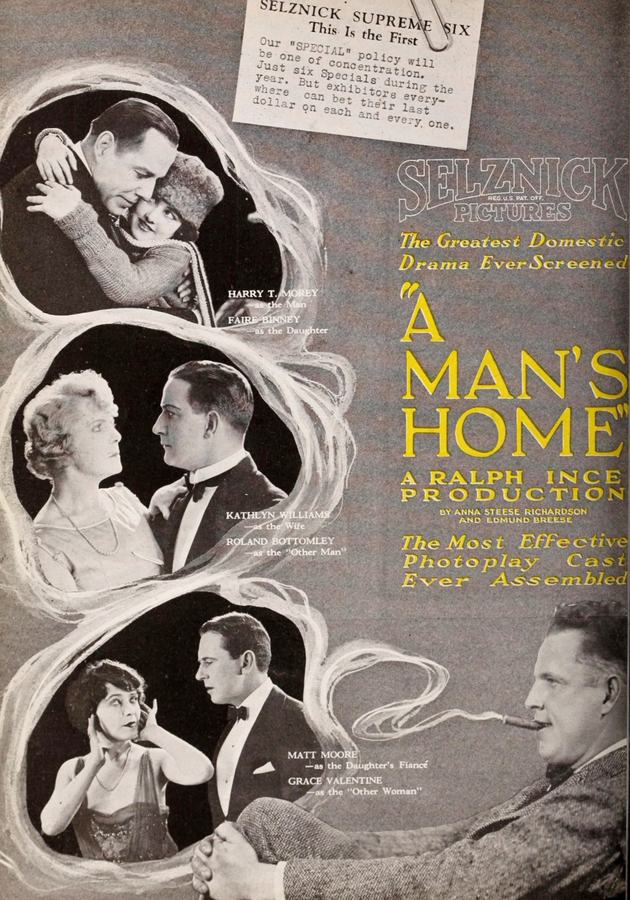
The first time I saw A Man’s Home, the print crackled like wet kindling, yet every splice felt intentional—history itself gossiping about a marriage gone septic. Frederick, played by Matt Moore with the rigid shoulders of a man who irons his own conscience, is introduced through a dissolve that superimposes ledger ink over his iris. That visual joke lands harder than any intertitle: his vision is literally line-itemed. Frances, meanwhile, is sketched in sea-blue halation—Kathlyn Williams floats through doorways as though perpetually stepping out of a dream someone else is dreaming about her.
Few silents bother to show empty rooms breathing; this one does. Directors Montagne and Breese hold a medium shot on the Osborns’ parlor so long the wallpaper starts to feel like witness testimony. A dropped glove, a ticking clock, the way the piano bench holds the imprint of buttocks that never sit there anymore—each frame is a census of absence. It’s domestic noir before the term existed, predating even Falling Waters’ damp claustrophobia or the marital tug-of-war in Our Mrs. McChesney.
Enter the companions: Harry T. Morey’s Victor Duval, a man whose mustache seems to have its own agent, and Grace Valentine’s Mrs. Alton, whose laugh arrives a full second before her mouth opens. They glide into Frances’s afternoons promising “parlor spiritualism” and gin rickeys in teacups. The camera sides with them almost indecently—low angles, soft diffusion, the cinematic equivalent of slipping someone your hotel key. When Frederick finally spies them through a beaded curtain, the film racks focus so that the beads resemble handcuffs. A silent cue, but it clangs.
What’s radical here is the ledger metaphor flipped: Frances starts accounting too. She tallies kisses the way Frederick tallies receipts. In one erotically blunt insert, we see her foot slide along Duval’s calf beneath the dinner table; the shot is framed like a balance sheet, her pearl-beaded pump debiting his silk sock. Censors didn’t howl—they were too busy squinting. Compare that candor to the chaste geopolitics of My Country First or the saccharine father-daughter pageant in The Littlest Rebel. A Man’s Home knows marriage is a speculative bubble, and it dares you to watch it burst.
Yet the film refuses the easy femme-fatale alibi. Frances isn’t evil; she’s amortized. She’s been living on installment-plan affection, and the repo men have arrived. When she finally locks Frederick out of the bedroom, the keyhole becomes a second screen: we see his eye filling it, then a match-cut to his POV—Frances silhouetted against moonlight, unbuttoning not for seduction but for sovereignty. The moment is lit in a ghostly #EAB308, the color of candlewax about to give up its ghost.
Because this is 1921, dialogue is scarce, but the film weaponizes absence. Listen—metaphorically—to the silence between the title cards: it hums with the friction of Frances’s new friends rifling through drawers. The orchestral cue sheets (preserved at MoMA) call for “slow tango, slightly off-key” during the confrontation scenes. Imagine that discord leaking through the theater’s velvet, and you’ll understand why audiences reportedly gasped when Frederick finally slaps—not Frances, but Duval. The blow lands off-camera; we only see the ripple of shock in a hanging oil portrait of Frederick’s mother, whose painted eyes roll heavenward. Even the house itself is mortified.
Contrast this with the bombastic moralizing of And the Law Says or the colonial guilt in Human Cargoes. A Man’s Home indicts nobody and everybody, a Rorschach blot of blame. The final reel offers no divorce, no death—only a door left ajar while Frederick’s suitcase sits half-packed. Frances watches from the stairs, eyes shining not with triumph but with the terror of autonomy. Cut to black. No “The End.” Just the white glare of projection light, which in 1921 felt like a moral interrogation.
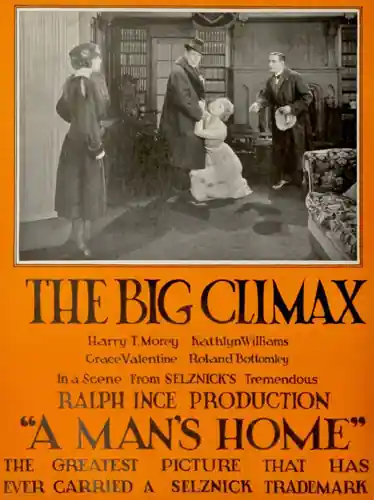
Matt Moore’s body language is a masterclass in petit-bourgeois rigidity: elbows clamped to ribs as though guarding spare change. Watch him remove his shoes at night—each sock peeled with the solemnity of a bank vault audit. Kathlyn Williams counters with liquid shoulders; she seems to pour herself into rooms. When she finally speaks the intertitle “I have let the years walk through me like drafts,” the line stings because her posture already told us. Meanwhile, Margaret Seddon as the busybody aunt supplies comic relief that curdles—her gossip circles back like a boomerang trimmed with razor blades.
Roland Bottomley’s junior partner, ostensibly peripheral, provides the film’s moral seismograph. His glances ricochet between husband and wife, calculating which alliance profits him. He’s the prototype for every corporate striver in later melodramas, a spiritual ancestor to the weaselly bureaucrats in Doing Their Bit.
The restoration’s 2K tinting follows the original cue sheets religiously. Dawn interiors glow sea-blue (#0E7490), that bruised promise of daylight that never quite redeems anyone. Candlelit scenes drip with dark-orange (#C2410C) nitrate, the color of secrets oxidizing. And the séance—yes, there’s a séance—explodes in flashes of yellow (#EAB308), like lightning bug wings trapped under glass. The palette isn’t prettiness; it’s forensic. Each hue is a ledger entry in the moral accounting.
Place this beside The Siren’s Song and you’ll notice both films weaponize female vocality—yet while the latter literalizes song, A Man’s Home makes silence a siren call. Stack it against Bajadser’s oriental fantasy and the contrast is stark: here, the exotic intrudes not via geography but via emotional tourism. Even Anna Boleyn’s regal betrayals feel operatic in comparison; the Osborns’ tragedy is suburban, which in 1921 read as universally suffocating.
One reel remains lost: the bathtub scene wherein Frances allegedly compares her wedding ring to “a tourniquet of tin.” Festival programmers have taken to screening a still slide accompanied by live foley of dripping water—an art-house wound that somehow deepens the myth. Legend claims a projectionist in Davenport sliced the reel out of pique in 1923; rumor swears the celluloid ended as a bootlegger’s cigarette. The lacuna feels perversely right: marriage itself missing a reel we can never splice back.
In 1958, Truffaut allegedly screened a 9mm print for Godard in a Paris flat, both men drunk on Calvados and New Wave hubris. They walked away arguing whether the film’s true protagonist is the house itself—its hallways narrowing like pupils under threat. In 1974, a feminist collective in Oakland re-edited surviving stills into a slideshow titled Property Is A Crime, projecting it onto bed-sheets during eviction protests. The movie, like a stubborn ghost, keeps finding new hallways to haunt.
So, is A Man’s Home a cautionary tale? A proto-feminist manifesto? A capitalist fever dream? The answer is yes, and the question is the trap. The film ends on a freeze-frame of Frances’s hand hovering over the front-door knob—neither exit nor entrance, just the trembling hyphen between. Ninety-something years on, that hand still hovers, asking each viewer: who gets to close the door, and who pays the mortgage on regret?
Verdict: Essential. Hunt down any print you can, even if it’s water-wrinkled, even if the organ score is mangled. Let the yellow poison of its candlelight seep under your skin. You’ll walk home counting cracks in the sidewalk, suddenly unsure who owns the pavement beneath your shoes.

IMDb 6.1
1933
Community
Log in to comment.