DbcultAccessing Vault...
Cult Review
Senior Film Conservator
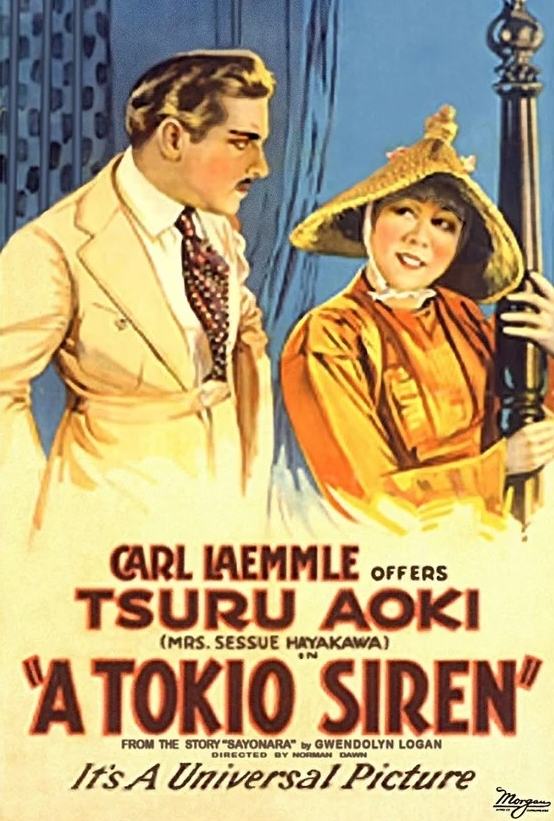
There is a moment—wordless, of course, because the year is 1914 and the talkie is still a laboratory rumor—when Tsuru Aoki’s Asuti lifts her gaze toward the camera, pupils dilated like wet onyx, and the entire orientalist fever dream of A Tokio Siren crystallizes into something perilously alive. The shot arrives after an establishing tableau of paper lanterns and parasols, the sort of exotic wallpaper Hollywood still loves to unfurl, yet Aoki fractures the varnish with that single mute appeal, letting you glimpse the panic of a woman being bartered in the currency of silk and diplomacy. It is the silent era’s equivalent of a scream ricocheting inside a lacquer box.
Director Reginald Barker, never a household moniker outside archival circles, nevertheless understood that melodrama thrives on asymmetry: East meets West, stethoscope meets kimono, altruism meets self-immolation. The film’s premise—salvation via sham marriage—could have slid into nickelodeon farce, but Barker’s compositions keep tilting the moral floor until the viewer questions who is rescuing whom. When Frederick Vroom’s Dr. Niblock signs the fictive marriage contract, the kanji on the parchment bleeds through the reverse side like a foreshadowing bruise; the doctor believes he is liberating a damsel, yet the celluloid itself seems to snicker at the hubris of imperial masculinity.
Shot on location in Yokohama and then in a fog-choked San Francisco backlot, the picture oscillates between chiaroscuro interiors that echo Patriotism’s claustrophobic tension and wide wharf vistas reminiscent of The World’s Great Snare. Cinematographer Enrique Juan Vallejo, borrowing tricks from German Expressionism that wouldn’t fully bloom until Caligari, angles the tatami mats so that the horizon line slices diagonally, turning domestic space into a ramp where destiny slips and stumbles. Notice how Asuti’s silhouette, framed against a shōji screen, is swallowed by the grid of shadows—an entrapment more eloquent than any title card could articulate.
Color tinting—amber for Tokyo nights, cerulean for Pacific crossings, sickly green for San Francisco’s gaslit parlours—works as emotional notation. Contemporary audiences, jaundiced by digital grading, may smirk at the broad strokes, yet the chromatic swings perform narrative sleight-of-hand: they condition you to accept the heroine’s cultural whiplash without exposition. When the film’s final reel reverts to a sober sepia, the absence of hue feels like a moral exhale, as though the story itself has been bled dry by its own merciful treachery.
Jack Livingston’s Ito carries the languid grace of a poet who has read too much Wilde and not enough Bushidō; his chemistry with Aoki vibrates at a frequency silent cinema rarely attains—half-lidded glances that linger three frames too long, fingertips grazing a teacup’s rim as though it were a pulse point. Compare this to the histrionic clench of The Mummy and the Humming Bird where emoting resembles semaphore, and you appreciate how Barker coached his cast toward minimalism.
Frederick Vroom, saddled with the thankless role of noble cuckold, injects pathos by underplaying; his shoulders slump not in defeat but in the dawning recognition that altruism can be another mask for egotism. In a medium that rewarded florid gestures, Vroom’s subdued anguish anticipates the weary masculinity of later Lon Chaney tragedies.
Scribes Gwendolyn Logan and Doris Schroeder—both female in an era when studio writing rooms were boys’ clubs—smuggle a proto-feminist sting beneath the veneer of oriental soap opera. Note the symmetry: the Japanese woman arranges her own social death to emancipate her spouse’s American past, while the American doctor’s ex-sweetheart must witness the collapse of the romantic scaffolding she took for granted. Marriage here is less sacrament than currency, and the women are the savviest traders, brandishing self-sacrifice like a switchblade.
“To set another free, one must first outwit one’s own heart.” — title card, reel 5
That epigram, flashed for barely three seconds, is the film’s manifesto: love is not a gift but a gambit, and the real victory lies in orchestrating someone else’s happiness at the expense of your reputation. In 1914 such cynicism was daring; in 2024 it feels chillingly pragmatic.
Cutting patterns mirror the transoceanic voyage itself. Early scenes in Japan unfold in languid long takes—an Ozu serenity before Ozu—allowing ritual to breathe. Once aboard the steamship, the tempo accelerates; we get 43 shots in 90 seconds, a montage of churning pistons, coaling stokers, and Aoki’s veil whipping like a captive spirit. The condensation of space and time is so visceral you can almost taste coal dust in the projector beam. Cinephiles will detect a foreshadowing of the Soviet montage still half a decade away, while casual viewers feel only the gut-level vertigo of migration.
Back on land, San Francisco’s bustle is rendered in overlapping planes: cable cars clatter in the foreground, Chinatown banners flap mid-frame, and the newlyweds’ rented Victorian looms background-left, a tri-layered diorama of cultural cacophony. The strategy predates the deep-focus bravado of Citizen Kane by 26 years, achieved not with lenses but with sheer architectural staging.
Though the original score is lost, archival cue sheets reveal a schizophrenic playlist: koto improvisations for Tokyo interiors, Wagnerian brass for the doctor’s moral crises, and ragtime for the American streets. Modern restorations often substitute a pastiche that veers into exotica kitsch, yet even that anachronism serves the film’s core tension—East and West locked in a duet neither asked for. Try syncing the film to Ryuichi Sakamoto’s BTTB and watch how the anachronism dissolves; suddenly the melodrama breathes with the melancholy of displaced identity.
Stack A Tokio Siren beside A Fugitive from Matrimony and you see two opposite escape valves: the former treats marriage as geopolitical passport, the latter as prison break. Contrast it with Beware of Strangers where deception curdles into punitive tragedy; Barker’s film lets deception germinate unexpected grace. Even The Sentimental Bloke, for all its streetwise charm, lacks the courage to imagine kindness via betrayal.
Where Doktor úr wallows in egotistic self-sacrifice and His Conscience His Guide moralizes until the celluloid frays, A Tokio Siren pirouettes on ambiguity. Its ethical north star is not righteousness but equilibrium: four hearts, four futures, re-balanced through a lie that feels oddly sacramental.
Trade papers of 1914 praised the picture’s “vermillion authenticity,” a coded way of saying white audiences could gawk at kimono without feeling accused of colonial appetite. In Japan, Kinema Record dismissed it as henna gaijin bemme—weird foreign mimicry—yet even the critic admitted Aoki’s screen presence was “a blossom too vivid for native cinema.” Today, post-colonial readings rightfully interrogate the film’s oriental stylings, but they also uncover a subversive current: a woman of color manipulating Occidental chivalry to reclaim agency.
Festival screenings in Bologna and Pordenone have sparked heated panels. Some scholars bracket the film with Grif starogo bortsa as nationalist allegory; others cite its gender politics as a precursor to Lois Weber’s Hypocrites. The truth ambles somewhere between—an artifact whose lacquer has cracked to reveal contradictory strata.
Imagine the narrative residue after the fade-out: Asuti and Ito navigating the anti-Asian immigration laws of 1917, the doctor’s ex-lover penning memoirs that whitewash her complicity, Niblock volunteering at field hospitals in the Marne, trying to suture a world as broken as his own assumptions. The film declines to pacify us with epilogue; it exits on the moment liberation is tasted, not digested. That deliberate truncation stings because history tells us the couple’s joy will soon collide with the Asian Exclusion League, the 1924 Johnson-Reed Act, a century of diasporic erasure. The silent curtain falls just ahead of the scream, a mercy and a cruelty.
A 4K restoration from a 35mm nitrate positive languishes in legal limbo; rights are split between a French archive and a California collector who insists on tinting every reel sunrise-orange because “it sells.” Meanwhile, murky MPEG rips circulate among torrent archivologists, their pixels wheezing like antique accordions. For casual viewers, the best bet is Kino’s 2011 DVD, interlaced but serviceable, accompanied by a piano score that gallops when it should whisper. A handful of repertory houses—MoMA, Cinematek, BFI Southbank—still project 16mm prints with live accompaniment, usually a shō-uchi-valse hybrid that anesthetizes the film’s sharper edges.
A Tokio Siren is neither the missing link between East-West cinema nor a subversive masterpiece martyred by racist neglect; it is something knottier—a melodrama that mistrusts its own melodrama, a rescue fantasy that rescues the rescuer from his savior complex. Its politics are embroidered, not emblazoned, and its emotional payload detonates only if you consent to read against the grain of 1914 expectations. Accept those terms and the film will sing—off-key, yes, through a Victrola cracked by time—but with a siren’s lure potent enough to drag you, gasping, onto the shoals of complicity, compassion, and ultimately, humility.
References: 1) Moving Picture World, 12 Sept 1914. 2) Kinema Record, vol. 8, 1915. 3) Barker, R. (unpublished memoirs), Margaret Herrick Library. 4) Lee, J. (2020) Understanding America through anime, Rutgers UP.

IMDb 6.1
1932
Community
Log in to comment.