DbcultAccessing Vault...
Cult Review
Senior Film Conservator
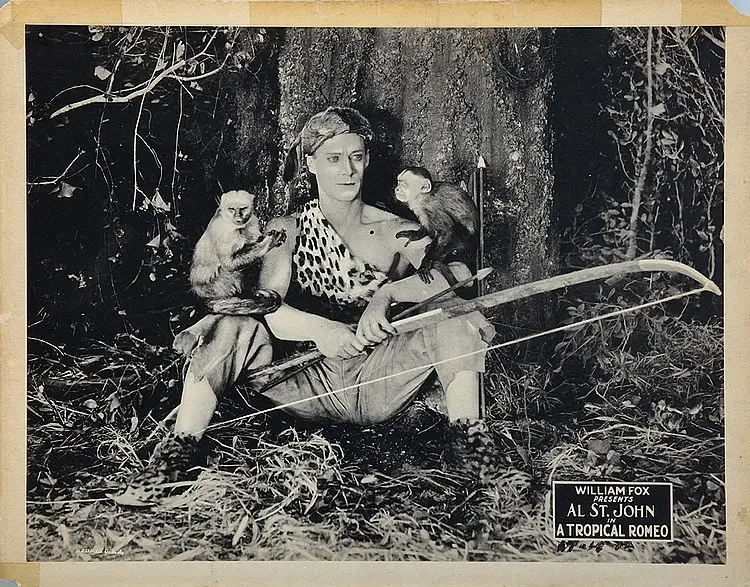
To witness Al St. John in his prime is to observe a gravitational anomaly. In the 1923 short A Tropical Romeo, the performer—often overshadowed by his contemporaries like Keaton or Lloyd—demonstrates a mercurial command of the frame that borders on the supernatural. While many films of this era, such as the domestic-centered Meet the Wife, relied on situational irony and social friction, St. John leans heavily into the pure, unadulterated geometry of the gag. The plot, a gossamer-thin pretext involving a tropical excursion and the pursuit of a fair maiden, serves merely as the skeleton upon which St. John drapes his virtuosic physical comedy.
In the early 1920s, cinema was grappling with its own identity, oscillating between the heavy-handed moralism of films like The Black Stork and the lighthearted escapism of the comedy shorts. A Tropical Romeo firmly plants its feet—or rather, its tumbling torso—in the latter camp. However, to dismiss it as mere fluff is to ignore the technical precision required to execute its set pieces. Unlike the rural, grounded antics found in Village Cutups, the tropical setting here introduces a chaotic element of the 'exotic' that challenges the protagonist's equilibrium at every turn.
"The film operates on a logic of escalating impossibility, where the environment itself conspires against the romantic aspirations of our hero, creating a symphony of slapstick that rivals the best of the Keystone era."
One cannot analyze St. John’s work without addressing his unique physicality. If Mary Pickford brought a sentimental depth to Suds, St. John brings a frantic, almost desperate energy to his roles. In A Tropical Romeo, his movements are not merely funny; they are an exercise in spatial awareness. Every fall is timed to the millisecond, every double-take is choreographed to maximize the frame's depth. He utilizes the palm trees and the sandy dunes with the same familiarity that a stage actor uses a proscenium arch. This is a stark contrast to the more rigid, theatrical staging seen in historical dramas like Held by the Enemy.
The narrative progression is a series of rhythmic pulses. We see the 'Romeo' figure attempting to maintain a semblance of dignity—a recurring theme in silent comedy—only to have it stripped away by the unforgiving nature of his surroundings. This theme of 'dignity under fire' is a common thread in the works of the time, yet here it is amplified by the isolation of the setting. There is no society to judge him, only the audience, making his failures feel more intimate and his eventual triumphs more rewarding.
When comparing A Tropical Romeo to its contemporaries, the differences in tonal ambition are striking. While The Changing Woman explored the nuances of female identity, St. John’s film remains stubbornly focused on the male ego's fragility. Similarly, while Her First Elopement utilized romance as a vehicle for social commentary, this film treats romance as a mere catalyst for physical exertion. It is interesting to note the sheer variety of cinematic output in the early 20s; for every high-stakes drama like Mann über Bord, there was a comedy that sought to dismantle the very seriousness those dramas worked so hard to establish.
Consider the use of tension. In a film like The Sex Lure or The Temptations of Satan, tension is built through narrative stakes and moral conflict. In A Tropical Romeo, tension is purely mechanical. Will the branch hold? Will the boat capsize? Will the protagonist's trousers remain intact? This pivot from the existential to the elemental is what defines the 'St. John' experience. He is the Everyman caught in a world that refuses to follow the rules of common sense.
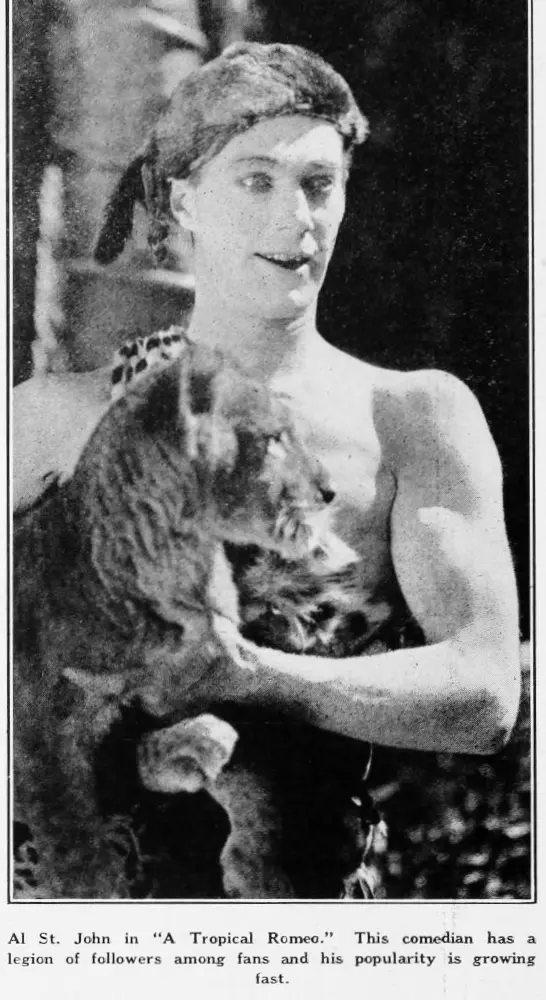
The cinematography in A Tropical Romeo deserves significant praise. The outdoor lighting, often a nightmare for early cinematographers, is handled with a crispness that highlights the textures of the island. The contrast between the bright, reflective sands and the dark, dense foliage creates a visual depth that was often lacking in indoor-bound productions like Leah Kleschna. This visual clarity is essential for slapstick, as the audience must be able to track the movement across the screen with absolute certainty. If the frame is too cluttered or the lighting too flat, the gag loses its punch.
Furthermore, the editing—though primitive by modern standards—is surprisingly sophisticated in its pacing. It understands the 'breath' between the setup and the payoff. This is a skill that was being refined across the industry, from the suspenseful cuts in Dangerous Pastime to the melodramatic beats of The Sin of Martha Queed. In the realm of comedy, however, the editing must be invisible; it must feel as though the events are unfolding in a single, chaotic breath.
Watching A Tropical Romeo today, one is struck by how much of modern action-comedy owes a debt to these early pioneers. The DNA of St. John’s stunts can be found in everything from Jackie Chan’s acrobatic fights to the calculated chaos of modern physical comedians. While the film may lack the high-brow aspirations of For the Queen's Honor, it possesses a raw, visceral honesty that transcends its era. It is a reminder that cinema, at its most basic level, is about the joy of movement.
St. John himself remains a fascinating figure. Often playing the 'Fuzzy' character in later Westerns, his early work as a lead shows a man of incredible range and athletic ability. He was a nephew of Roscoe 'Fatty' Arbuckle and a frequent collaborator with Buster Keaton, and that lineage is evident in every frame of this film. He possesses Arbuckle’s surprising grace and Keaton’s stoic resilience, yet he adds a layer of frantic, wide-eyed mania that is entirely his own. This 'tropical' outing serves as a perfect showcase for that specific energy.
In the grand tapestry of 1920s cinema, A Tropical Romeo might seem like a small thread, but it is one of vibrant, unyielding color. It lacks the pretension of the 'prestige' films of the day, opting instead for a direct connection with the viewer's sense of wonder and amusement. It is a film that understands its limitations and turns them into strengths, using a simple premise to explore the infinite possibilities of the human body in motion.
Whether you are a scholar of the silent era or a casual fan of classic comedy, this film offers a wealth of material to admire. From its inventive use of location to St. John’s peerless performance, it stands as a testament to the creative explosion that defined the first few decades of the silver screen. It reminds us that before there were digital effects or complex soundscapes, there was simply a man, a camera, and the audacity to fall down in the most beautiful way possible.
A masterclass in silent slapstick that proves Al St. John is a titan of the genre. The film's kinetic energy and technical precision make it a must-watch for anyone interested in the roots of cinematic comedy.
IMDb 4.7
1927
Community
Log in to comment.