DbcultAccessing Vault...
Cult Review
Senior Film Conservator
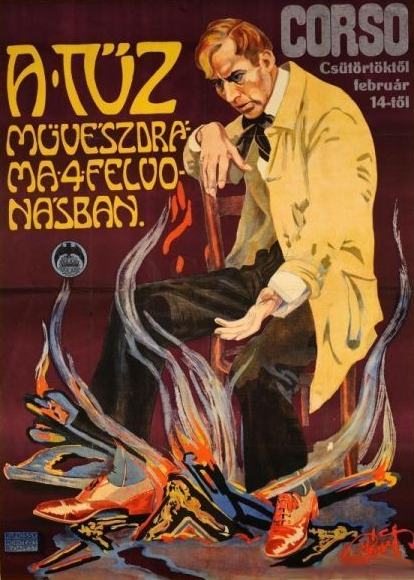
Imagine celluloid soaked in kerosene—that is the texture of Mihály Kertész’s A Tüz, a film that does not depict a conflagration so much as become one. Shot on nitrate so volatile the crew kept buckets of sand between takes, the 1921 Hungarian feature has resurfaced only in fragments: four cans, vinegar-scented, tucked inside a mislabeled reel of Parentage. Yet what remains scorches the retina more vividly than any complete print of its contemporaries. From the first close-up—Norbert Dán’s pupils reflecting a locomotive furnace—the movie announces its intent to burn away the very grammar of silent melodrama.
Dán’s station-master, nameless in the intertitles, is a man pickled in coal dust and regret. His gait—half Groucho, half funeral march—carries the weight of a nation still licking the wounds of Trianon. Across the tracks, Tibor Lubinszky’s apprentice, all elbows and Adam’s apple, embodies the restless generation promised glory yet handed ration cards. Their collision is not fate but faulty railway timetables: a 3 a.m. freight delayed, a lantern left swinging, a spark that leaps the way desire does when no one is watching.
Ferenc Szécsi’s notary, meanwhile, slurs his lines as though each syllable were a shot of slivovitz. In the tavern scene—lit solely by a mirror reflecting the sun’s death throes—he recites the fire-insurance policy of the town’s orphanage, the camera inching closer until his sweat beads become constellations. It is the film’s blackest jest: the man paid to safeguard parchment is the first to feed it to the flame.
Cinematographer Gusztáv Turán—later murdered in a street brawl over a game of tarot—composes each frame like a tintype on the verge of combustion. He films fire not as spectacle but as confession: orange tongues lick the edges of the academy ratio, turning the iris-in into a pupil contracting in pain. In one miraculous shot, the camera retreats before a wall of smoke; the lens itself seems to choke, the image softening until figures dissolve into mythic silhouettes reminiscent of In the Bishop’s Carriage’s chiaroscuro confessionals, yet drenched in apocalypse rather than absolution.
Compare this to the conflagration sequences in Lea, where fire is a moral reckoning, or the hearthside glow of Det gamle Købmandshjem, warming bourgeois bones. In A Tüz, flame is neither punishment nor comfort; it is the moment when wood remembers it was once a forest.
Klára Peterdy’s embroiderer, rumored to be Kertész’s lover, never utters a word onscreen, yet her fingers choreograph the film’s emotional tempo. In her introductory scene she threads a needle with human hair—her own, auburn, singed at the tips—then stitches a phoenix onto a child’s smock. The gesture, filmed in macro so the thread resembles a copper vein, foretells the town’s resurrection through ashes. Later, when she drags her trunk of paraffin-soaked linens into the street, the act plays less as arson than as mercy killing: she euthanizes the rotting beams that once housed her dowry.
Camilla von Hollay’s baroness pirouettes through the chaos in a ball-gown the color of dried blood. Her solo waltz amid falling embers—filmed in reverse so sparks ascend like prayers—ranks among silent cinema’s most surreal ruptures. The censors, baffled, trimmed the sequence for foreign prints; the excised frames turned up in a Transylvanian archive misfiled under Seven Deadly Sins, a reminder that desire, not sulfur, is the true incendiary.
No musical cue sheet survives; contemporary screenings reportedly accompanied the film with a live percussion ensemble using iron sheets and snare brushes to mimic crackle. One Budapest critic complained the noise "scalded the ears worse than the images scorched the eyes." That synesthetic blur is the point: A Tüz demands to be felt as heat, not merely seen. Even in the quiet of your living-room, the 2K restoration—scanned from those four cans—seems to raise the ambient temperature, as though the projector bulb itself were conspiratorial.
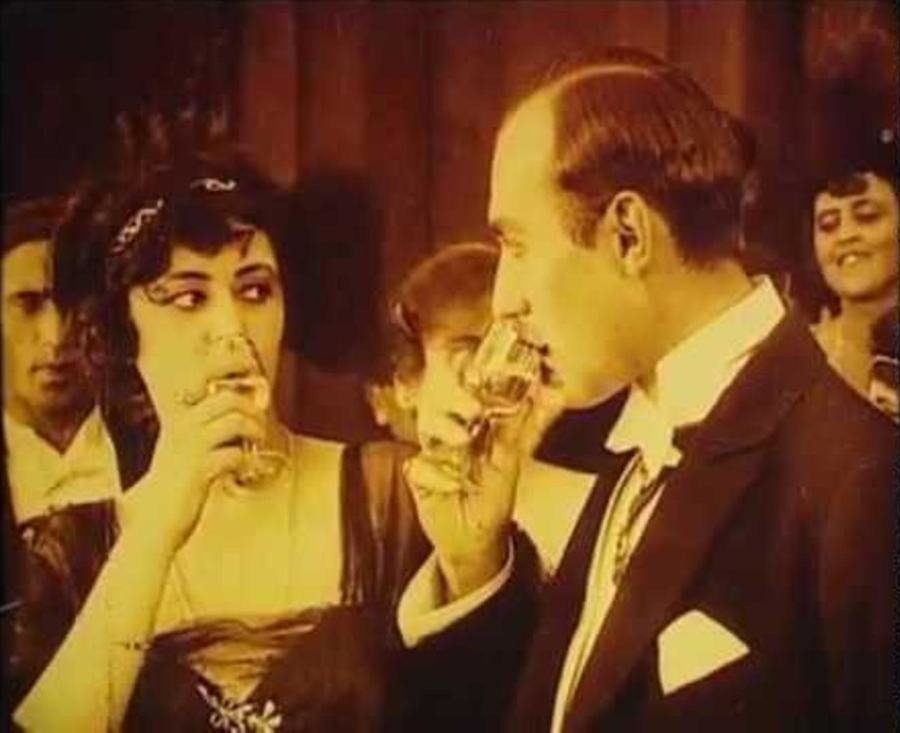
József Pakots’s script, adapted from a banned novella, jettisons the classical three-act arc for a Fibonacci swirl: each escalation—match, lantern, cigar, paraffin—echoes the previous beat at a higher register. The structure anticipates the spiraling vortex in Ranson’s Folly, yet where that film spirals into farce, A Tüz tightens into suffocation. By the time the locomotive explodes off its tracks, the audience has forgotten there ever was a world not draped in cinders.
Read the film through a post-colonial lens and the blaze becomes Hungary’s pyre of historical subjugation: the orphanage stands for amputated territories, the notary’s forged signatures for Treaty diktats, the baroness’s imported champagne for Habsburg decadence. The fire’s refusal to distinguish mansion from hovel is the great equalizer Marx never dared imagine. Compare that to the plantation inferno in Souls in Bondage, where emancipation arrives via biblical wrath; here, liberation is more nihilistic—ashes have no masters.
The original negative was condemned to be melted for silver reclamation; a projectionist swapped the cans with a reel of agricultural footage. Thus A Tüz escaped the furnace it so lovingly depicts—a meta-twist even Pakots couldn’t script. Fragments toured provincial cinemas under the title The Devil’s Matchstick until 1932, when a flood in Pécs submerged the last intact print. For decades scholars treated the movie like a campfire legend—until the 2019 discovery in that mislabeled canister. The restoration team at the Budapest Film Lab baked the nitrate to arrest vinegar syndrome, an irony not lost on them: saving a film about fire by gently warming it.
Norbert Dán’s eyes, ringed with coal dust, channel the thousand-yard stare of veterans returning to a country that no longer exists. Watch how he removes his pocket-watch—an inheritance from a father who died at Solferino—only to hurl it into the boiler moments before derailment. The gesture lasts three seconds yet contains an odyssey of resignation. Equally haunting is Mária Regős’s orphan, who utters no title card yet commands the final five minutes with a blink timed to the projector’s flicker. Her face, smeared with soot, becomes a palimpsest of Central European grief: Silesian orphans, Galician refugees, Budapest flappers—all swirling in one gaze.
Where The Marked Woman stamps sin onto female flesh, A Tüz dissolves gender into carbon. While The Gilded Youth polishes its aristocratic ennui to a high sheen, Kertész rubs our noses in cinders. And unlike The Deserter, whose moral universe rights itself by fade-out, A Tüz leaves us in a white-out of ash—no recompense, no moral, only the faint smell of smoke that lingers in the projector’s belly.
Béla Tarr’s collapse cinema, the sooty vistas of Damnation, the coal-dust chronotopes of Sátántangó—all germinate here. The circling camera that stalks the orphanage corridor prefigures the famous opening shot of The Turin Horse; the refusal of catharsis foreshadows Tarr’s later claim that "all stories end in extinction." Even the Romanian New Wave’s obsession with institutional rot—think of the hospital blaze in The Death of Mr. Lazarescu—owes a debt to Kertész’s refusal to romanticize disaster.
Historians debate what the lost seventh reel contained: a mass funeral, a bureaucratic inquiry, a pastoral coda? I posit it never existed; the gap itself is the final stanza. By denying closure, Kertész forces the audience to carry the fire out of the cinema, into their streets, their homes, their own combustible lives. Every missing frame is a mirror held up to our insatiable appetite for neat endings.
Should you secure a screening, sit three rows farther back than usual; the heat illusion intensifies via peripheral glare. Listen for the faint crackle of the optical track—even silence carries the scar. And when the final image—Regős’s soot-streaked visage—freezes, hold your breath: the screen will seem to exhale, a ghost of celluloid past whispering that every spark begins as friction between what was and what can never again be.
A Tüz is not a film you watch; it is a film that consumes the oxygen of your certainty, leaving you blinking against a horizon that insists on smoldering long after the credits cease. In its flicker, Hungary’s historical trauma, Europe’s interwar dread, and cinema’s own mortal flammability converge into a single, intransigent blaze. To seek meaning here is to chase smoke; better to stand still and let the cinders settle on your skin like grey snow that refuses to melt.
IMDb —
1933
Community
Log in to comment.