DbcultAccessing Vault...
4.9/10
Senior Film Conservator
A definitive 4.9/10 rating for a film that redefined the boundaries of cult cinema. A Venetian Night remains a cornerstone of transgressive art.
From the ethereal depths of early 20th-century cinema emerges A Venetian Night (1914), a silent German masterpiece that transcends its era with a narrative audacity rarely seen in films of its time. Far from a mere historical curiosity, this picture, penned by Karl Vollmöller, masterfully navigates the treacherous waters between romantic idealism and harsh reality, all set against the intoxicating, labyrinthine backdrop of Venice. It's a film that demands close attention, not just for its visual poetry but for its profound psychological undercurrents and an innovative dream sequence that anticipates the surrealist leanings of later cinematic movements.
The narrative commences with a Young Stranger, a figure of wide-eyed innocence and poetic sensibility, utterly consumed by the romantic allure of Venice as depicted in his cherished tome. His pilgrimage to this city of canals and masquerades is framed as an almost spiritual quest, a pursuit of the sublime. Yet, his arrival is immediately tinged with an almost farcical awkwardness, rendering him a vulnerable target for the opportunistic Pitrello, a hotel tout whose predatory gaze instantly identifies the Stranger as a lucrative mark. This initial encounter, a jarring juxtaposition of the Stranger's lofty romanticism with Pitrello's earthy pragmatism, deftly establishes the film's thematic tension: the clash between perception and reality, between the imagined and the tangible.
Simultaneously, the film introduces another narrative thread, equally steeped in poignant longing: a Bride, resplendent in her wedding finery, yet utterly bereft of joy. Her heart, a fragile vessel of unrequited love, belongs not to the wealthy wine merchant she is destined to marry, but to a dashing Officer, who stands nearby, a silent testament to her true affections. The solemnity of the occasion is undercut by the palpable sadness emanating from the Bride, a sorrow so profound it threatens to eclipse the celebratory facade. It is into this emotionally charged tableau that the Young Stranger unwittingly stumbles, his gaze falling upon the pale, ethereal beauty of the Bride. For him, it is an instantaneous, profound infatuation, a love at first sight that is, tragically, built upon a foundation of pure illusion.
The film's central conceit of mistaken identity is brilliantly executed through the simple, yet potent, symbol of a rose. As the bridal party departs the church, the Bride, in a moment of desperate tenderness, casts a single rose towards her beloved Officer. Yet, in a cruel twist of fate, the Young Stranger intercepts this poignant gesture, convinced that the bloom is a direct missive of affection intended for him. This misinterpretation becomes the fulcrum upon which the entire subsequent narrative pivots, propelling the Stranger into a romantic fantasy that grows increasingly elaborate and detached from reality. The wedding feast, a scene of ostensible merriment, only serves to deepen this delusion. The Bride's furtive, longing glances towards her Officer are, in the Stranger's mind, redirected towards himself, fueling his burgeoning, yet entirely unfounded, hopes. This delicate dance of gazes and misread intentions is a testament to the film's subtle power, echoing the intricate social dynamics explored in works like After the Ball, where social cues and perceived affections often dictate tragic outcomes.
As the revelry of the wedding feast wanes, the Bride, feigning indisposition, retreats to her room, her heart heavy with unspoken longing. In an adjoining chamber, the Young Stranger drifts into slumber, the cherished rose clutched to his lips, a physical manifestation of his romantic aspirations. It is here that A Venetian Night transcends the conventions of early cinema, plunging headlong into the realm of the subconscious with a dream sequence of unparalleled complexity and psychological depth. This is no mere fantasy; it is a phantasmagoria, a vivid, often terrifying landscape conjured by the Stranger's hyperactive imagination, still reeling from the day's events. The dream commences with a shadowy, spectral dance, a parade of the day's characters, their forms distorted and their movements spectral, hinting at the unsettling events to come.
The dream rapidly intensifies, transporting the viewer into the Bride's room, where the true drama of her heart unfolds. The Officer, her clandestine lover, is present, pleading with her, their stolen moments imbued with a desperate urgency. A sudden, ominous knock at the door shatters their fragile intimacy, forcing the Bride to conceal her lover behind the heavy curtains. The entrance of the Bridegroom, his senses dulled by excessive drink, adds a layer of drunken menace to the unfolding tension. But it is the sudden, almost supernatural appearance of Pitrello, dropping stealthily from an upper transom, that catapults the dream into a realm of pure nightmare. Unseen by the inebriated Bridegroom, Pitrello engages in a swift, silent, and utterly brutal combat with the hidden Officer, culminating in his death. This act of cold-blooded murder, witnessed only by the horrified Bride, is a moment of profound shock, a testament to the film's willingness to delve into the darker facets of human experience. The dream, much like the psychological unraveling in Prestuplenie i nakazanie, explores the terrifying consequences of hidden desires and illicit actions, albeit through a more fantastical lens.
The dream sequence, far from being a mere digression, serves as the film's emotional and thematic core. Following the Officer's murder, the Bride, terror-stricken, manages to persuade her oblivious husband to leave her room. In a desperate act born of sheer panic, she conceals the lifeless body in her own bed. It is at this juncture that the Young Stranger, his romantic song drifting from his room, unwittingly becomes the central figure in her nightmare. The Bride, seizing upon a desperate idea, seeks his aid in disposing of the corpse. The Stranger, initially repulsed by the gruesome reality, is ultimately swayed by her entreaties, his ingrained chivalry compelling him to assist. What follows is a nightmarish odyssey through the moonlit canals and shadowed alleys of Venice, a macabre dance with death orchestrated by the ever-present, malevolent Pitrello.
The dream escalates into a relentless pursuit, a Sisyphean task of trying to dispose of the body. Every attempt by the Young Stranger is thwarted by the shadowy figure of Pitrello, who seems to materialize out of thin air, always one step ahead. The deep well, a potential grave, is inexplicably blocked by Pitrello's squatting form. The journey by gondola to the far-off shores of the Island of the Dead, meant to be a final resting place, is similarly sabotaged. Pitrello, with a chilling defiance of logic, drags the body back to shore, then, in a truly surreal turn, conjures three more corpses, setting them up like so many nine-pins. This grotesque tableau, a horrifying spectacle of multiplying death, pushes the Stranger to the brink of madness, reminiscent of the surreal and unsettling imagery found in films like The Mystery of Edwin Drood, where reality itself seems to warp under the pressure of guilt and obsession.
The nightmare's climax is a series of frantic confrontations. The Officer, miraculously resurrected, lunges at the Young Stranger, sword in hand. The Stranger, summoning an unexpected heroism, emerges victorious. Yet, this triumph is fleeting, as another Officer, then another, and finally a fourth, spring to life, engaging him in a desperate, unending struggle. Each victory is immediately negated by Pitrello, the Stranger's "Evil Genius," who, with a malevolent breath, rekindles the spark of life in the fallen, condemning the Stranger to an eternal battle. This relentless pursuit, joined by a vast, weapon-wielding mob, is a powerful visual metaphor for the inescapable nature of guilt and the terror of a conscience haunted by perceived transgression. The dream culminates in the Stranger's frantic return to the Bride's room, where, after recounting his fearful misadventures, he is rewarded with a kiss – a fleeting moment of solace in a night of terror, a testament to the power of imagined heroism and reciprocal affection, even if only within the confines of a dream.
The abrupt transition from the dream's surreal intensity to the mundane reality of dawn is jarring, yet profoundly effective. The Young Stranger awakens, his romantic reverie shattered not by the memory of the nightmare, but by the prosaic weight of another body in his bed. His initial assumption that it is the Bride quickly gives way to disgust as he realizes he shares his slumber with the inebriated Bridegroom, a stark and rather vulgar symbol of his romantic delusion. This sudden immersion back into the unvarnished truth serves as a cruel awakening, brutally dispelling the heroic fantasies he had woven in his sleep. The bustling hotel, filled with servants eager for tips and the ever-present, orchestrating Pitrello, contrasts sharply with the silent, shadowy world of his dream, underscoring the vast chasm between his internal landscape and external reality.
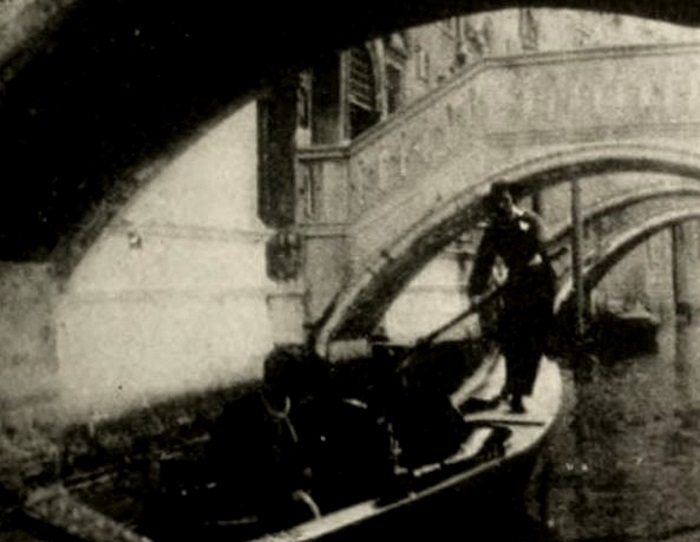
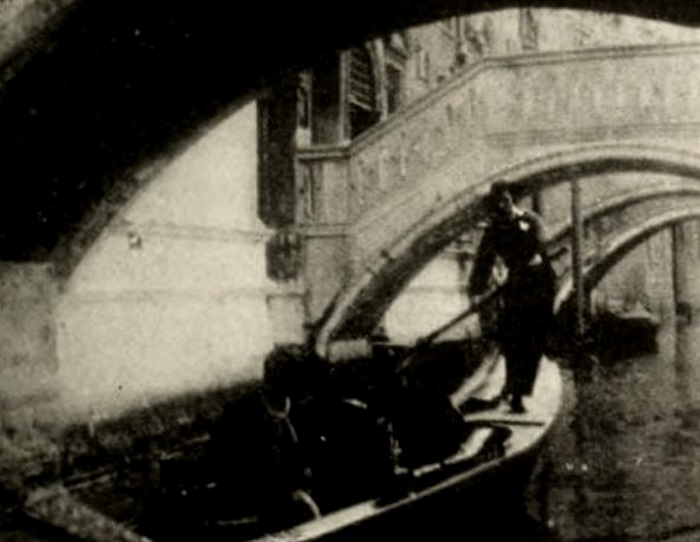
The film’s denouement is a masterclass in poignant understatement. As the bridal party prepares to depart in a gondola, the Young Stranger observes, his heart heavy with the dawning realization of his folly. The Bride, no longer veiled by his romantic projections, makes unmistakable room for her true love, the Officer. The Bridegroom, oblivious in his drunken stupor, remains a tragicomic figure, a foil for the Stranger's now-shattered illusions. The Stranger, holding the withered rose – once a symbol of hope, now a relic of delusion – presses it to his lips one last time before scattering its petals upon the indifferent waters of the Grand Canal as the gondola glides beneath his vantage point. This final gesture is not one of bitterness, but of profound, melancholic acceptance, a silent elegy to a love that never truly existed outside the confines of his own fervent imagination. It is a moment reminiscent of the crushing reality faced by characters in dramas like Fedora, where grand romantic visions often unravel in the face of insurmountable truths.
A Venetian Night stands as a remarkable achievement in early silent cinema, particularly for its audacious embrace of psychological realism within a fantastical framework. Karl Vollmöller's screenplay is a testament to the power of narrative innovation, crafting a story that is both deeply personal and universally resonant. The film's direction, while uncredited in some records, exhibits a sophisticated understanding of visual storytelling, using the evocative setting of Venice not merely as a backdrop, but as an active participant in the unfolding drama. The narrow canals, the shadowy bridges, the opulent hotels – all contribute to an atmosphere that oscillates between romantic enchantment and claustrophobic dread.
The performances, particularly from the central figures, are imbued with a silent eloquence that transcends the lack of spoken dialogue. The Young Stranger's journey from wide-eyed idealist to disillusioned observer is conveyed with a nuanced vulnerability, while the Bride's internal conflict – her sorrow, her fear, her secret love – is communicated through subtle expressions and gestures that speak volumes. Pitrello, as the enigmatic, almost supernatural antagonist of the dream, embodies the darker, more predatory aspects of the human psyche, a harbinger of the Stranger's subconscious fears. His role, shifting from a mundane hotel tout to a malevolent dream architect, showcases a fascinating duality that adds considerable depth to the film's thematic exploration of illusion versus reality. This complex portrayal of characters and their internal struggles sets it apart, much like the compelling character arcs found in It Is Never Too Late to Mend, though with a distinctively dreamlike quality.
What truly elevates A Venetian Night is its pioneering use of the dream sequence as a narrative device, not just for spectacle, but for profound psychological exploration. Predating the more overt surrealist movements, this film delves into the subconscious mind with a boldness that was ahead of its time. The dream is not merely a diversion; it is the crucible in which the Young Stranger's romantic illusions are tested, stretched, and ultimately, broken. It is a space where his repressed anxieties and desires manifest in grotesque, exaggerated forms, where his innocent infatuation transforms into a harrowing ordeal of murder, pursuit, and resurrection. This innovative approach to storytelling, where internal reality dictates external narrative, offers a fascinating parallel to the internal journeys depicted in films such as Cinderella, where dreams and wishes significantly shape the protagonist's fate, albeit in a far more whimsical manner.
The film also offers a compelling commentary on the nature of perception and the seductive power of self-delusion. The Young Stranger's entire Venetian experience is filtered through the lens of his romantic ideals, leading him to misinterpret every signal, every gesture. His dream, a direct consequence of his waking fantasies, becomes a heightened, distorted reflection of his desires and fears, a world where he is both hero and victim. The stark contrast between this vivid internal world and the mundane, often cruel, external reality is the film's most enduring message. It reminds us how easily we can construct elaborate narratives in our minds, only to have them crumble when confronted with the unvarnished truth. This theme resonates strongly with the disillusionment portrayed in films like War Is Hell, where grand illusions are brutally shattered by harsh realities, though in a vastly different context.
In conclusion, A Venetian Night is far more than a historical artifact; it is a vibrant, daring piece of cinema that continues to captivate and provoke thought. Its blend of romantic drama, psychological thriller, and surrealist fantasy creates a unique viewing experience that challenges the audience to question the boundaries between reality and illusion. The film's ambitious narrative, its compelling characterizations, and its groundbreaking dream sequence cement its place as a significant work in the pantheon of silent film. For enthusiasts of classic cinema, or indeed anyone interested in the foundational explorations of the human psyche on screen, this Venetian journey is an absolute essential, a profound meditation on the intoxicating, yet often heartbreaking, power of dreams and the inevitable dawn of reality. Its enduring legacy lies in its ability to transport us not just to a bygone Venice, but into the very heart of human longing and disillusionment, much like the timeless tales of desire and consequence found in A Sister to Carmen, but with a uniquely introspective gaze.
IMDb —
1927
Community
Log in to comment.