DbcultAccessing Vault...
Cult Review
Senior Film Conservator
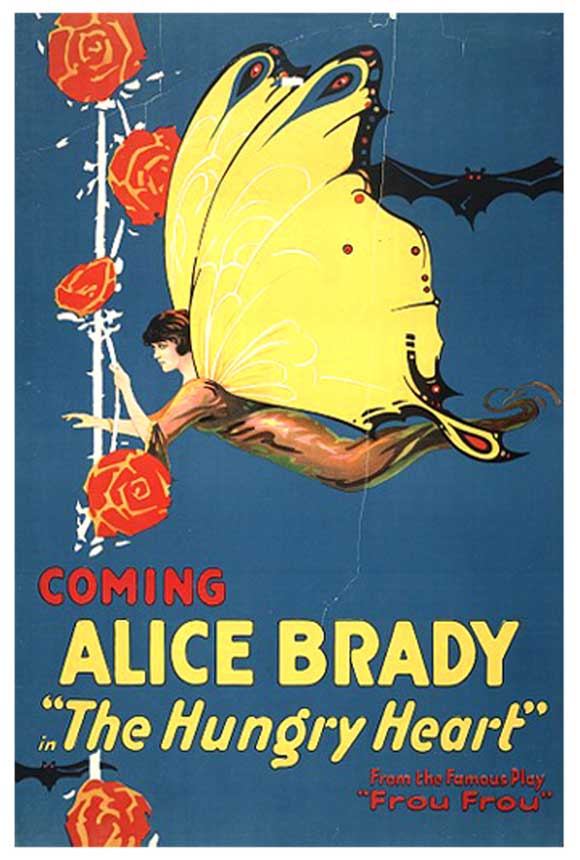
In the 1917 cinematic tapestry A Hungry Heart, the character of Gilberte—famously known as Frou Frou—serves as a devastating personification of the friction between individual vitality and the stultifying expectations of Edwardian domesticity. Alice Brady delivers a performance that transcends the pantomime often associated with the silent era, capturing the frantic, almost breathless quality of a woman who realizes her life is being lived by proxy. The nickname 'Frou Frou' is not merely an endearment; it is a sonic representation of rustling silk, a superficial sound that suggests a lack of substance, a label that Gilberte both inhabits and eventually detests. Unlike the protagonists in The Soul Market, who navigate the commodification of their beauty with a certain savvy, Gilberte is a victim of her own perceived lightness.
The narrative engine of A Hungry Heart is fueled by a tragic transposition of roles. Louise, portrayed with a hauntingly restrained sorrow, is the 'sensible' sister, the one whose internal landscape is a graveyard of unrequited longing for Henry de Sartorys. When Henry chooses the vivacious Gilberte, the film sets the stage for a domestic tragedy that mirrors the psychological depth found in The Sphinx. The five-year jump in the narrative reveals a household where the 'correct' order has been surreptitiously restored through emotional usurpation. Gilberte, though the wife and mother, finds herself an ornamental guest in a home managed by Louise and inhabited by a husband who treats her as a charming child rather than an intellectual or emotional partner. This displacement is visceral; we see it in the way Georgie, the son, gravitates toward the stability of Louise, leaving Gilberte to wither in the periphery of her own existence.
When the Count Paul de Valreas re-enters the frame, he represents more than just a romantic alternative; he is a return to the 'gaiety' of Gilberte’s youth. The transition to Venice is handled with a melancholic visual flair. Venice, a city of sinking palaces and stagnant water, serves as the perfect objective correlative for Gilberte’s moral and social decline. The duel between De Sartorys and Paul is a sharp, violent intrusion of masculine honor codes into a narrative that has, until then, been defined by feminine interiority. Much like the themes of retribution explored in The Folly of Revenge, the duel solves nothing; it merely punctuates a tragedy that was already written in the quiet moments of domestic neglect. Paul’s death is the final severance of Gilberte’s connection to the world of light and laughter, leaving her in a purgatory of guilt and physical decay.
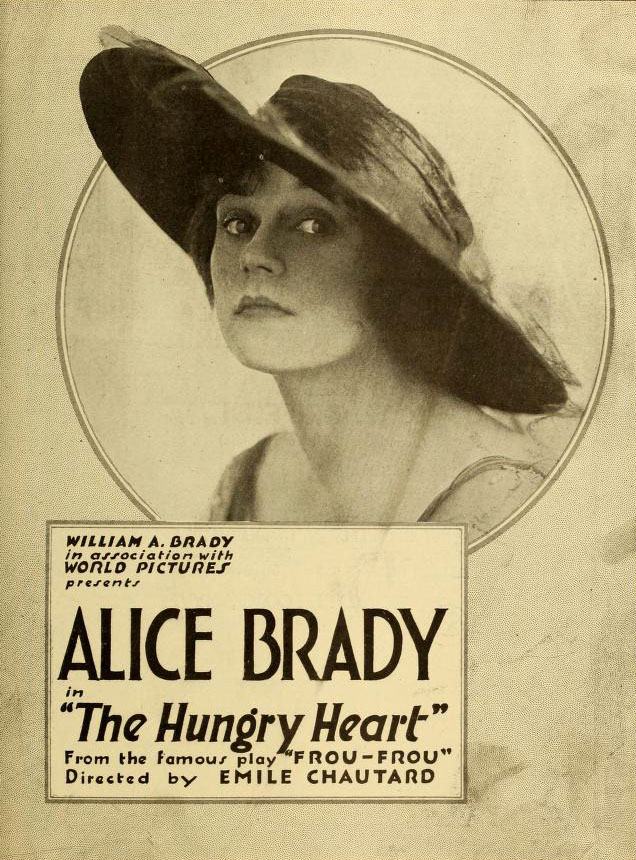
The final act of A Hungry Heart is a masterclass in the 'deathbed reconciliation' trope, yet it avoids the saccharine pitfalls of its contemporaries. Gilberte’s return to her husband’s home is not an act of triumph but one of total surrender. She is 'chastened,' a word that carries the heavy weight of social and religious judgment. The cinematography here shifts, focusing on the starkness of her features, stripped of the 'Frou Frou' artifice. Her plea to die in the house she entered as a bride is a desperate attempt to reclaim the only narrative arc society deems valid for her: that of the repentant wife. This sequence resonates with the same emotional gravity found in As Ye Repent, where the soul's journey toward forgiveness is paved with the wreckage of past indiscretions.
When examining A Hungry Heart alongside The Whirl of Life, one can see a recurring fascination with the dizzying pace of modern existence and its toll on the human spirit. While The Upstart might focus on social mobility, A Hungry Heart is preoccupied with the terrifying inertia of social roles. Gilberte cannot move upward or outward; she can only spin in place until she collapses. The film also shares a thematic DNA with The Devil, particularly in its depiction of how external temptations prey upon internal voids. Gilberte’s 'hungry heart' is not seeking sin; it is seeking substance in a world that only offered her silk.
The screenplay by Frances Marion, based on the work of Meilhac and Halévy, is remarkably sophisticated for 1917. Marion understands that the true villain is not the husband, the sister, or the lover, but the rigid societal structure that forbids a woman from being both vivacious and responsible. The dialogue—conveyed through intertitles—avoids the overwrought sentimentality of Destiny's Toy, opting instead for a sharper, more vitriolic edge during the confrontation between Gilberte and Louise. This 'furious tirade' is perhaps the most honest moment in the film, a rare instance where the 'butterfly' reveals the steel beneath her wings, even if that steel is used only to sever her own ties to respectability.
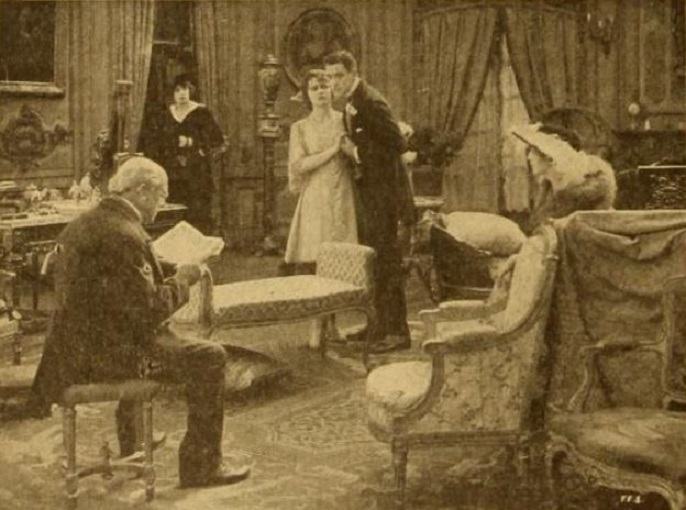
Visually, the film utilizes light and shadow to demarcate the two worlds Gilberte inhabits. The Brigard household is often bathed in a soft, diffused glow, suggesting a dreamlike irresponsibility, while the Sartorys estate is defined by hard lines and deep shadows, emphasizing its role as a domestic prison. Alice Brady’s transition from the 'light-hearted and care-free' girl to the woman pleading on her knees is a harrowing transformation. It lacks the brute physicality of The Bruiser, but it possesses a psychological violence that is far more enduring. Her chemistry with George MacQuarrie (De Sartorys) is intentionally chilly, highlighting the lack of emotional oxygen in their marriage, whereas her scenes with Edward Langford (Paul) crackle with a dangerous, kinetic energy.
In the pantheon of early silent drama, A Hungry Heart stands as a poignant reminder of the fragility of the human ego when placed under the microscope of public expectation. It is a film that refuses to offer a truly 'happy' ending, acknowledging instead that some ruptures are too deep to be fully healed. The final image of Gilberte bequeathing her husband and son to Louise is a devastating admission of her own perceived obsolescence. It is a sacrifice that feels both noble and utterly tragic, a final act of a woman who spent her life trying to find a place where her heart could finally be full, only to find that the only place left for her was a memory. For those who appreciate the nuanced exploration of the female psyche, this film remains as vital and heartbreaking as it was over a century ago, standing alongside works like Memoria dell'altro in its haunting depiction of love and loss.

IMDb —
1931
Community
Log in to comment.