DbcultAccessing Vault...
6.3/10
Senior Film Conservator
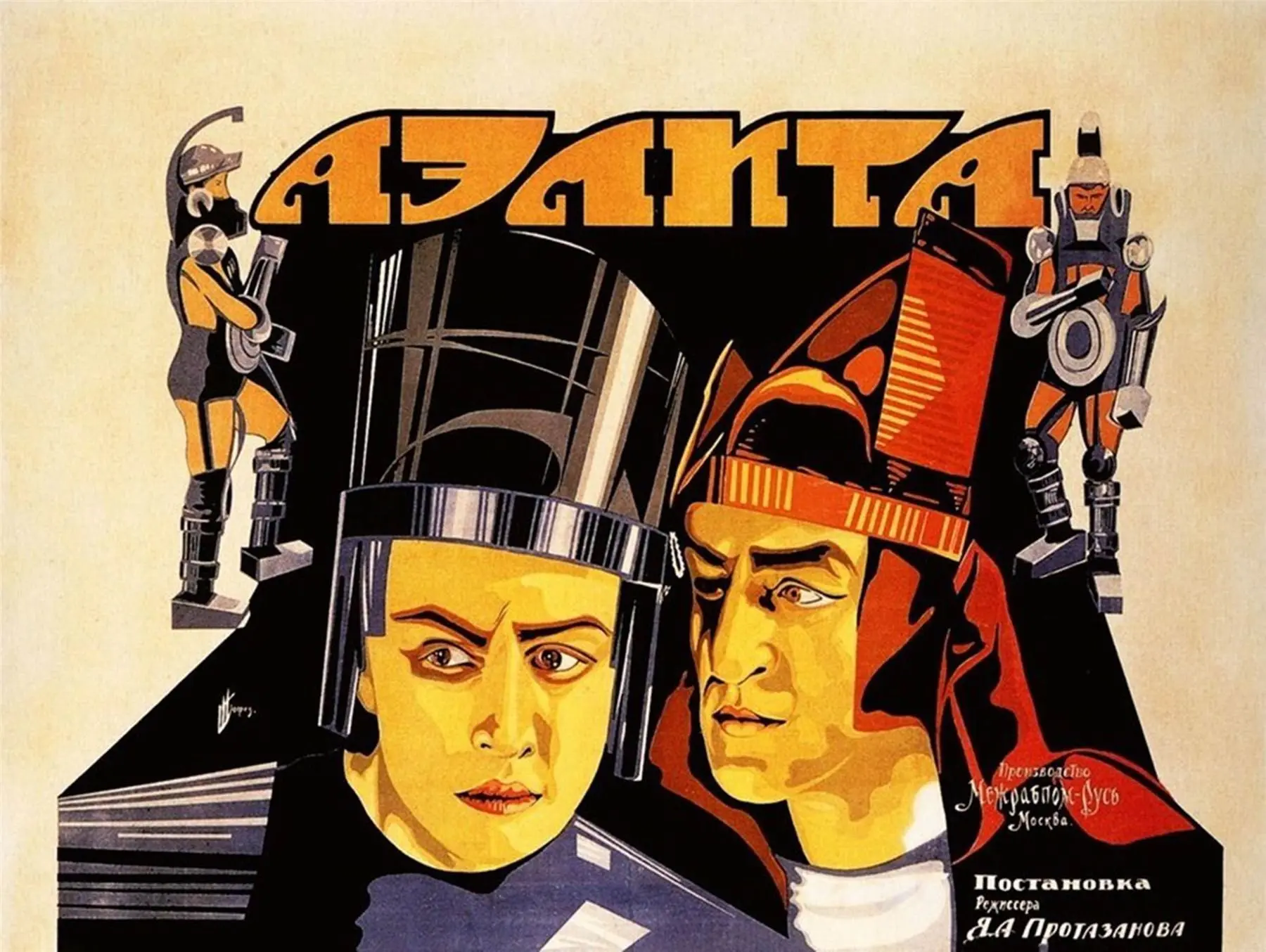
A definitive 6.3/10 rating for a film that redefined the boundaries of cult cinema. Aelita, the Queen of Mars remains a cornerstone of transgressive art.
Yakov Protazanov’s 1924 opus, Aelita, the Queen of Mars, stands as a monolith of early cinematic ambition, a work that refuses to be neatly categorized. It is a bifurcated masterpiece, split between the crushing, dusty realism of post-Civil War Russia and the jagged, avant-garde abstraction of a Martian kingdom. To watch Aelita today is to witness the birth of the science fiction epic, a precursor to Lang’s Metropolis and a fascinating artifact of the Soviet New Economic Policy (NEP) era. The film does not merely depict a voyage to another planet; it explores the psychological fragmentation of a society attempting to reconcile its utopian aspirations with the grim reality of scarcity and human frailty.
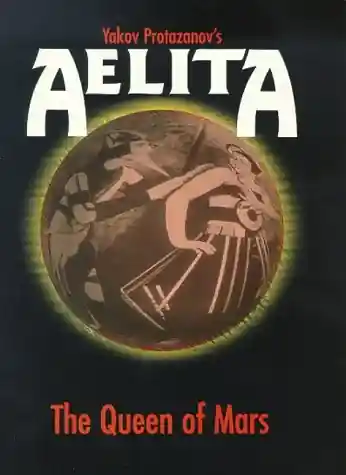
The narrative centers on Los, played with a simmering, neurotic intensity by Nikolai Tsereteli. Los is an engineer who embodies the restless intellect of the new Soviet man, yet he is haunted by jealousy and a sense of displacement. His obsession with Mars is not just scientific; it is an escape from a domestic life that feels increasingly alien. This thematic depth elevates the film beyond mere pulp adventure. While films like The Primrose Ring dealt with the whimsy of childhood and social duty, Aelita plunges into the adult psyche’s capacity for delusion. Los’s journey is fueled by a cryptic message that may or may not be a signal from another world, a plot device that mirrors our own modern obsession with the 'unidentified' and the 'other.'

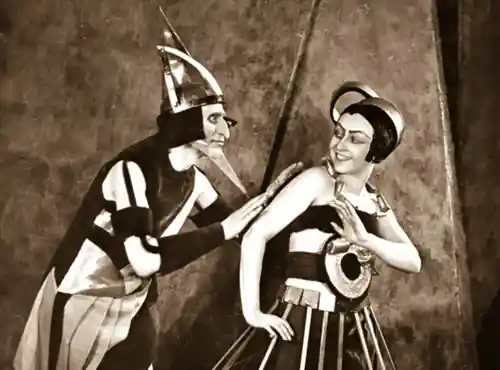
The true star of the film, beyond the eponymous Queen (portrayed by the luminous Yuliya Solntseva), is the production design. The Martian sequences are a triumph of Constructivism, featuring sets by Isaac Rabinovitch and Victor Simov and costumes by the legendary Alexandra Exter. These aren't just backgrounds; they are architectural manifestations of power and alienation. The sharp angles, translucent materials, and geometric headpieces create a visual language that feels startlingly modern even a century later. This aesthetic choice serves to dehumanize the Martian elite, contrasting their rigid, crystalline world with the chaotic, organic textures of Moscow.
When we compare this to the theatricality of Der Tänzer, we see Protazanov pushing cinema into a realm of pure visual metaphor. The way Aelita watches Earth through her telescope is a voyeuristic inversion of the cinema-going experience itself. She is the ultimate spectator, falling in love with a shadow on a screen, much like the audiences of 1924 fell in love with the flickering images of Hollywood stars. This meta-textual layer adds a sophistication that was often lacking in contemporary dramas like Love's Redemption, which relied on more traditional romantic tropes.
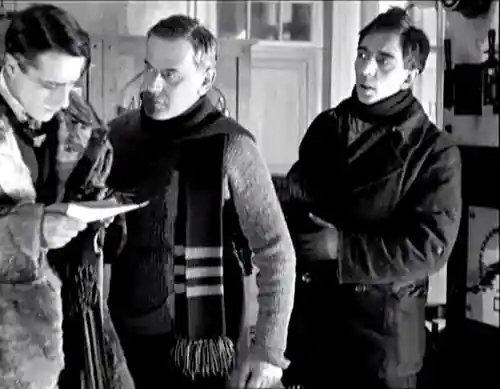
The film’s middle act, involving the arrival of Los and the Red Army soldier Gusev on Mars, serves as a fascinating piece of propaganda—or perhaps a critique thereof. Gusev, played by Nikolay Batalov, brings a boisterous, earthy energy to the proceedings. He represents the exported revolution, the idea that the Bolshevik fire must spread even to the stars. The scenes of the Martian workers rising against the Elders are staged with a grandiosity that anticipates the great Soviet montage films of the late 1920s. However, there is an underlying cynicism here. The revolution on Mars is sparked as much by Gusev’s boredom and Los’s romantic obsession as it is by genuine ideological fervor.
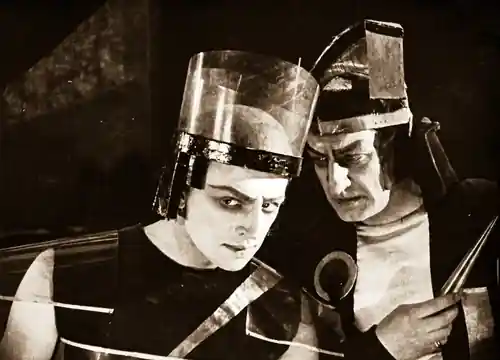
This ambiguity is what makes Aelita so compelling. It captures the tension of the NEP period, where the radicalism of the revolution was being tempered by a return to certain capitalist structures and social norms. The domestic scenes in Moscow, featuring the detective Kravtsov (Igor Ilyinsky), provide a satirical counterpoint to the cosmic drama. Kravtsov is a proto-noir figure, but played for laughs, a man looking for mysteries where there are none, while the greatest mystery of all—human nature—remains unsolved. This blend of genres—sci-fi, romance, satire, and propaganda—is handled with a dexterity that makes contemporary attempts at 'genre-bending' look amateurish. It shares a certain thematic restlessness with Hoppla, Herr Lehrer, though Protazanov’s canvas is infinitely larger.
As the film reaches its climax, the boundaries between the Martian revolution and Los’s internal state begin to dissolve. The revelation that much of the Martian odyssey may be a projection of Los’s guilt-ridden mind is a masterstroke of psychological cinema. It transforms the film from a space opera into a study of trauma and escapism. This narrative rug-pull is far more sophisticated than the straightforward moralizing found in Forbandelsen or the simplistic heroics of Almost Heroes. Protazanov suggests that the 'final frontier' is not space, but the human conscience.
The acting throughout is exemplary of the era’s transition from pantomime to psychological realism. Solntseva’s Aelita is a figure of tragic curiosity, her movements stiff and regal, yet her eyes betraying a profound loneliness. Batalov’s Gusev provides the necessary grounding, a reminder of the physical world that Los is so desperate to leave behind. Even the minor roles, such as the Elders, are performed with a grotesque physicality that enhances the film’s dreamlike quality. The film’s pacing, though occasionally languid by modern standards, builds a sense of mounting pressure that mirrors the boiling point of a society on the edge of transformation.
When placed alongside other silent era films, Aelita feels uniquely global yet intensely Russian. While The Indian Wars attempted to document a vanishing frontier with a sense of historical duty, Aelita creates a frontier out of thin air and geometry. It lacks the pastoral simplicity of Colombine, opting instead for a confrontation with the industrial future. Even compared to the gritty crime narratives like Railroaded, the stakes in Aelita feel more profound because they encompass the entire human experience—from the breakfast table to the galactic throne.
The film’s legacy is undeniable. One can see its fingerprints on everything from Flash Gordon to Star Wars, yet none of its successors quite capture the same blend of ideological weight and avant-garde daring. It is a film that demands multiple viewings to fully grasp its layers of meaning. Is it a cautionary tale about the dangers of escapism? A celebration of the revolutionary spirit? Or a tragic romance about two people separated by the ultimate distance? The answer is all of the above. Like the cryptic signal 'Anta Odeli Uta,' the film remains an enigma, beckoning us to look closer at the screen and ourselves.
In the pantheon of silent cinema, Aelita, the Queen of Mars remains an essential viewing experience. It is a testament to what cinema can achieve when it is not afraid to be difficult, weird, and overtly political. While some might find the Moscow subplots distracting, they are crucial for grounding the Martian fantasy in a recognizable human reality. The film reminds us that even when we reach for the stars, we carry our terrestrial baggage with us. For those who enjoyed the dark romanticism of Drama na okhote or the social critiques of Piccadilly Jim, Aelita offers a cosmic expansion of those themes that is as visually stunning as it is intellectually stimulating. It is a bold, beautiful, and bizarre journey that everyone should take at least once.

IMDb 4.6
1934
Community
Log in to comment.