DbcultAccessing Vault...
5.5/10
Senior Film Conservator
A definitive 5.5/10 rating for a film that redefined the boundaries of cult cinema. Alice's Monkey Business remains a cornerstone of transgressive art.
Is Alice's Monkey Business worth watching today? Short answer: Only if you are a dedicated student of animation history or a Disney completist. For the average viewer seeking narrative depth, this 1926 short will feel like a fragmented fever dream, but for those interested in the technical evolution of the medium, it is a fascinating relic of primitive experimentation. This film is for those who enjoy the 'rubber hose' animation style and the historical curiosity of the silent era; it is NOT for anyone expecting a cohesive story or modern pacing.
Before we dive into the technical weeds, let's establish the baseline for this production. This film works because the visual inventiveness of Julius the Cat’s anatomy provides a level of surrealism that live-action of the era couldn't touch. This film fails because the live-action integration of Margie Gay feels increasingly secondary to the cartoon antics, leaving the 'Alice' character as little more than a bystander in her own series. You should watch it if you want to see the literal DNA of Mickey Mouse being formed through the character of Julius.
If you are looking for entertainment that resonates with modern sensibilities, the answer is a firm no. However, if you are looking to understand how Walt Disney and Ub Iwerks mastered the art of the visual gag, then it is an essential text. The film is a bridge between the crude drawings of the early 1920s and the sophisticated character work seen later in Harem Scarem. It exists in a vacuum of 1920s colonial tropes, which makes it a difficult watch for some, but a necessary one for those tracking the cultural history of American cinema.
The plot of Alice's Monkey Business is a loose framework designed to facilitate a series of increasingly bizarre sight gags. Alice and Julius are 'big game hunting,' a theme common in the 1920s, as seen in other works like Roaring Lions on the Midnight Express. The logic of the world is purely elastic. When Julius needs a weapon, his tail becomes a gun. When they need to escape, the environment itself bends to their will. This isn't storytelling in the traditional sense; it is a showcase of what the pen can do that the camera cannot.
One specific scene stands out: the moment they are brought before the Lion King. The court isn't a place of majesty, but a place of chaotic, rhythmic movement. The lions move with a synchronized, jittery energy that predates the more fluid movements found in An Elephant's Nightmare. It is a masterclass in 'squash and stretch' before the term was even formalized. The way the Lion King’s jaw unhinges to deliver a roar is both terrifying and hilarious in its exaggeration.
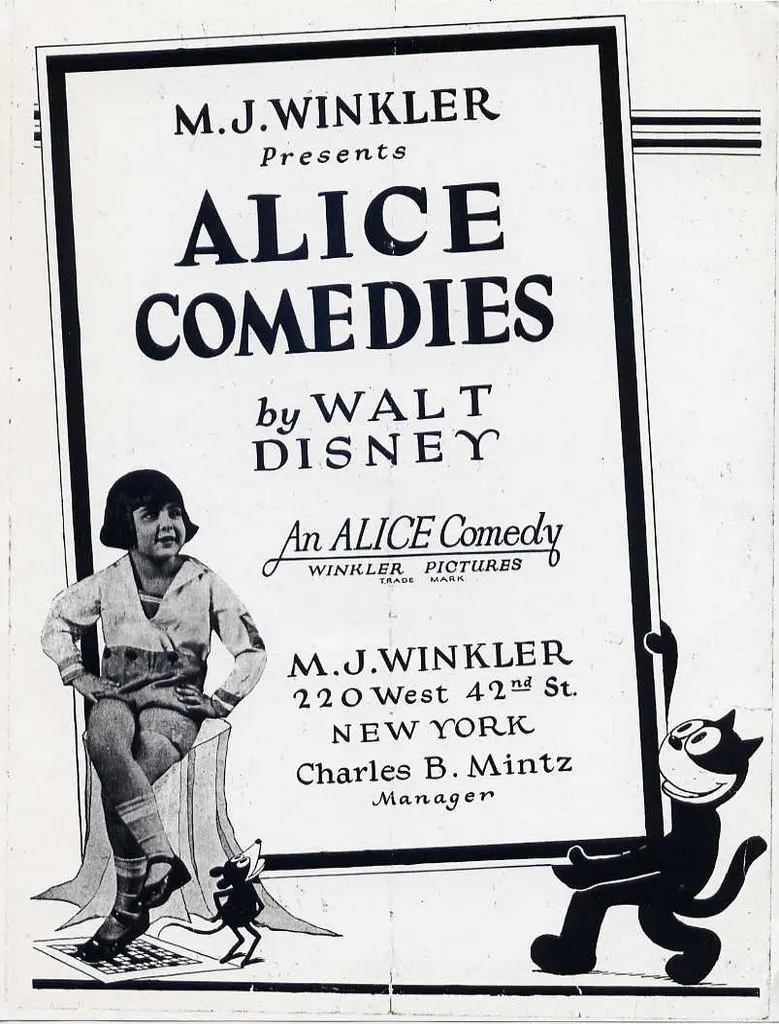
By 1926, the Alice Comedies were struggling with a central identity crisis. Margie Gay, who replaced Virginia Davis, is a fine child actress, but the animators were clearly more interested in Julius. Julius was Disney's answer to Felix the Cat, and in this short, he carries the entire emotional weight. He is cynical, resourceful, and slightly violent. It works. But it’s flawed. The live-action Alice often looks like she is standing in a different movie entirely, a technical hurdle that wouldn't be fully cleared for decades.
The interaction between Julius and the monkeys is the highlight of the film. The monkeys function as a singular, buzzing hive-mind of mischief. There is a specific gag involving a monkey using a coconut as a projectile that is timed with such precision it rivals the work of Buster Keaton. It is this dedication to timing that makes the film watchable. Without the rhythm, it would just be a series of drawings. With it, it becomes a dance.
The cinematography, if you can call it that in a hybrid film, is static. The camera rarely moves, acting as a proscenium arch for the action. This was standard for the time, as seen in The Cabaret or Prohibition. However, the 'ink and paint' work here is remarkably clean. The blacks are deep, and the contrast between the live-action footage and the animation is surprisingly sharp for a film nearly a century old.
The pacing is relentless. Silent shorts had to move quickly to keep the audience's attention without the benefit of synchronized sound or dialogue. Every three seconds, there is a new visual stimulus. It’s exhausting. It’s also brilliant. The film doesn't give you time to think about the thinness of the plot because it’s already moved on to the next absurdity. It lacks the dramatic weight of something like Confessions of a Queen, but it makes up for it in pure, unadulterated energy.
Pros:
The animation by Ub Iwerks is top-tier for 1926. The gags are genuinely inventive, particularly the court scene. It serves as a vital historical document of the pre-Mickey era. The technical restoration of surviving prints allows the line work to shine.
Cons:
The 'big game hunting' theme hasn't aged well. Margie Gay is underutilized and often looks confused by the empty space she's acting against. The film lacks a satisfying resolution, ending abruptly as many shorts of the era did.
When you compare Alice's Monkey Business to other films of the period, like The Man from Glengarry or Three X Gordon, you see a stark contrast in intent. While those films were aiming for melodrama or traditional narrative, Disney was aiming for the impossible. He wanted to break the rules of reality. This short is a successful, if messy, attempt at that rebellion. It shares a certain chaotic spirit with You're Pinched, but with the added layer of hand-drawn imagination.
Alice's Monkey Business is a fascinating, flawed, and frantic piece of cinema history. It isn't a 'masterpiece' in the sense that it provides a profound emotional experience, but it is a masterclass in early 20th-century visual problem-solving. The film is a loud, silent shout from a young Walt Disney, proving that he could blend two disparate worlds into one cohesive—if insane—vision. Watch it for Julius. Watch it for the lions. But don't expect it to make a lick of sense. It is a fever dream captured on cellulose, and in the landscape of 1926, that was more than enough.
IMDb 6.8
1931
Community
Log in to comment.