DbcultAccessing Vault...
Cult Review
Senior Film Conservator
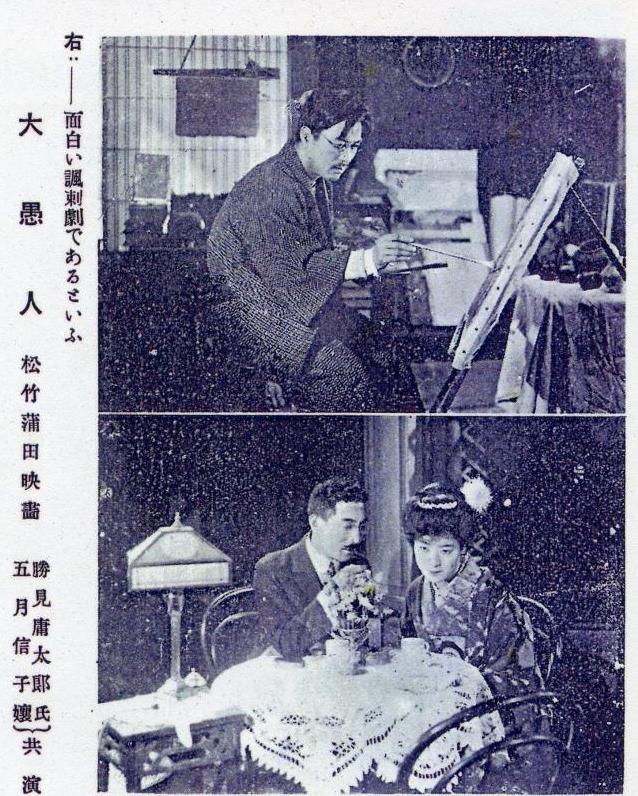
To watch 1923’s Daigujin is to witness the very marrow of Japanese silent cinema being extracted and offered up to the gods of celluloid. Directed by the polymathic Yôtarô Katsumi, who also contributed to the script alongside Mokushô Katsumi, this film is not merely a historical artifact; it is a visceral exploration of the tensions that defined an empire in flux. While many Western audiences might be more familiar with the sprawling epics like Potop, Daigujin operates on a much more intimate, yet equally profound, spiritual scale. It is a film where the silence is not an absence of sound, but a heavy, deliberate presence that speaks of duty, divinity, and the crushing weight of the past.
The visual language of Daigujin is one of architectural dominance. The shrine is not just a setting; it is a character that demands obeisance. Katsumi utilizes the camera to frame Sôtarô Okada against the towering torii gates and the intricate woodwork of the inner sanctum, making him appear both monumental and infinitesimally small. This juxtaposition is key to understanding the film’s central conflict: the man vs. the office. Unlike the more overt social critiques found in Who's to Blame?, Daigujin’s subversion is quiet, hidden in the flickering shadows of the oil lamps and the stiff, ceremonial movements of its protagonists.
"Okada’s performance transcends the histrionics of the era, offering a masterclass in internalised agony that feels startlingly modern."
The ensemble cast, including the luminous Chitose Hayashi and the formidable Nobuko Satsuki, provides a counterpoint to Okada’s stoicism. Where he represents the unmoving stone of tradition, they represent the flowing water of human emotion. This dynamic creates a friction that rivals the domestic intensity of The Big Sister. However, while that film deals with the tangible bonds of family, Daigujin elevates these struggles to a metaphysical plane. When Satsuki’s character confronts the High Priest, it is not just a daughter questioning a father; it is the future interrogating the past.
Technologically, 1923 was a year of immense transition for the Japanese industry, and Daigujin reflects a sophisticated understanding of the medium’s evolving grammar. The editing rhythm is surprisingly agile, moving from wide, contemplative shots of the shrine grounds to tight, suffocating close-ups that capture the micro-expressions of the cast. It lacks the frantic energy of Petticoats and Pants, opting instead for a somber grace that feels almost liturgical. The cinematography treats light as a sacred element, using it to halo the virtuous and cast the conflicted into deep, obsidian voids.
The screenplay, a collaborative effort between the Katsumi brothers, avoids the easy tropes of the 'shingeki' (new drama) movement while still embracing its emotional honesty. There is a narrative density here that reminds one of the complex character studies in Leon Drey, though transposed into a cultural context where individual desire is often subsumed by communal obligation. The film explores the concept of 'giri' (burden of duty) with a surgical precision that leaves the viewer both enlightened and devastated.
While Daigujin is quintessentially Japanese, its themes of spiritual alienation resonate with international works of the same period. It shares a certain thematic DNA with Der Thug. Im Dienste der Todesgöttin in its fascination with the darker, more obsessive side of religious devotion. Yet, where the German film leans into the macabre, Katsumi maintains a dignified restraint. Similarly, the exploration of innocence lost in Daigujin can be compared to the pathos of Little Eva Ascends, though the former trades sentimentality for a stark, uncompromising realism.
Sôtarô Okada’s portrayal of the High Priest is perhaps the film’s greatest achievement. He moves with a deliberate, heavy gait that suggests the weight of the gods is literally resting upon his shoulders. His face is a mask of stoic endurance, yet his eyes betray a flickering humanity that is both beautiful and tragic. This is a performance that rivals the emotional depth of the leads in Hearts of Men, though filtered through a vastly different cultural lens. In Daigujin, the heart is not worn on the sleeve; it is buried beneath layers of silk and centuries of tradition.
The supporting cast, particularly Naminosuke Horikawa and Yôtarô Katsumi himself, flesh out a world that feels lived-in and precarious. The interactions between the priests and the laity reveal the cracks in the social facade, suggesting that the 'Great Shrine' is not just a place of worship, but a fortress under siege. This sense of social fragility is also present in I figli di nessuno, where the breakdown of traditional structures leads to personal ruin. In Daigujin, the ruin is more subtle, manifesting as a slow erosion of the soul.
One cannot discuss Daigujin without acknowledging its technical merits. The use of natural light in the outdoor sequences creates an ethereal atmosphere that contrasts sharply with the claustrophobic, candle-lit interiors. This mastery of light and shadow places the film in the same league as the visual storytelling found in A Romance of Happy Valley, though Katsumi’s world is far less idyllic. There is a grit to the beauty here, a sense that the divine is inextricably linked to the dust and decay of the physical world.
The film also experiments with symbolic imagery—the recurring motif of the flowing river, the falling leaves, and the unblinking eyes of the shrine’s guardian statues. These elements serve as a visual shorthand for the transient nature of existence, a core tenet of the film’s philosophy. It is a much more sophisticated use of symbolism than the somewhat didactic approach seen in Johnny Ring and the Captain's Sword or the straightforward morality of Angel of Crooked Street.
As the film reaches its crescendo, the personal and the political converge in a finale that is as visually stunning as it is emotionally draining. The High Priest’s ultimate choice is not a victory, but a surrender—a recognition that some things are too vast to be controlled by a single man, no matter how holy. This nuanced ending sets Daigujin apart from the more conventional resolutions of films like The Square Deceiver or the melodramatic heights of The Sunny South or The Whirlwind of Fate. It is an ending that lingers, prompting the viewer to reflect on their own place within the grand cycles of history and faith.
Even when compared to exotic narratives like A Maori Maid's Love, Daigujin stands out for its profound cultural specificity and its ability to translate that specificity into a universal human experience. It is a testament to the power of the Katsumi brothers' vision and the extraordinary talent of the early Japanese film pioneers. To ignore this film is to ignore a vital chapter in the history of world cinema. It is a haunting, beautiful, and deeply moving work that deserves to be celebrated, restored, and discussed with the same fervor as the great masterpieces of the silent era.
Ultimately, Daigujin is a film about the courage it takes to remain standing when the world you know is crumbling. It is a cinematic prayer, a mournful song for a lost time, and a brilliant display of artistic integrity. In the dark of the theater, the spirit of the Great Priest still flickers, reminding us that even in the silence, there is a story that needs to be told.

IMDb —
1918
Community
Log in to comment.