DbcultAccessing Vault...
Cult Review
Senior Film Conservator
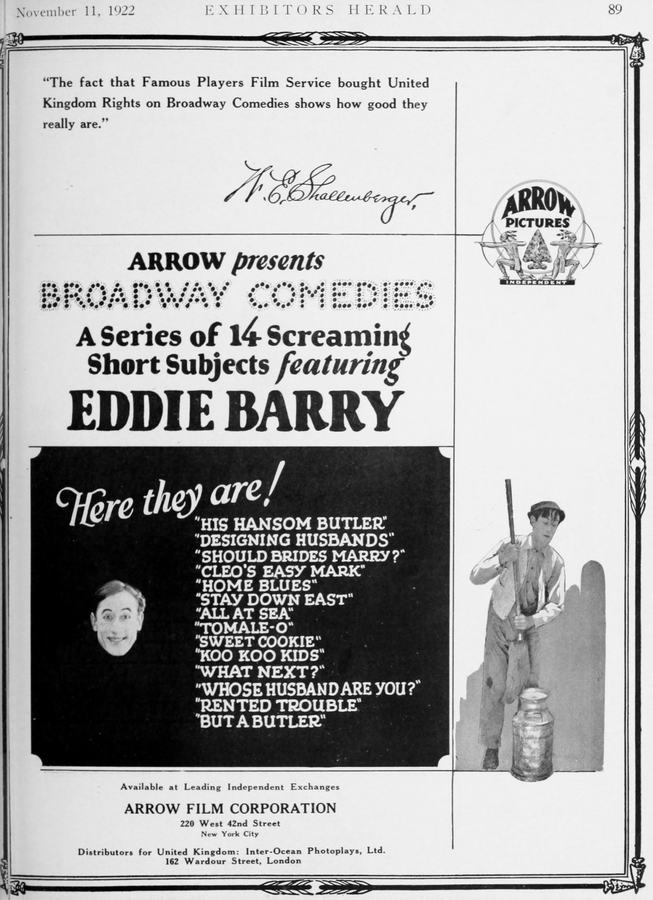
There is a moment—halfway through this effervescent one-reeler—when the camera tilts with the roll of the ship and the iris circle closes on Eddie Barry’s eyes, two panicked moons reflected in a silver platter. In that blink you sense the whole film’s wager: identity is as flimsy as a waiter’s dickey, love as volatile as uncorked moonshine, and the ocean itself a grand leveller of wallets and waistcoats.
Shot in the wake of post-WWI euphoria, All at Sea pirouettes on the deck of the Victorian melodrama and kicks its corsets overboard. Paramount’s modest unit borrowed a liner berthed in Long Beach, rigged mahogany corridors with klieg lights, and let cinematographer Fred W. Jackman chase shadows that slant like cutlasses. The result feels, even a century later, as fizzy as champagne smuggled in a tin of flour.
The premise is feather-light yet, under that fluff, hides a shiv of social commentary. Vera Reynolds—played by the eponymous starlet whose eyes could sell you both the Brooklyn Bridge and the tollbooth—embodies disposable wealth. Her father, a railroad baron chewing cigars like celery, dispatches her on a cruise to forget a suitor “beneath her station.” Enter Eddie Barry (the rubber-limded vaudevillian whose surname the script happily literalises). He gate-crashes the gangway, pockets empty but pupils blazing, and is promptly catalogued among the human cargo in steerage.
What follows is less a love story than a card trick. Eddie swaps a crate of contraband hooch for a steward’s jacket, then the jacket for a tuxedo culled from a drunken viscount, and finally the tuxedo for Vera’s heart. The transformations occur at whip-crack speed—title cards wink, scenes skid, disguises pile like decks in a magician’s trunk. At 58 minutes the film runs shorter than a modern sitcom double-bill, yet it still finds room for a ballroom brawl, a jewel heist, a roving mariachi quartet and a lifeboat drill turned slapstick ballet.
Vera Reynolds, often dismissed as merely “the girl” in histories, carries whole sequences with the angle of her cloche hat. Watch her slide a bracelet off her wrist—slowly, as if unpeeling an orange—while the thief salivates; the gesture speaks louder than any subtitle. Eddie Barry, meanwhile, channels every ounce of his Music Hall pedigree into physical gags: a single take of him balancing seven soup tureens while tap-dancing to appease seasick dowagers deserves canonisation in the hall of silent-comedy Valhalla.
The supporting rogues’ gallery is painted in primary colours: the jewel thief (credited only as “Lamont”) sports a pencil moustache he could sweep the deck with; Vera’s governess, a harridan in bombazine, hisses every intertitle like a leaky valve. Yet even these cartoons feel placed with purpose—each a cog in the ship’s microcosm of capitalism at play.
Jackman’s camera is restless, stalking through portholes, sliding down banisters, even plunging briefly beneath water (a watertight box rigged by the same engineers who later shot He Who Gets Slapped). The print surviving at UCLA has a cyan cast in night scenes, giving moonlit decks the pallor of refrigerated pewter; by contrast, the first-class salon blazes amber where chandeliers burn like miniature suns. This colour shift, though unintended, fortuitously splits the narrative into temperature zones: cold desperation below, feverish affluence above.
Intertitles—often a liability in silents—here crackle with jazz-age slang: “She’s got ice worth a king’s ransom, but the king’s in hock!” One card dissolves into animated doodles of fishes nibbling diamonds; the next explodes with a hand-drawn champagne cork that ricochets across the frame. These playful asides anticipate the meta-gags of later Tex Avery and remind us that, even in 1920, cinema was winking at its own artifice.
No original cue sheets survive, but contemporary exhibitors were advised to interpolate “Ain’t We Got Fun” for Eddie’s steerage scenes and “I’ll See You in C-U-B-A” whenever rum-runners appear. Modern festivals often commission new scores; the most exhilarating I’ve heard—performed by a three-piece combo of accordion, muted trumpet and spoons—turned the screening into a speakeasy jig. Silence here is not absence but an open invitation, a gap where viewers can pour their own bootleg soundtrack.
Strip away the pratfalls and what remains is a sly treatise on mobility—social, geographical, romantic. The ocean liner is a floating America: ostensibly egalitarian (everyone risks drowning) yet rigidly stratified by deck hierarchy. Eddie’s ascent from coal-scented bilge to starched linen mirrors the country’s Horatio Alger myth, but the film refuses to moralise. His wealth is won not by toil but by bootleg barter; his tuxedo is a lie, yet the film celebrates the masquerade. In the Roaring Twenties, authenticity is for suckers; reinvention is the national pastime.
Gender politics, admittedly, lag: Vera is pawn then prize. Yet her final smile—directly at the camera, breaking the fourth wall—carries complicity. She knows the game is rigged, but she also knows she holds the trump card: desire. The film’s closing long shot frames the lovers against a lifebelt labelled “S.S. Opportune,” a pun that doubles as mission statement.
Place All at Sea beside Hearts United (also 1920) and you see how swiftly the form was mutating. Where Hearts United clings to pastoral innocence, All at Sea smells of diesel and bootleg gin. Its DNA reappears decades later in Some Like It Hot—cross-class drag, gangster pursuit, final embrace on a moving vessel—yet few trace the lineage, perhaps because the earlier film survives only in patchy prints, circulated like samizdat among archivists.
If you crave darker waters, The Devil’s Needle (1916) offers narcotic nightmares; if you want pastoral moon-calf romance, Comin’ Thro’ the Rye suffices. All at Sea occupies the middle buoy—buoyant, effervescent, bobbing between cynicism and swoon.
A 2K restoration premiered at Pordenone 2019, scanned from a 35 mm nitrate positive discovered in a Slovenian monastery (don’t ask how it got there). The new print restores approximately 47 seconds of hitherto-lost subplot involving a stowaway cat who ends up wearing the villain’s monocle. Alas, the film remains commercially unavailable on Blu-ray; your best bet is an occasional DCP tour or the grey-market rip circulating among silent-film forums—grainy, speckled, yet weirdly alive, like watching a ghost through frosted glass.
Because cinema should sometimes feel like breaking into a party you weren’t invited to, discovering you can dance better than the hosts, and leaving with confetti in your hair and someone else’s pearls in your pocket. Because every frame is a reminder that movies are mercury, not marble—shape-shifting, reflective, impossible to pin. Because love, like bootleg liquor, tastes sharpest when swigged illicitly on a rolling deck at midnight, salt stinging your lips, engine throb matching your pulse.
Rating: 8.5/10 – A frothy, furious gem whose wake still ripples through the comedies of disguise we quote without knowing why.
IMDb —
1930
Community
Log in to comment.