DbcultAccessing Vault...
Cult Review
Senior Film Conservator
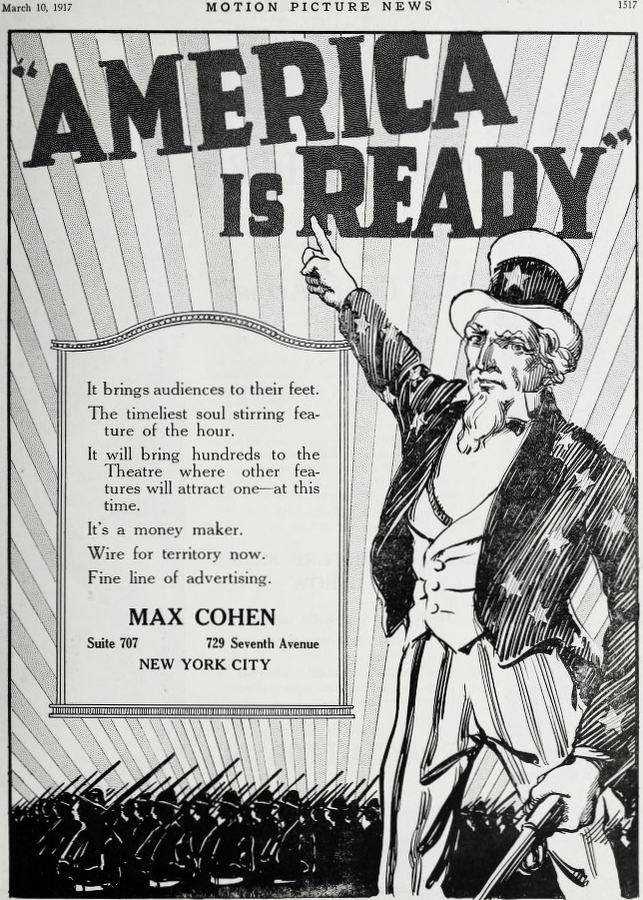
The year 1917 represents a seismic pivot in the global consciousness, a moment where the Victorian ghost finally exhaled its last breath and the cold, hard machinery of the modern age took center stage. Amidst this transition, America Is Ready emerged not as a mere piece of entertainment, but as a psychological weapon, a celluloid blueprint for a nation shedding its neutral skin. To watch it today is to witness the birth of the military-industrial complex as a visual aesthetic, a phenomenon far removed from the sentimental narratives of the era like The Sentimental Lady.
While many films of the late 1910s were obsessed with the morality of the individual—take for instance the ethical quandaries presented in The Cowardly Way—America Is Ready operates on a macroscopic scale. It ignores the singular protagonist in favor of the collective machine. The camera lingers on the churning gears of industry, the sparks flying from molten steel, and the rhythmic percussion of rivets being driven into the hulls of warships. There is a strange, almost eroticized fascination with the tools of destruction, a visual language that predates the avant-garde industrial symphonies of the 1920s.
The pacing of the film is relentless. It lacks the pastoral, often languid tempo found in domestic dramas such as Always in the Way. Instead, the editing mimics the heartbeat of a nation in high gear. Every frame is saturated with the intent of persuasion. The director utilizes the silent medium's unique ability to transcend language through pure iconography: the flag, the bayonet, the smokestack. These are the totems of a new American religion, one where readiness is the ultimate virtue.
To understand the impact of America Is Ready, one must contrast it with the escapist fare of its time. While audiences were often seeking solace in the whimsical antics of Twin Kiddies or the exoticized adventures of The Jungle Child, this film demanded a confrontation with reality. It stripped away the artifice of the stage-play-on-film style that dominated early cinema, opting for a documentary-adjacent realism that felt urgent and, at times, threatening.
Even when compared to European imports like the German production Das Gesetz der Mine, which dealt with the harsh realities of resource extraction and labor, the American film feels uniquely focused on the externalization of power. It isn't interested in the interiority of the worker or the soldier; it is interested in their utility. This is a stark departure from the romanticized heroism seen in The Bugler of Algiers, where war is still framed through a lens of 19th-century chivalry.
Technically, the film is a marvel of its specific constraints. The lighting is often harsh, emphasizing the metallic textures of the artillery and the grit on the faces of the laborers. There is no room for the soft-focus glamour of an Anna Held vehicle. This is cinema as a blunt force instrument. The use of intertitles is sparse but authoritative, acting as declarative statements of fact rather than dialogue for character development. The film’s structure follows a logical progression from raw material to finished weapon, from civilian to soldier, echoing the assembly line logic of the Fordist era.
One cannot ignore the inherent tension in the film’s presentation. While it purports to show a defensive posture, the sheer scale of the mobilization suggests an appetite for intervention. It shares a certain thematic DNA with The Three Black Trumps in its obsession with destiny and the inevitable collision of opposing forces. However, where other films might find tragedy in this collision, America Is Ready finds a grim, industrial glory.
Looking back from a century’s distance, the film serves as a chilling reminder of how effectively the medium of film can be harnessed to shape public opinion. It lacks the nuanced storytelling of The Sparrow or the dark, atmospheric tension of Zatansteins Bande, but it possesses a raw, unadulterated power that those more sophisticated narratives often lack. It is the sound of a giant waking up, recorded on silver nitrate.
The film also highlights the divide between the burgeoning art of cinema and its role as a state tool. In the same year that Love Aflame was exploring the heights of passion, and Gambler's Gold was examining the vices of the modern man, America Is Ready was busy constructing a new national identity. It paved the way for the grand spectacles of the 1920s, yet it remains rooted in a very specific, very desperate moment in time.
In the grand tapestry of 1917 cinema, which included the gravity-defying stunts of De levende ladder and the psychological depth of The Master Passion, this propaganda short stands as a monolith of purpose. It does not ask for your empathy; it demands your participation. It is a haunting, fascinating, and deeply impressive artifact of a world on the brink of a total transformation, proving that even in its infancy, the motion picture was the most potent mirror—and hammer—ever gifted to humanity.
Ultimately, America Is Ready is a testament to the sheer logistical audacity of the early 20th century. It captures a moment where the American spirit was forged in the fire of European catastrophe, and it does so with a visual confidence that belies its age. It is a film that should be studied not just by film historians, but by anyone interested in the mechanics of power and the enduring influence of the moving image on the collective psyche.

IMDb —
1926
Community
Log in to comment.