DbcultAccessing Vault...
5/10
Senior Film Conservator
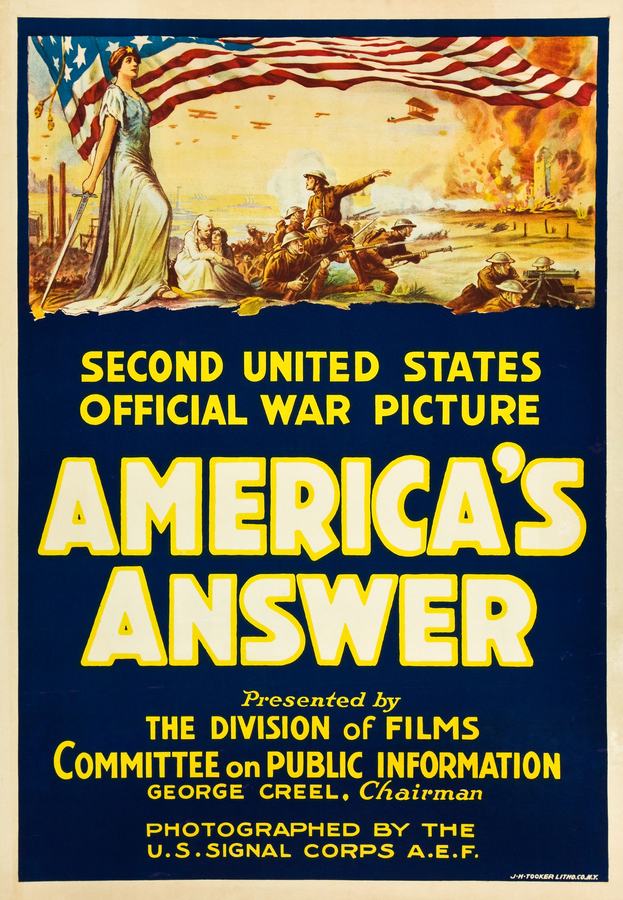
A definitive 5/10 rating for a film that redefined the boundaries of cult cinema. America's Answer remains a cornerstone of transgressive art.
The first thing that strikes you is the dust—ghosts of nitrate flecks swirling like chalk in water, a reminder that America's Answer is literally decomposing before our eyes. Yet within that granular necrosis lies a kinetic urgency no modern 4K restoration could ever counterfeit.
Shot by army cameramen who doubled as trench engineers, the documentary bypasses the tidy linearity of Triumph's poster aesthetics or the moral absolutism of The Dishonored Medal. Instead, it opts for a mosaic structure: troopships belching coal smoke are intercut with French washerwomen scrubbing uniforms in rivers that only weeks earlier ran red. The effect is a double-exposure of hygiene and horror, a cinematic hand-tinted fever where cleanliness becomes the final, absurd optimism.
Imagine orchestrating the arrival of five hundred thousand souls without Google Sheets or satellite comms. The film’s middle reel is an ode to proto-industrial choreography: supply trains reverse into sidings with balletic precision; quartermasters chalk inventory codes onto coffin-lids repurposed as crates for corned beef. One shot peers down from a water tower as an entire regiment changes formation in under forty seconds—an inadvertent Busby Berkeley sequence performed on cinder and soot.
Compare that mechanical ballet to the anarchic energy of Hoodoo Ann’s slapstick street riots, and you realize that real-life mobilization can out-surreal any fiction. The camera doesn’t merely record; it exults, turning clerical ledgers into epic poetry and mule trains into mythic beasts.
Edwin F. Glenn, nominally the “cast,” appears sporadically—a brigadier whose mustache seems borrowed from Melies’ moon. His presence is less narrative anchor than ritual cameo, blessing the lens with the same awkward benevolence a bishop bestows on a steamroller.
Yet the film’s emotional torque lies in anonymous close-ups: an Alabama private displaying a sweetheart’s daguerreotype laminated in gutta-percha; a Syrian-American interpreter teaching farm boys to pronounce “Voici la guerre” without swallowing the R. These micro-portraits prefigure the humanist close-ups that Bogdan Stimoff would later weaponize in his Balkan epics, proving that the human face, not the general’s map, is cinema’s ultimate battlefield.
Originally released without synchronized score, America’s Answer relied on live military bands who varied their repertoire according to hometowns projected in the auditorium—ragtime for Harlem theaters, Sousa for Midwestern lyceums. Contemporary festival curators often retrofit it with avant-garde string quartets, but I insist on experiencing it raw, letting the projector’s mechanical chatter stand in for artillery. The absence of sound design paradoxically amplifies spatial awareness: you hear the squeak of hobnail boots on cobblestones that no Foley artist could replicate.
While basking in its own idealism, the film inadvertently exposes the empire beneath the uniform. Senegalese tirailleurs salute their Yank counterparts with a complex mix of brotherhood and rivalry; a Puerto Rican artillery unit is framed heroically, yet the intertitle card spells “ Porto Rico ,” the colonial orthography of the day. Such slippages remind us that America’s Answer is not merely a dispatch from France but a palimpsest of U.S. expansionism—less jingoistic than A vörös Sámson, yet incapable of untangling its liberation rhetoric from its civilizing mission.
Cuts arrive like whiplash. A medium shot of a chaplain blessing a motorcycle courier smash-cuts to a field hospital where orderlies lift a stretcher bearing a flag-draped amputee. The ellipsis forces the viewer to bridge peace and carnage in the same breath, predating Soviet montage by a full year. If Vyryta zastupom yama hlubokaya excavates the aftermath of war graves, America’s Answer dynamites the temporal gap between anticipation and consequence.
Nurses arrive midway, their white veils fluttering against horizon-high stacks of artillery shells. One sequence follows a Red Cross driver navigating a convoy at dusk; her only illumination is the cigarette tips of resting infantry. The camera fetishizes her competence without eroticizing it—a rarity in 1918—turning her Ford Model T into a chariot of steadfast modernity. Compare that with the damsel-in-peril trope of The Little Dutch Girl, and you see the film quietly seeding proto-feminist iconography amidst patriarchal chaos.
Watch the final reel—an aerial panorama of trenches zigzagging like infected arteries—and you’ll spot the visual precursor to the closing shot of Eye of the Night’s noir cityscape. The DNA is unmistakable: the godlike angle, the geometric abstraction of human folly. Even the iris-out—a soldier’s silhouette eclipsing the sun—prefigures the operatic fade-outs that cap The Moment Before.
Critics often dismiss the film as recruitment propaganda, yet its tonal dissonances undercut any univocal message. Yes, there are flag-waving crescendos, but they sit adjacent to images of muddy latrines, soldiers delousing shirts in kettles that once brewed café au lait. The contradiction is deliberate; it mirrors the American psyche itself—equal parts Wilsonian idealism and rugged pragmatism. Where Hands Up! opts for slapstick deflection, America’s Answer weaponizes ambiguity.
Only three complete 35 mm prints are known: one at the Library of Congress (nitrate, deaccessioned from cold storage), one in a private Parisian archive, and a 16 mm reduction in St. Louis that’s missing the second reel. Every screening risks further vinegar syndrome; the image fissures like parched soil. Yet each fleck of lost emulsion reveals the white-hot urgency that birthed it. Cinephiles speak of “haptic cinema”—here, the term is literal; you can feel the film’s death under your fingernails as you handle the reels.
Some archivists push for 8K scans to “immortalize” the footage, but I side with purists who argue that the flicker of photochemical decay is part of the narrative. To flatten it into pixels is to turn trench mud into Photoshop texture. I’ve seen both: a DCP at MoMA that looked like over-polished marble, and a battered print at Pordenone where every scratch felt like barbed wire. The latter haunts me still; the former merely impressed me.
1918 Variety called it “a visual tonic for war-weary stock exchanges.” Modern sensibilities bristle at its casual imperial gaze, yet TikTok historians remix its footage with lo-fi hip-hop, captioning it “POV: you just landed in France and the wine hits different.” The meme flattens context, yes, but also reintroduces a forgotten artifact to Gen-Z doom-scrollers who’ve never heard of the Marne. Perhaps that’s another kind of answer—America’s ongoing reply to its own myths.
Some scenes—especially the nighttime barrage—bear hallmarks of staged reenactment: artillery flashes that illuminate faces in chiaroscuro too perfect for battlefield chaos. Scholars still duel over what’s vérité versus what’s choreographed, a debate reminiscent of The People vs. John Doe’s courtroom reconstructions. My take? The fakery doesn’t diminish authenticity; it amplifies the constructedness of all war memory, then as now.
I first encountered America’s Answer in a cramped Bologna projection booth where the ventilator wheezed like asthmatic bagpipes. Mid-reel, the projector seized, and for five breathless minutes the room filled with the sweet-sharp odor of warm nitrate—almond and acetone, death and manicure salons. When the film restarted, the image had bloomed: whites flared into solar flares, blacks sank into obsidian. That sensory overload—olfactory, optical, aural—taught me more about the Great War than any monograph. History isn’t just seen; it’s inhaled, it stains your cuffs.
America’s Answer is neither elegy nor hymn. It is a celluloid telegram hurled across a century, its Morse code flicker warning us that every arrival carries departure within it. The doughboys marched into France believing they could end all wars; the film marches into our retina reminding us we’re still inventing new endings. To watch it is to hold a match to archival night—brief, blazing, destined to burn your fingers. And yet we strike again, because memory, like war, is an addiction we swear we can quit tomorrow.
IMDb 8.3
1924
Community
Log in to comment.