DbcultAccessing Vault...
Cult Review
Senior Film Conservator
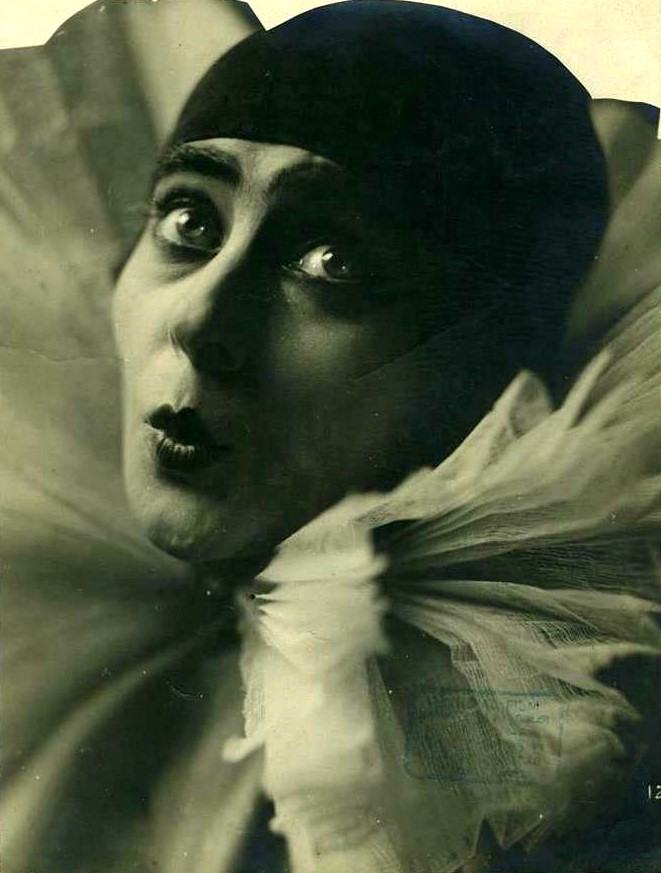
The greasepaint hasn’t dried when the blade finds its mark.
There is, at first, the rattle of a gong that might have been borrowed from a commedia dell’arte wagon rolling through the Po Valley. Then a slow iris-in on Tatiana Gorka’s Alexandra: cheekbones sharp enough to slice moonlight, eyes already rehearsing a grief they have yet to feel. Lucio D’Ambra—journalist, scenarist, occasional magician—doesn’t let us settle. Within ninety seconds a carnival trumpet squeals, the camera tilts up to the flies, and the dagger, clutched in a trembling kid-glove, writes its scarlet signature across what the intertitles insist is “l’innocenza tradita.” The betrayal is not the victim’s but ours: we have been lured into a revenge tale only to watch the floorboards splinter into jurisprudence.
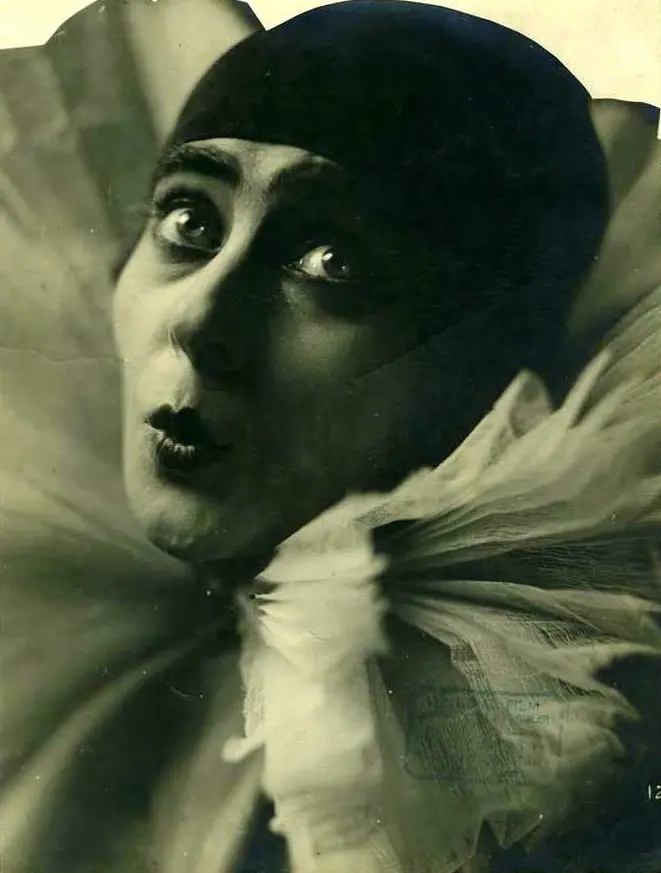
Silent Italian cinema of 1920 is supposed to be all divas and fainting aristocrats on mountain crags, right? D’Ambra spits on that cliché. He shoots the opening theatre sequence with a handheld Debrie that sways like a drunk sailor, catching the frayed velvet, the gas-jet footlights, the sweat-darkened ruff of a clown who watches Alexandra’s rampage from the wings. The clown—Renato Piacentini in porcelain mask and grin that won’t wipe off—becomes the film’s ironic chorus. He is Amleto (Hamlet) refracted through greasepaint: a prince without a castle, mouthing pantomime warnings the protagonist never heeds. His painted tear is still drying when Alexandra is hauled off by gendarmes whose capes flap like black fins.
The second act relocates to a Turin courtroom rendered in cavernous two-point perspective. D’Ambra, ever the essayist, intercuts the trial with flashbacks shot on a soundstage whose walls are cracked like broken melody lines. Alexandra’s father—an anarchist printer—was found skewered to a lithograph stone. We see the body only in negative space: a chalk outline, a spilled tray of Caslon type, a cat licking ink. The montage obeys musical rather than legal logic; each new witness is introduced with a cymbal crash, each contradiction with a harp glissando. The effect is Sturm und Drang on 14-frames-per-second.
Gorka’s performance mutates here from grand guignol to something closer to penitentiary naturalism. In close-up her pupils quiver—actual tremors captured by a 50 mm Kinamo lens—while the intertitles reduce her defense to four words: “Non era lui… ma io…” The ellipsis is the film’s moral black hole. She cannot articulate the misidentification; the language of the law has already swallowed her syntax.
Contrast this with the contemporaneous The Third Degree, where justice somersaults into romance. D’Ambra denies that comfort. His judge (a cadaverous Angelo Gallina) recites the sentence while a metronome ticks in the recess—an auditory hallucination made visual by the swinging pendulum of the camera. The condemned woman doesn’t faint; she straightens her spine, eyes fixed on the clown who has slipped into the gallery, still masked. Their gazes lock: tragedy acknowledging its own absurd twin.
Cinematographer Ubaldo Arata (later to lens Maciste in Hell) treats exposure like a moral ledger. In the death-cell sequence Alexandra’s face is split: one half blasted by the corridor’s arc lamp, the other lost in tenebrous shadow. The bisection is not symbolic—it’s forensic. We are asked to measure lumens of guilt, totting them like an accountant of the soul. When the priest (Maurice De Grunewald) offers last rites, his crucifix catches the beam, projecting a cruciform silhouette that slips across the actress’s throat. Spirituality, here, is reduced to geometry and wattage.
Meanwhile, the clown—now stripped of his mask—presses his face against the bars from the opposite corridor. Piacentini’s bare skin looks powdered even without greasepaint, a reminder that identity itself is a residue. D’Ambra cuts on the glint of the crucifix to the glint in the clown’s eye, forging a visual rhyme that implicates spectator, entertainer, and clergy in the same voyeuristic economy.
The current restoration by Cineteca di Bologna grafts a newly commissioned score—clarinet, prepared piano, and electronics—onto the original Italian release print. Rather than illustrative accompaniment, composer Lucio D’Ambra Jr. (grand-nephew) treats the film as a palimpsest. During the stabbing he withholds all pulse; we hear only granular crackle, like boots grinding glass under snow. When the verdict is read, a single clarinet sustains a microtonal bend for 43 seconds—an eternity at 18 fps—until the digital waveform itself tears. The effect is ontological: silence no longer signifies absence but the audible fracture of justice.
Purists may carp, yet compare The Master Mystery where every buzz-saw threat is telegraphed by a galloping Wurlitzer. D’Ambra’s strategy is anti-nostalgic: he weaponizes modernity to make muteness scream.
Italian divas—from Bertini to Menzoini—specialized in femme fatale inflation: women whose passions ballooned until they popped in spectacular repentance. Gorka goes the other direction; she shrinks, not from guilt but from existential shrink-wrap. Watch her shoulders retreat inward after the appeal is denied: the gesture is less melodrama than phenomenology of incarceration. The cell becomes a proscenium reversed—audience of one, spectacle of none.
D’Ambra further complicates the gaze by inserting a female jurator (Elisa Severi) who votes for the death sentence. The shot-counter-shot refuses er sisterly solidarity; instead Severi’s eyes possess the same metallic sheen as the dagger. Women, the film implies, are not a bloc—they are juridical individuals capable of lethal impartiality. One thinks ahead to Separate Trails (1922) where the jury of matrons debated maternity law; here the verdict is already etched in steel.
Shot in the autumn of 1920, while Turin metalworkers hoisted red flags and D’Annunzio was plotting Fiume, the film channels Biennio Rosso anxieties into jurisprudential fatalism. The father’s anarchist pamphlets— glimpsed only in long shot—carry headlines about the occupazione delle fabbriche. Alexandra’s act is thus overdetermined: personal vendetta collides with ideological aftermath. The courtroom extras are not stage caricatures but actual Fiat workers laid off that summer; their faces betray a proletarian exhaustion no prop department could fake.
Scholars often bracket Amleto with The Furnace for its industrial backdrop, yet D’Ambra’s concern is post-industrial: what happens when the factory gates close and the only forge left is the crucible of law.
For decades the sole print languished in a rusted biscuit tin mislabeled “Commedia 1920”. When archivist Elena Mingozzi opened it in 2018 the nitrate reeked of almonds—sign of imminent auto-ignition. A 4K wet-gate rescue followed, revealing textures previously dissolved: the velvet nap of Alexandra’s robe, the verdigris on the prison’s copper taps. Yet the film remains curiously untaught in survey courses, eclipsed by His House in Order and other West-End adaptations that pacify rather than perturb.
Blu-ray distribution is pending; streamers cite “limited star recognition.” Their loss. In an era when Fruits of Desire and The Wrong Door receive 4K restorations, relegating Amleto e il suo clown to 35 mm university circles feels like critical malpractice.
Great cinema teaches us to see our complicity in the spectacle of suffering. Greater cinema—this film—makes us feel the blade slip in after the credits. Long after the projector’s click fades you may find yourself rubbing an imaginary scar under the rib, wondering which innocences you have sentenced in the name of narrative closure. That phantom ache is the mark of a work still alive, still clowning in the dark, daring you to laugh or repent or—most unnervingly—both at once.
Seek it out, if only to discover how silently a dagger can turn in the gut of history.
IMDb —
1921
Community
Log in to comment.