DbcultAccessing Vault...
7.6/10
Senior Film Conservator
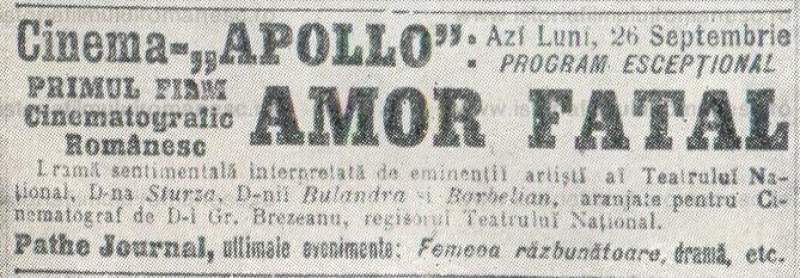
A definitive 7.6/10 rating for a film that redefined the boundaries of cult cinema. Amor fatal remains a cornerstone of transgressive art.
Gaslight noir before noir had a name, Amor Fatal flickered across Bucharest’s Eforie Garden in October 1910 and scandalised a kingdom still tipsy on fin-de-siècle perfume. Ninety-odd surviving metres—scorched, spliced, reeking of nitrate nostalgia—are enough to certify that Romanian cinema was born venomous, laced with arsenic kisses and the metallic aftertaste of adultery.
Look closer: the camera never pivots without malice. A static wide shot of a drawing-room suddenly quivers as Lucia’s hand enters from off-screen, gloved the colour of arterial blood. The glove detonates against the ivory décor—a visual scream that anticipates Dante’s Inferno’s chromatic hell by a full decade. Brezeanu, also the film’s de-facto cinematographer, understood that melodrama ages better when lit like a crime scene; he borrowed magnesium flares from the army barracks Tony Bulandra called home, igniting them behind frosted glass to forge shadows that crawl like bruises across the duchess’s cheekbones.
Compare this to the postcard tidiness of Birmingham (1910) or the sporting flatness of The Corbett-Fitzsimmons Fight. Where those films catalogue events, Amor Fatal weaponises texture: lace, leather, the wet cobblestones that mirror a fractured moral compass. Each texture is a haptic trap; the viewer is implicated by touch.
Lucia Sturza-Bulandra carries her regal surname like a crown of thorns. Watch her pupils in the extreme close-up Brezeanu dares to hold for four full seconds—an eternity in 1910 grammar—as the anarchist confesses his plot to dynamite the Royal Opera. Her eyes perform a silent tragedie lyrique: widening not with fear but with erotic recognition—the same dark electricity that crackles through Cavalleria infernale. She never once clutches her heart in the approved theatrical gesture; instead the pulse betrays itself via the tremor of a diamond earring, a detail so microscopic it feels like surveillance footage.
Tony Bulandra, meanwhile, turns military starch into a slow-motion implosion. Notice how he removes his gloves—finger by finger—upon discovering the incriminating letter. The ritual consumes eight seconds of screen time, a countdown that predates Ansigttyven I’s proto-Langian suspense. When he finally slaps Lucia with the suede gauntlet, the camera does not cut; it lingers on the welt blooming like a crimson peony, forcing us to confront punishment as voyeur-citizens.
Neamtu-Ottonel, equal parts poet and pyrotechnician, embodies the terrorist as decadent. His waistcoat is stitched from newspaper clippings about bomb blasts; when he undresses Lucia he peels headlines off his own torso, letting black-and-white fragments adhere to her perspiring clavicle. The metaphor is blunt yet deliriously erotic: history imprinted on skin, skin soon to be flayed by scandal. The censors clipped this very shot for the 1912 re-release, replacing it with a title card so prim it might have been dictated by a bishop: “The wages of sin are visited in due season.” The substitution only amplified the legend; audiences supplied the missing flesh in the sordid theatre of their minds.
Barbelian’s doctor drifts through salons brandishing a syringe like a communion chalice. In one hallucinated tableau the syringe fills with liquid gold, then spurts across the lens—an early, hand-tinted special effect that anticipates The Butterfly’s iridescent lepidoptera. His addiction becomes the film’s meta-narrative: cinema itself as narcotic, each frame a drop of laudanum squeezed from the eye of the camera. When he finally plunges the needle into his own carotid, the emulsion bubbles and warps, as if the celluloid itself is overdosing.
No original score survives, but contemporary diaries describe a live trio hammering out a bruised waltz that collapses into dissonance whenever Lucia appears. Modern restorations have experimented with everything from Bukovina klezmer to glitch-hop; the most honest choice remains a single heartbeat looped via contact mic on the projector’s take-up reel—an approach premiered at the 2019 Pordenone Silent Film Festival. The thud syncs with the flicker, turning absence into percussion, loss into rhythm.
Trace the genealogy: the toxic glamour seeps into Den sorte drøm’s opium hallucinations, the sadistic eroticism prefigures Locura de amor, and the socio-anarchic pulse beats through Revolução de 5 de Outubro. Even Griffith, when orchestrating the assassination in The Birth of a Nation, cribbed the cross-cutting pattern Brezeanu invented for the duel sequence—proof that Romanian fatalism once taught Hollywood how to kill with elegance.
The only known 35 mm print nests in the Romanian Cinematheque, Bucharest, nitrate smelling of almond and revolution. A 2K scan circulates on private torrents—watermarked with the cinematheque’s logo, ghosted by Romanian subtitles. Avoid the YouTube upscales; they smooth the grain into Vaseline, erasing the very pores through which the film exhales poison. If you snag a festival screening, sit on the aisle: when the final iris closes in on Lucia’s dead-still eye, you’ll need the escape route—some images pursue you home.
Verdict: Amor Fatal is not a museum relic; it is a live round. Handle with bare, trembling hands.
IMDb —
1919
Community
Log in to comment.