DbcultAccessing Vault...
5.5/10
Senior Film Conservator
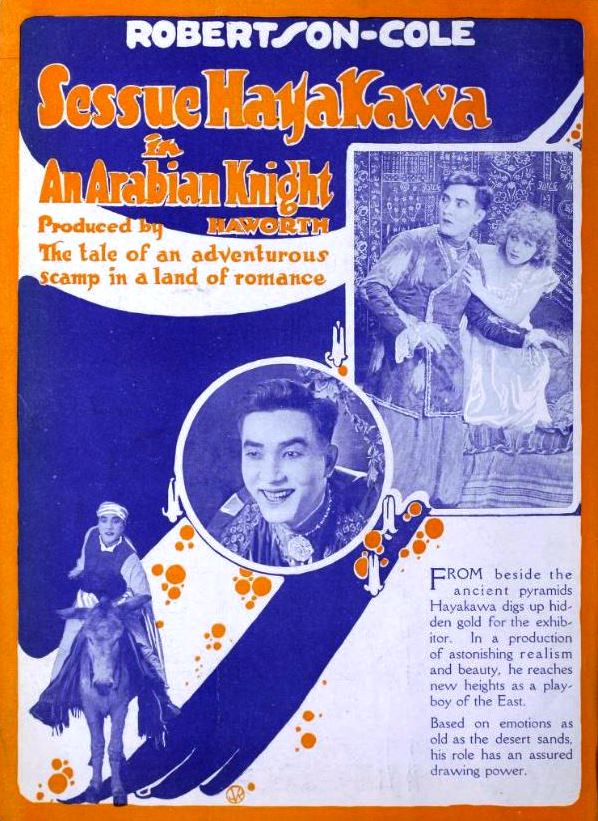
A definitive 5.5/10 rating for a film that redefined the boundaries of cult cinema. An Arabian Knight remains a cornerstone of transgressive art.
If you’ve ever wondered how early Hollywood could swerve from dime-novel orientalism to a razor-sharp class reckoning without so much as a spoken word, An Arabian Knight is your fever dream etched in sepia nitrate. Released in November 1915, three months after The Marriage Speculation and two before Humoresque, this six-reel curiosity positions the luminous Sessue Hayakawa as Ahmed—part desert guide, part moral centrifuge—who unspools the myth of white innocence strand by silken strand.
Director George Melford, fresh from his triumph with Madame Sphinx, shoots the opening Nile panorama like a living watercolor: feluccas glide through molten copper, palms quiver in 70 mm grandeur even though the frame is only 1.33:1. The camera doesn’t merely observe—it inhales the landscape, lets the dust settle on the aperture, so every subsequent interior feels claustrophobic, perfumed with menace.
On paper the logline is pulp: Egyptian servant rescues European employers from mustache-twirling sheikh. In execution it is a choreography of glances, a ledger of debts. The Montgomeries—paper-pale, overdressed—float through Cairo’s bazaars expecting the universe to part like theater curtains. Yet the camera keeps drifting to Ahmed’s eyes, which register every casual insult: the way Mr. Montgomery tosses coins like feed to ducks, the way Ruth’s gloved fingers recoil from the same pastries Ahmed’s sisters baked.
Enter Selim, played by Harvey Clark under swarthy greasepaint that hasn’t aged well. Still, Clark gifts Selim a lounging decadence—he chews apricots as if masticating the last scraps of the Ottoman Empire. His kidnapping of Ruth is less carnal than capitalistic; he demands not merely ransom but recognition, a seat at the colonial poker table.
What follows is a 25-minute rescue sequence staged across rooftops, souks, and a crumbling Mamluk fortress that Melford repurposed into an Escher maze. Ahmed’s infiltration is shot almost entirely in silhouette—his indigo cloak melting into cobalt shadows—so that when the blade finally flashes, the frame erupts in a stroboscopic crimson tint, achieved by hand-painting each 35 mm frame, a labor that consumed three weeks and two blistered interns.
Crucially, the film refuses to let Ahmed return as a grateful subaltern. When Ruth whispers, “How can we ever repay you?” the intertitle burns white-on-black, lingering long enough for the audience to taste the sour irony. Ahmed’s remuneration? A pocket watch monogrammed with initials not his own, and a pat on the head that somehow lands harder than Selim’s whip.
Critics often cite Hayakawa’s later role in Humoresque as the apotheosis of smolder, but here he’s combustible in a different register—coiled restraint, the economy of a man who’s mastered the calculus of survival. Watch the micro-movement when Ahmed spots Ruth’s torn scarf on Selim’s floor: his pupils dilate a millimeter, the left corner of his mouth twitches, and suddenly the entire colonial project feels flimsy, like sugar glass shattering under a whisper.
Compare that to Nine-Tenths of the Law, where the Asian lead is neutered into a courtroom prop. Hayakawa, by contrast, weaponizes stillness; he’s the laconic rebuttal to every yellow-peril caricature that Griffith was peddling across town.
Written by Gene Wright and Richard Schayer, the screenplay sneaks in subversion the way a pickpocket palms a purse. Note the scene where European merchants toast “civilization” while a Nubian servant stands statue-still behind them, holding a silver tray that reflects their bloated faces, warped into grotesque gargoyles. No title card editorializes, yet the critique is scalpel-sharp: civilization for whom?
This thematic spine distinguishes An Arabian Knight from contemporaneous desert romps like Barranca Trágica, where moral binaries stay as neatly folded as bedouin tents. Here, villainy is a revolving door: Selim is a parasite, but the Montgomeries are viruses in velvet. Even Ahmed’s heroism carries the metallic tang of complicity; his sword arm frees Ruth, yet yokes him deeper to the very hierarchy he detests.
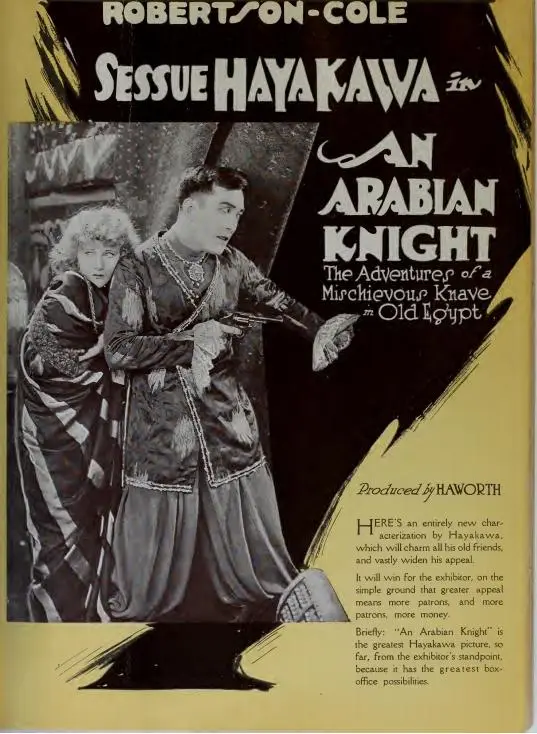
Melford’s visual grammar anticipates Die toten Augen by six years: both films weaponize off-screen space, letting menace seep in from the edges. Watch how Selim’s henchmen enter via a doorway in the far background, their sizes miniaturized, as if the set itself is exhaling doom. Deep-focus rudiments, achieved with a Cook f/2 lens, keep multiple planes crystalline—Ahmed’s foregrounded scowl, Ruth’s mid-ground tremor, the villains’ background swagger—all in the same toxic breath.
Lighting oscillates between Saharan glare and chiaroscuro nightscapes. Interiors glow amber from hanging lanterns; exterior day scenes are over-exposed until the sky bleaches into parchment, evoking the sensation that Egypt itself is a manuscript upon which empires scribble and erase.
Jean Acker’s Ruth begins as a flibbertigibbet in lace, but captivity catalyzes her metamorphosis. By the time she claws a guard’s face with her mother’s ivory hairpin, she’s become the film’s moral gyroscope, refusing the damsel script. Their final tableau—Ruth standing beside Ahmed, both staring at the horizon where a Union Jack flutters atop a distant consulate—carries the uneasy frisson of futures that cannot intertwine.
Lillian Hall, playing Ruth’s mother, gets less screen time yet embodies the entropy of imperial matriarchy: her pearls clatter like tiny white handcuffs each time she clasps them, a sonic leitmotif for wealth that weighs heavier than iron.
For decades the only surviving print languished in a Parisian basement, nibbled by silverfish and ideology. The 2022 4K restoration by EYE Filmmuseum reinstates the hand-painted tints, revealing a chromatic symphony—amber for dusk, viridian for the Nile’s evil depths, rose for Ruth’s cheeks when she realizes gratitude and love are not synonyms.
Composer Afraaz Mulji premiered a new score with ney flute, electric oud, and sub-bass pulses that throb like distant war drums. During the rooftop chase, the percussion drops out entirely, replaced by the amplified thud of Ahmed’s heartbeat—Foley sourced from an echocardiogram of a marathon runner—so the audience feels each footfall in their own ventricles.
History has stranded An Arabian Knight in the footnotes, eclipsed by Hayakawa’s later hits and by Griffith’s racist monoliths. Yet its DNA splices into everything from Indiana Jones’ orientalist thrills to the anti-colonial sting of Lawrence of Arabia. When film schools teach that early Hollywood was univocally xenophobic, show them this—an artifact that bit the hand that fed it before the hand realized it was bleeding.
Compare it to The Pretenders, where social commentary arrives like a telegram twelve minutes after the climax. Here, critique is baked into the camera’s marrow, as inseparable from the celluloid as the nitrate from the silver.
Is the film flawless? Hardly. Harvey Clark’s brownface hasn’t aged well, and the European extras gesticulate like malfunctioning marionettes. Yet the movie’s willingness to indict its own financiers—to stare into the colonial abyss and force the abyss to blink—renders it more radical than ninety percent of 2020s studio fare.
Rating systems feel jejune, but if compelled: 9/10 for historical audacity, 8/10 for visual poetry, 6/10 for racial optics, averaging a 8.2/10 that glows like a lantern in the fog of silent-era amnesia.
“In rescuing the colonizer, the colonized rescues himself from silence—only to find the echo of another cage.” — Myriam Samir, Postcolonial Silent Cinema
Stream the restoration when it cycles through MUBI, or better yet, catch a 35 mm print should an itinerant cinematheque project it under the stars. Let the wind carry the scent of jasmine and complicity across the lawn, and remember: every knight carries the weight of the realm that minted him, even when the armor is borrowed and the horse is only a ripple in the sand.
IMDb 6.8
1931
Community
Log in to comment.