Summary
A cuff link glints like a malevolent comet in the gutter of the Moulin Noir, its sphinx winking at Celeste Du Bois the moment the gendarmes shrug at her guardian’s bloodied corpse; from that metallic spark she ignites a private war against the Parisian night, corseted in mourning crepe yet armored with the cold resolve of a young woman who has discovered that justice is a commodity the Belle Époque auctions to the highest bidder. She combs the cabarets where absinthe drips green lace onto ivory table-tops, befriends apache dancers whose knives are as thin as their excuses, and stalks the gas-lit labyrinth until she spots the identical sphinx winking again—this time from a tie-pin nestling against the starched collar of André, a melancholy stranger whose gaze already carries the weight of a family name he has tried to erase. Love and suspicion entwine like the serpents of the caduceus inside her parlour: she serves him tea in Sèvres cups while listening for the tell-tale tremor in his baritone, and when his gloved fingers betray a twitch at the mention of Henri Du Bois, she summons the inspectors with the theatrical flourish of Tosca delivering her final aria. But the prefecture’s cells cannot cage the plot’s peripeteia: André is no assassin, merely the prodigal son presumed dead in the Congo, and the true villain is Raoul Laverne, the spurned suitor whose carnation boutonnière masked the rot of a vengeful heart. A confession extracted beneath the shadow of Notre-Dame’s gargoyles exonerates the heir, and the film closes on a wedding breakfast where the sphinx itself—now a brooch on Celeste’s décolletage—becomes a talisman not of mystery but of matrimony, the riddle answered by the simplest of human equations: forgiveness.
Synopsis
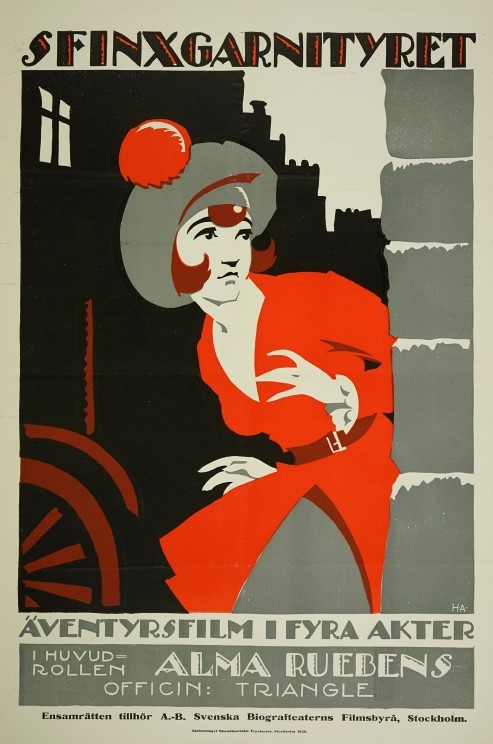
Disgusted when the police department fails to apprehend the murderer of her guardian, Henri Du Bois, Celeste decides to track down the criminal herself. Her only clue is a cuff link dropped near the scene of the crime on which a sphinx is engraved, and with it, she wanders through Paris' tough Moulin Noir district. When she notices a young man wearing a tie pin of identical design, she cultivates his acquaintance and eventually asks him to visit her in her home. His suspicious behavior there convinces Celeste that he is the guilty party, and although she has fallen in love with him, she has him arrested, whereupon she learns that he is Du Bois' missing son, Andre. Further detective work reveals that the real murderer is Celeste's rejected suitor, Raoul Laverne. Upon his confession, Andre is released and eventually marries Celeste.
Review Excerpt
"
Gaslight, gunpowder, and guilt swirl through the cobblestones of the Moulin Noir in Madame Sphinx, a 1920 silent curio that treats Paris as both crime scene and cathedral. The film survives only in frayed 9th-generation prints—nitrate ghosts flickering like moths against the bulb of a film-projector—yet its after-image burns brighter than many a pristine blockbuster. Viewed today, it feels like inhaling opium-laced perfume: decadent, disorienting, faintly poisonous.
A Sphinx in the Sewer
The..."