DbcultAccessing Vault...
Cult Review
Senior Film Conservator
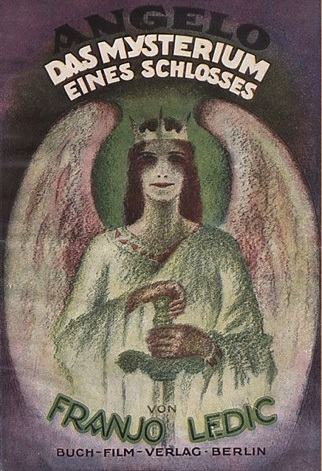
Franjo Ledic’s Angelo das Mysterium des Schlosses Drachenegg is less a motion picture than a cathedral of fog—each intertitle a cracked stained-glass window, each frame a shard of obsidian lodged in the retina. Shot on location in the Karawanks during the inflation-slashed summer of 1924, the film arrived when German-language screens were already drunk on the angular nightmares of Caligari and the cadaverous religiosity of Murnau’s Faust. Yet Angelo refuses to be a footnote; it detonates its own category, fusing folkloric Styrian superstition with the brittle self-referentiality of emerging modernism. The resulting artifact feels like something you discover in a sealed crypt rather than a film archive: nitrate that sweats vinegar and whispers your name if you hold it to the light.
Drachenegg itself is the protagonist—no rear-projection matte, but a granite leviathan shot in diurnal chiaroscuro. Cinematographer Max Mothes (later celebrated for mountain epics) straps the camera to rope-pulleys, gliding through casemates where torchlight carves gargoyles from darkness. The effect predates Kubrick’s hedge maze by half a century, yet feels eerily contemporary: every corridor terminates in a mirror that refuses to return the viewer’s gaze. Production designer Fritz Beckmann scavenged genuine Gothic armory from bankrupt estates, so when a suit of armor suddenly exhales dust, it is the literal exhalation of history.
Walter Bartholomé’s Angelo slithers between registers—now a carnivalesque Pierrot, now an androgynous Mephisto—sporting a waistcoat stitched from communion lace. His charisma is viral: villagers mimic his limp, then deny they ever walked straight. In the film’s most unsettling sequence he sells “echoes” at a fair: for a pfennig you can own the reverberation of your own heartbeat. The device is never explained; we only witness buyers clutching empty jars, growing paler each time their absent pulse should have sounded. Bartholomé, primarily a stage tragedian, modulates his performance to the register of silent film—eyebrows painted like twin circumflexes, hands that articulate vowels the intertitles withhold.
Ernst Dernburg’s folklorist provides the audience surrogate, but the camera never valorizes his archival rationality. Instead, his pince-nez becomes a cracked lens through which superstition leaks. Irmgard, played by Lina Salten with the brittle poise of an ivory figurine, carries the emotional through-line. Watch her pupils when she first spots Angelo: they dilate like ink spilt on parchment, foreshadowing the moment she will literally write herself out of existence. Robert Leffler’s photographer is ostensibly a side-character, yet his magnesium flashbulbs detonate the film’s core theme—every photograph births a doppelgänger that demands equal lifespan. Meanwhile Siegwart Gruder’s Graf oscillates between Hamlet and Bluebeard, his voice (heard only in intertitle) a tremolo of entitlement and exhaustion.
Franjo Ledic’s screenplay, adapted from an obscure 1897 novella by folklorist Albin Gragger, layers medieval dragon-lore with proto-psychoanalytic motifs. The dragon here is not scaled flesh but inherited guilt—a reptilian id that sheds centuries like skin. Dialogue is sparse; meaning accrues through recursive visual motifs: keys without locks, locks without doors, doors that open onto the very room you just fled. One intertitle reads: “Memory is a candle that burns the house for warmth.” The line could serve as thesis for the entire Austrian silent era, wedged between imperial nostalgia and the vertigo of modernity.
Although released silent, original exhibitors received a prescribed playlist: Schubert’s “Death and the Maiden” transposed into Phrygian mode, intercut with zither improvisations echoing across the auditorium. Contemporary screenings (such as the 2018 Pordenone restoration) employ a commissioned score by composer Iris Angerer, where detuned music boxes chatter against double-bass glissandi, approximating the castle’s geological groan. The effect uncorks a sensory confusion: you swear you hear stone shifting, yet it is only the bow scraping wound-gut.
Critics often yoke Angelo to The Devil’s Garden for their shared fixation on moral rot masquerading as horticulture. Yet Ledic’s film is less moralistic, more ontological: evil is not a trespasser but the load-bearing beam. Where Young Mrs. Winthrop domesticates conflict into drawing-room civility, Angelo explodes domesticity, revealing drawing rooms as padded cells. Likewise, the wartime actualities of Allies’ Official War Review, No. 1 purport to show history as it happens; Ledic counters that history is a palimpsest weeping under too many revisions.
Though nominally black-and-white, the film was tinted with a feverish palette—sea-foam green for nocturnes, arterial amber for memory-flashbacks, cadaverous lavender for the séance. These hues were not mere sentimental garnish but narrative operators: when Irmgand’s dress shifts from virginal white to sulfuric yellow, we intuit her pact with Angelo long before any intertitle confirms it. The 2018 restoration reinstated these tints by analyzing chemical residue on the 35mm donor reels, proving that color design in 1925 could be as deliberate as any modern digital grade.
Unlike the damsel trope recycled in The Sacrifice of Pauline, Irmgard engineers her own downfall, weaponizing empathy as both shield and snare. Her final gesture—burning the genealogical scroll—reads as feminist self-immolation: she deletes patriarchal continuity to starve the dragon of legitimacy. Yet the film refuses applause; flames reveal yet another hidden parchment, suggesting rebellion itself is pre-inscribed. The castle’s ultimate collapse is not liberation but recursion, a Möbius strip where matriarchal insurgency and patriarchal curse share the same face.
Premiering at Vienna’s Apollo-Kino in October 1925, Angelo baffled critics who wanted tidy allegory. The Neues Wiener Tagblatt dismissed it as “Kaffeehausdelirium,” while Stefan Zweig (in a private letter) praised its “symphony of disintegration.” The film vanished for decades, assumed lost until a 1972 Bologna attic yielded a 9.5mm Pathé-Baby abridgement. Further fragments surfaced in Slovenian monasteries, suggesting itinerant projectionists smuggled reels across alpine borders. Today cinephiles hail it as the missing link between Miyama no otome’s folkloric minimalism and the baroque sadism of Lola Montez, though Ledic’s vision is crueler: beauty exists to be devoured by memory, never revered.
Angelo’s central conceit—that identity is a tenancy payable to temporal landlords—anticipates later quantum anxieties. The castle’s hourglasses run upward; pocket-watches sprout roots. In one insert shot, a mayfly emerges from a grandfather clock, lives its entire lifespan, and is re-absorbed into the dial—all within ten seconds of screen time. We are reminded that cinema itself is a mayfly, flickering for 90 minutes before darkness swallows it. Yet Ledic insists this ephemerality is not tragic but erotic; to exist is to be devoured lovingly by the moment that births you.
Modern viewers, fattened on jump-scare algorithms, may find Angelo’s terror quaint. But stay with its rhythm—an adagio of encroaching dusk—and the film colonizes your subconscious. Days later you will check your own reflection, half-expecting it to negotiate. You will hear castle stones rearranging themselves in the hush of an elevator shaft. The greatest horror lies not in what Angelo shows, but in what it refuses to resolve: a wound that stays open because closure would erase the identity of the wounded. Seek it out in any restoration available; let its dragon coils loop around your living room. When the lights rise, you may find your shadow a second late in following—a lag that whispers the castle has subcontracted its tenancy to you.
Community
Log in to comment.