DbcultAccessing Vault...
Cult Review
Senior Film Conservator
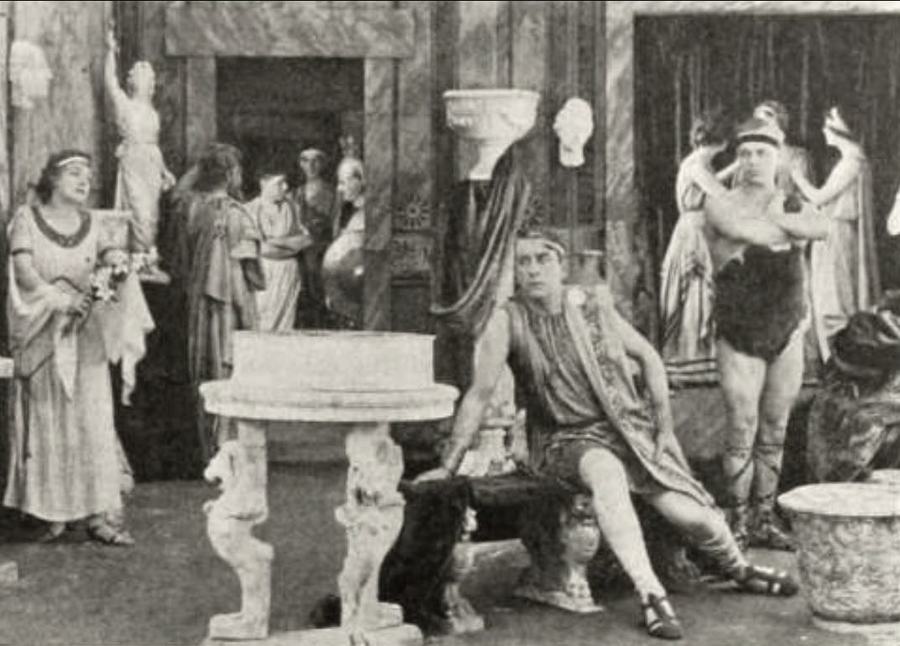
Dreams cut in stone, hearts cut by gold
There are films you watch and films that watch you. The Marble Heart—released in the shadowed autumn of 1913—belongs to the latter cabal. It is a slender reel, barely five reels of brittle celluloid, yet it lunges across epochs with the swagger of an emperor and the sigh of a poet. From the first iris-in, Charles Selby’s scenario fuses two eras into a Möbius strip: ancient Athens where sculpture was currency and rhetoric the only true coin, and a gas-lit present where banknotes flutter like wounded doves. The conceit is brazen: what if the same heartbreak is merely rebooted every few millennia, updated in costume but never in essence?
Raphael—played by King Baggot with the wan gravitas of a man who already suspects the universe is laughing at him—lives in a loft that smells of wet clay and unpaid rent. His hands, calloused by chisels, twitch even in repose, as though perpetually coaxing shoulders from blocks of possibility. When sleep finally corners him, the film’s palette turns hallucinatory: intertitles flare like sun-bleached parchment, and we tumble into a polychrome Athens that never quite existed. Here Yona Landowska’s Phidias strides through the Agora, draped in robes that cling like accusations, while Brinsley Shaw’s Diogenes barrels across the frame, eyes glittering with mischief wrapped in cynicism.
What astonishes is not the historical pageantry—columns, processions, libations—but the moral algebra. Every statue commissioned by Gorgias (Frank Smith, all rings and predatory smiles) is a promissory note on Phidias’s soul. The sculptor may sign his name beneath perfect clavicles, yet ownership belongs to the man who can gild them. In close-up, Landowska’s face is a battlefield: pride wrestles dread, victory uncertain. When the marble maidens stir, life flickering behind calcite pupils, the effect is less fantasy than documentary of a conscience curdling.
The film’s visual grammar anticipates Expressionism by half a decade. Shadows sprawl like spilled ink; sets tilt just enough to unsettle equilibrium. One shot—camera angled up at a statue’s nostrils while the live actress, identically lit, steps into frame—collapses art and artist into a single, accusatory gaze. You half expect the intertitle to read: “You who behold, know that you too are carved by capital.”
Back in the modern arc, Edna Hunter’s Marco glides through salons where chandeliers drip like frozen waterfalls. She is introduced via a cut-glass close-up: eyes two polished onyxes, smile a scalpel. The nickname “marble heart” is whispered behind ostrich-feather fans; it sticks because it flatters her severity. Men wager estates for a single waltz; women counterfeit illnesses to escape her gaze. Raphael, poor sculptor, watches her as one might watch a comet—awestruck, sensing catastrophe, unable to look elsewhere.
The courtship montage is a masterclass in ellipsis. A glove dropped, a handkerchief retrieved, a glove returned: three shots, three heartbeats, transaction complete. Baggot lets his shoulders sag millimetre by millimetre; the curvature of defeat is charted like a slow stock-market crash. When Marco ultimately weds a faceless banker, the wedding announcement fills the screen in ornate serif: letters swell until they blot out the groom’s name entirely—an erasure both literal and symbolic.
What follows is a triptych of ruin. First comes financial implosion: Raphael’s commissions evaporate, patrons evaporate faster. Creditors hover like gargoyles; one inserts himself between Raphael and the camera until his shadow eclipses the lens—a visual overture to despair. Next, spiritual erosion: the sculptor retreats to a garret whose skylight frames the moon like a sterile coin. He attempts a comeback—chiseling a massive block meant to be Marco’s likeness—but each swing of the mallet chips away more of his own visage, captured via double exposure that predates Fantasma’s ghostly superimpositions by several years.
Finally, death arrives wearing the mask of coincidence. Marco, now widowed and wealthier, returns to Raphael’s studio, perhaps seeking absolution, perhaps amusement. A thunderclap; the power fails; candles gutter. In the strobing dark, the unfinished statue topples—an implacable white blur. The next intertitle, austere and unforgiving, announces her demise. The camera lingers on her hand, veins marble-blue, palm upturned in an ambiguous gesture that could be apology or final dismissal.
The coda returns to the dream-Athens. Phidias stands amid shards of his shattered creations; Diogenes lights a lamp at noon, muttering about honest men. Fade to Raphael, alone, caressing a block of raw marble. Overlap: ancient chisel meets modern mallet, the same metallic cry. Fade-out. No redemption, merely the echo of strikes against stone.
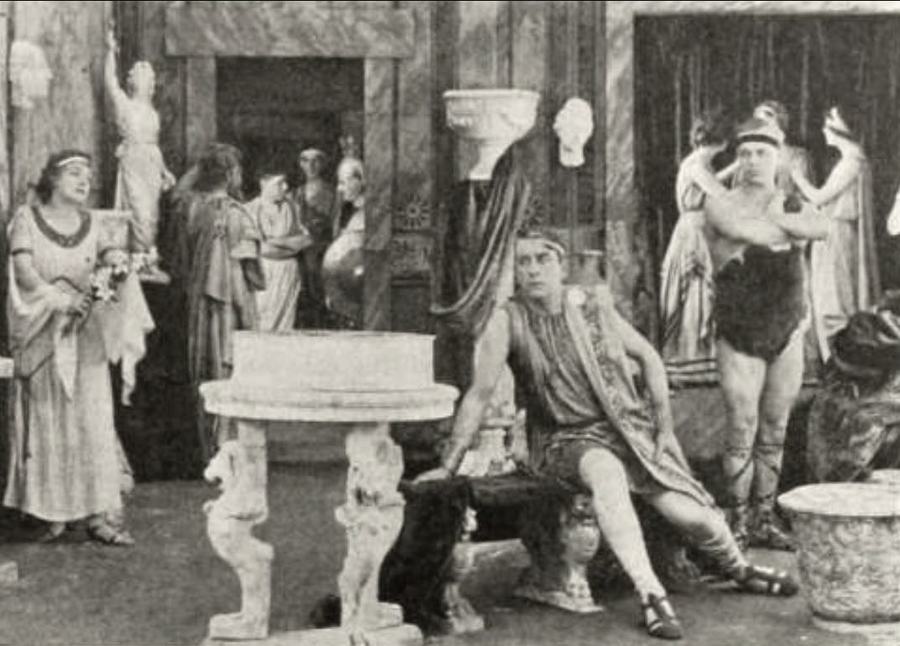
Yona Landowska shoulders the dual role with chameleonic poise. Her Phidias vibrates with the hubris of someone who believes beauty can be legislated; her Raphael quivers with the knowledge that it cannot. The distinction is conveyed not through prosthetics but tempo: in antiquity her gestures sweep like banners; in modernity they retreat into pockets of hesitance. Watch her fingers drum against a toga hem, then against a frock coat—same digits, different verdicts.
King Baggot, a matinee idol famed for swashbucklers, here trades virility for vulnerability. His shoulders curve inward, forming a parenthesis around an absence. In a late scene he cradles a shattered bust of Marco, rocking it like a lover or a child; tears streak plaster dust into warpaint. The moment would veer into bathos were it not for the microscopic quiver at the corner of his mouth—half grin, half rictus, wholly devastating.
As Gorgias, Frank Smith exudes the oleaginous charm of someone who has never heard the word no. Yet in a fleeting shot—watch it quickly—he stands before his treasury, candlelight dancing across gold ingots, and his expression slackens into something akin to boredom. Wealth, the film winks, is its own kind of poverty.
Budgetary constraints mutate into aesthetic triumph. The Athenian Agora is evoked by three columns and a sky painted on a bedsheet; through forced perspective and smoke, it feels vaster than any CGI colosseum. Marble is merely painted wood, yet under carbon-arc glare it gleams like bone. When statues spring to life, the trick is simple: actresses made up in alabaster powder strike poses, the camera freezes, a jump cut swaps them with actual statues, reverse for thawing. Primitive? Perhaps. But the jolt is uncanny, predating similar stunts in His Majesty, the Scarecrow of Oz by months.
Lighting oscillates between cathedral solemnity and nightclub leer. Cinematographer Ned Reardon bathes Marco in top-light that carves cheekbones into ski-slopes of shadow; Raphael, by contrast, is often bottom-lit, eyes receding into bruised sockets. The disparity is ideological: she is spectacle, he is specter.
Few silent dramas risk poetry in their titles; verbosity alienates audiences. Selby dares. Witness: “Love coined in marble outlasts the mint of man, yet buys nothing but remembrance.” Or: “When gold speaks, virtue folds its wings.” The words shimmer with Decadent ennui, recalling A Celebrated Case’s florid intertexts, yet never collapsing into purple goo. Each line is an epitaph, terse enough to be carved on a tombstone.
Place The Marble Heart beside its contemporaries and its singularity sharpens. Where The Last Days of Pompeii stages cataclysm in plaster-of-Paris miniatures, this film excavates interior volcanoes. Alone in New York sentimentalizes urban alienation; here isolation is a metaphysical condition, not merely geographic. Even Pilgrim’s Progress, with its allegorical baggage, lacks the cyclical nihilism that makes Marble Heart feel almost Nietzschean.
And yet the film was marketed as a “society melodrama,” its posters promising titillation rather than tragedy. Perhaps that bait-and-switch explains its box-office mediocrity; exhibitors reported walkouts once patrons realized they had purchased a meditation, not a romp. History, like Marco, has a cruel sense of humor.
For decades the sole print languished in a Romanian monastery archive, mislabeled as Phidias the Heathen. A 2018 4K restoration by the EYE Filmmuseum unearthed tints mentioned in Selby’s shooting script: cobalt for the dream-Athens nights, amber for modern salons, crimson for the fatal storm. The hues bloom now like bruises under translucent skin. A new score—piano, obstinate percussion, subtle theremin—underscores the uncanny without spoon-feeding sentiment.
Watch The Marble Heart and you may exit feeling anesthetized, as though a dentist of fate has drilled your sensitivity raw. The film proposes a bleak arithmetic: beauty plus ownership equals nullity; love minus wealth equals debris. Its temporal loop hints that progress is mere décor, that we are all unpaid apprentices chiseling monuments to others’ triumphs. Yet within that chill lies a morbid catharsis: to name despair is to loosen its grip, if only by a sliver.
There is no heart in the marble, only the echo of strikes that once tried to carve one. Go ahead—listen. You might still hear the hammer ringing across the centuries, patient, metallic, inevitable.
IMDb —
1924
Community
Log in to comment.