DbcultAccessing Vault...
Cult Review
Senior Film Conservator
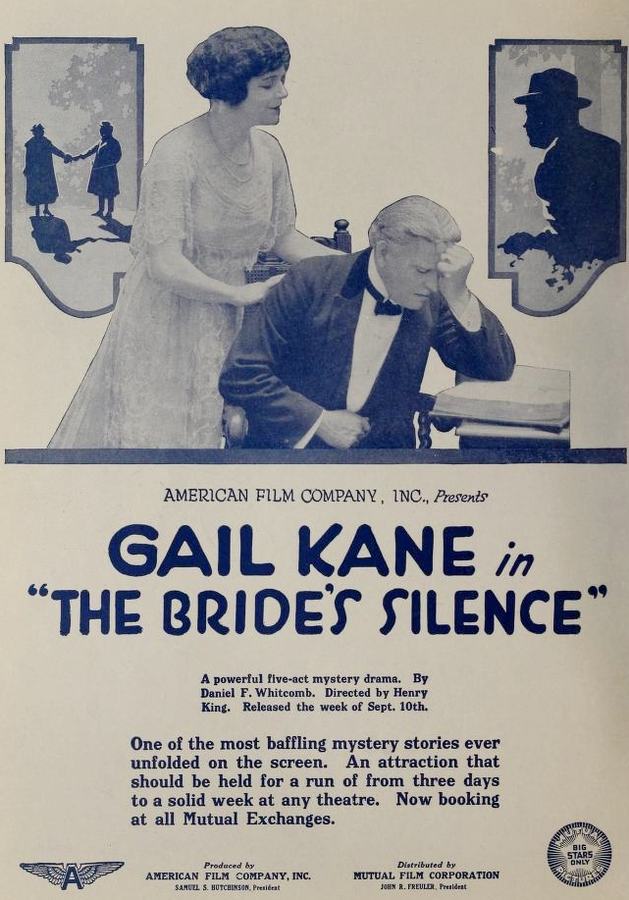
Nobody gasps when the dagger finds Nathan Standish’s heart; instead, the camera—fragile as celluloid conscience—lingers on the velvet portieres swelling with an in-drawing of breath, as though the mansion itself inhales the crime. That inhalation becomes the film’s governing rhythm: every secret drawn inward, every confession choked before it can blossom into sound.
The Bride's Silence is a 1919 production released wide in 1920, shot under the austerity of gaslight and magnesium flare, yet Daniel F. Whitcomb’s script feels suspiciously modern—like a suture between Wilkie Collins and Hitchcock before Hitchcock was even publishing in The Henley Telegraph. Director William P.S. Earle never achieved household-name immortality, but here he orchestrates chiaroscuro like a man convinced the human face is just another surface for tenebrism. When Sylvia, played by Gail Kane with the porcelain brittleness of a Meissen figurine, closes her fingers around the murder weapon, the close-up is so tight her knuckles become alps of guilt under a Caravaggio moon.
Forget whodunits in tidy drawing-room parcels. This narrative pivots on the question: how long can a psyche be barricaded behind its own nobility? Sylvia’s silence is not complicity but a grotesque act of familial calligraphy—rewriting culpability in order to preserve a crest. The film’s true coup is that it never condemns her; it simply allows the weight of marble statues, ancestral portraits, and Wagnerian moral absolutism to press upon her until her mind buckles.
Lew Cody’s Paul Wagner is both Pygmalion and Pontius Pilate. His courtroom scenes—rendered only in intertitles and reaction shots—ooze the sanctimony of a man who has mistaken jurisprudence for theology. When he hoists the wedding ring onto Sylvia’s finger, the gesture feels less like union than like slipping a padlock onto a condemned library door. Cody’s eyes, half-lidded with self-congratulation, foreshadow the talkies era’s caddish antiheroes, though they lack the warmth that even a scoundrel like Wolf Lowry manages to exude.
After her somnambulant aria of guilt, Sylvia is whisked to a Swiss-style chalet cut into a mountain cratered with snow that reflects light like innumerable camera flashes. Cinematographer Jules Cronjager—who would later lens The Commanding Officer—frames the sanitarium as a negative space: white on white, void on void. The absence of urban clutter paradoxically intensifies Sylvia’s interior cacophony; her silhouette against the alps becomes a Rorschach blot of culpability. The film’s tinting veers from lapis to cadaverous amber, suggesting both dawn and bruise.
Here the influence of Germanic dread, fresh from the spasms of post-war Expressionism, bleeds into American silent cinema. One can trace diagonal shadows that would feel at home in Obozhzhenniye krylya or Gefangene Seele, yet Earle refuses the geometric hysteria of Weimar; instead, his terror coils inward, like a spring tightened by Puritan repression.
Jim Farley’s Bobbins is sketched with Dickensian economy: angular shoulders, sidewinder glance, a voice implied only through curt intertitles. Society’s readiness to lynch the servant class supplies the film’s most mordant social commentary. Farley underplays magnificently; his resignation is so absolute it borders on saintly. Compare him to the histrionic vengeance ofDie toten Augen’s protagonist, and you appreciate how restraint can be a thunderclap.
Detective Bull Ziegler—Henry A. Barrows in a performance lacquered with world-weary rectitude—functions as the film’s moral tuning fork. He stalks parlors and courtrooms with a bulk that seems carved from courthouse granite. Note the sequence where he measures the angle of a blood-spatter shadow: the proto-forensic curiosity nudges the movie toward scientific modernity without derailing its gothic locomotive.
When Sylvia finally detonates her confession in the hush of night, Whitcomb’s intertitles fracture into fragmentary poetry: “The blade… the snow… his eyes—open like doors I cannot close.” Earle overlays her words upon a double-exposure of Nathan’s death-bed, creating a spectral montage decades ahead of its time. The sequence prefigures the hypnagogic confessionals in Hitchcock’s Spellbound, yet does so with the austerity of a chamber play rather than Dalí excess.
Gail Kane’s physical acting in these moments is a masterclass in micro-gesture: the flutter of eyelids like trapped moths, the way her left hand clutches the counterpane as though it were the last ledge before a moral abyss. Modern viewers accustomed to Method fireworks may find her subtlety almost alien, but the cumulative effect is harrowing.
Too many silents collapse under last-act coincidences delivered by Western Union. Here, the telegram arrives like a delayed thunderclap that re-writes the moral ledger yet refuses catharsis. The cousin’s suicide—signed with ink mixed with her own life—externalizes vengeance but cannot unbruise Sylvia’s psyche. Earle bravely denies us a kiss-of-reunion shot; instead, Wagner and Sylvia stare across the sanitarium solarium, snow-light carving trenches between them. Memory regained is not innocence restored.
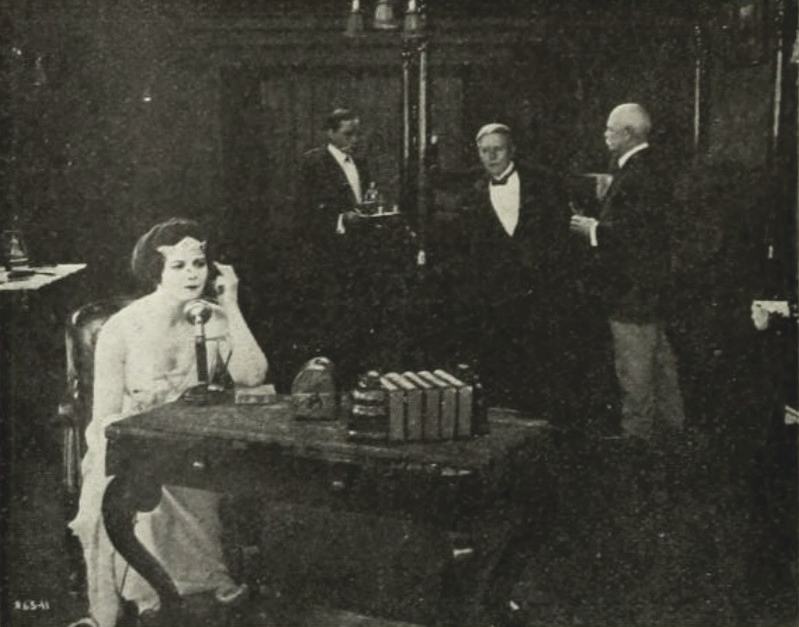
This refusal of closure catapults the film into the same rarified territory as Fear (1920), where guilt metastasizes beyond factual innocence. The Bride's Silence, however, is colder, more Protestant; it suggests that conscience can be a life sentence even when the gavel falls the other way.
Velvet appears first as drapery, later as the mossy hush of coffin-lining, finally as the bruised skin beneath Sylvia’s eyes. Marble surfaces—from mantelpiece busts to sepulchral floor tiles—echo with footstep reverb, reminding us that dynastic pride is ultimately lithic: heavy, chill, grave-ready. Snow, falling like white noise, erases sin but also evidence, implying that absolution is indistinguishable from oblivion. Together the trinity forms a visual fugue that hums beneath the plot like a church organ whose pipes open into catacombs.
If you admire the moral vertigo of The Dawn of a Tomorrow or the gendered masochism in A Woman’s Honor, you’ll recognize kindred DNA here. Yet The Bride's Silence eschews the religious redemptivism of the former and the proto-feminist triumph of the latter; it lands closer to Arthur Schnitzler’s novellas, where eros and thanatos waltz in mirrored ballrooms.
The film also converses with The Master Hand’s obsession with puppetry: Sylvia as marionette of patriarchy, her strings pulled by surname, marriage contract, and finally her own retroactive memory. Earle’s blocking repeatedly frames her within doorjambs or between balustrades, literalizing the bars of invisible prisons.
Henry A. Barrows delivers perhaps the most naturalistic turn; his Ziegler exudes a corporeal weariness that feels imported from a late-1940s noir. Lew Cody, by contrast, theatricalizes every gesture—arching brows like circumflexes accenting his own moral lexicon. The tension between their acting styles mirrors the film’s dialectic: modern forensic clarity versus Victorian melodrama.
Gail Kane shoulders the narrative’s emotional tonnage with such brittle intensity you fear her cheekbones might splinter. Contemporary critics dismissed her as “over-nervous,” yet hindsight reveals a woman mapping PTSD before the term existed. Watch the dissolve where her pupils dilate upon hearing the cousin’s name; in that instant, memory crashes against amnesia like two tectonic plates, and the resulting fault line is her restored identity.
No original score survives, but cue sheets recommended a pasticcio of Schumann and Grieg, punctuated by “dramatic organ when Sylvia seizes dagger.” Archival screenings with live accompaniment reveal how a simple motif—say, the opening of Schumann’s “Kind im Einschlummern”—can braid maternal consolation with mortal dread when paired with Kane’s frenetic clasping of bed linens.
Yet the film’s boldest auditory choice is its embrace of negative space. Intertitles shrink to single words: “Remember.” “Silence.” “Snow.” Each card lingers long enough for projector chatter to seep into consciousness, turning the auditorium itself into a confession booth.
Why did The Bride's Silence evaporate from canonical conversation while The Spirit of '76 or The Night Workers gained footnote immortality? Perhaps its pessimism was too caustic for Roaring Twenties optimism. Perhaps the lack of a marketable “monster” made it less reel-friendly for revival houses. Whatever the cause, its rediscovery feels apposite in an era obsessed with trauma narratives and the fallibility of recall.
Modern restorations reveal textures once lost to duping: the glint of a silver letter-opener, the motes swirling in a projector beam as Sylvia prays for absolution. These granular details add a phenomenological immediacy that places viewers inside her sensorium. We do not merely witness her breakdown; we inhale the lilac dust of the carpet, taste iron in the air when the dagger is wiped clean.
The Bride's Silence is not a comforting artifact; it offers no moral lighthouse, only the wavering glow of a handheld lantern sliding across fog. What lingers is the suspicion that memory and identity are mutually hostile, that to remember is to fracture, and that silence—far from golden—may be the most corrosive metal of all. In an age when cinema often confuses volume with profundity, this reticent masterpiece whispers its tremors straight into the marrow. Seek it out, preferably in a venue where the projector’s mechanical heartbeat can sync with your own, and discover how loudly a hushed film can scream.
IMDb —
1918
Community
Log in to comment.