DbcultAccessing Vault...
5.2/10
Senior Film Conservator
A definitive 5.2/10 rating for a film that redefined the boundaries of cult cinema. Anna Karenina remains a cornerstone of transgressive art.
There are films you watch, and there are films that watch you—Gardin’s 1914 Anna Karenina belongs to the latter coven. Shot on orthochromatic stock that turns every blush into bruise-violet shadow, this czarist fever-dream prefigures both Napoleon’s rhythmic montage and the intimate sadism of Hamlet’s palace intrigues, yet it smells of birch smoke and tallow candles, not post-revolutionary gunpowder.
Gardin’s directorial strategy is perilously simple: he lets silence scream. Intertitles arrive like obituary notices—terse, metallic—then vacate the frame so Kholodnaya’s shoulders, trembling under twenty pounds of sable, can articulate the entire lexicon of forbidden want. Watch the way she removes her glove in the mazurka sequence: one digit at a time, as though peeling back the decade that separates respectability from disgrace. The gesture lasts maybe three seconds, yet it detonates across the narrative like a mortar shell lobbed into a crystal cabinet.
Railway as secular iconostasis
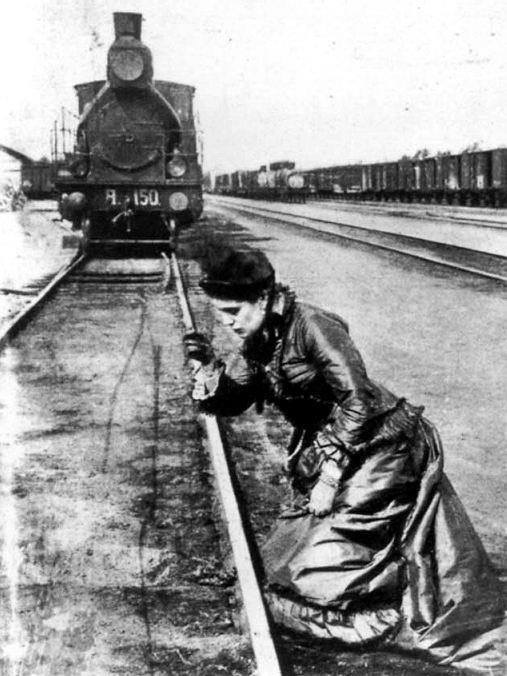
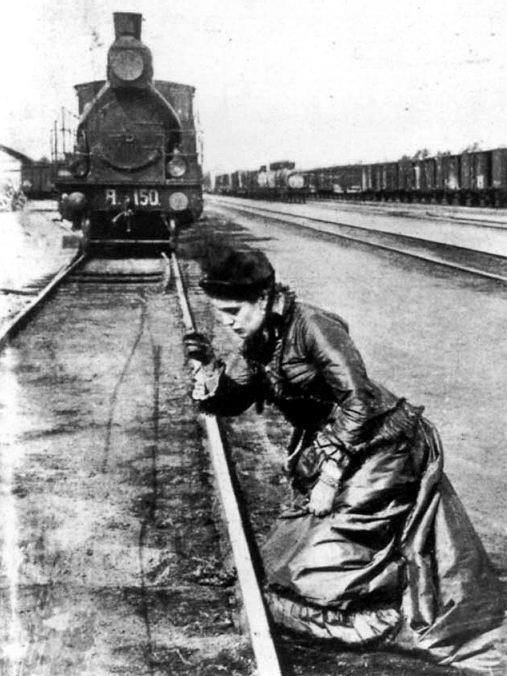
Tolstoy’s iron horse becomes, in Gardin’s hands, a roving confession booth. The first time Anna hears its whistle she is still cocooned in marital tulle; the second, she’s a refugee from every drawing-room whisper. By the third, the locomotive’s headlamp transfigures into a halo of annihilation. Notice how cinematographer A. Levitsky undercranks the wheels so the spokes strobe like orthodox crosses—salvation and execution collapsed into a single optical shiver.
Compare this to The Port of Doom, where ships glide like iron hearses; Gardin’s train is more voracious, a moving guillotine that severs not heads but social identities. In a society that measures love by the rustle of banknotes, the railway is the great leveler—serf and countess alike reduced to grease-spattered silhouettes.
Vera Kholodnaya—celluloid vestal or sacrificial pawn?
Histories remember Kholodnaya as Russia’s first screen goddess; Gardin’s film remembers her as a battlefield. Every close-up weaponizes her cheekbones—those blades could slice the moral scaffolding of an empire. Yet the genius lies in micro-movements: observe how her pupils dart left whenever Anna lies to Karenin, a tic so minute it feels like an electrical short-circuit inside your optic nerve.
The actress was twenty when shooting commenced, already married to a banker who bankrolled half the production. Off-set, she wore the same Parisian chinchilla you see onscreen, blurring the membrane between performer and mannequin. Such slippage bleeds into the role: Anna’s despair is authentic because Kholodnaya’s own celebrity was a gilded cage. When she swallows the theatrical poison in the final reel (Gardin omits Tolstoy’s gruesome platform demise, opting for a bourgeois boudoir suicide), the tear slithering down her cheek carries the collective angst of an actress who intuits that stardom itself is a form of adultery—an illicit liaison between public and private flesh.
Vronsky: epaulettes as erotic shorthand
Vladimir Shaternikov’s Vronsky is less a paramour than a parade-ground mirage. His moustache curves with the same feral arrogance as the double-headed eagle on his cap-badge. Gardin rarely grants him private close-ups; instead he’s staged in regimented tableaux—row upon row of cadets, buttons gleaming like Orthodox domes—so that when he breaks ranks for Anna the transgression feels apocalyptic. The actor reportedly practiced saber drills between takes to maintain a testosterone sheen that reads even through flickering 16 fps. The ploy works: every time he grazes Anna’s wrist the frame appears to blister.
Karenin: the bureaucrat as metaphysical bookkeeper
Mikhail Tamarov renders the cuckolded husband as a human abacus, beads clicking behind hollow eye-sockets. Gardin shoots him from waist-high, so the infamous “ears that stick out” Tolstoy detail become satellite dishes intercepting gossip. Notice the lighting scheme: a top-down kerosene lamp carves Karenin’s face into parchment ledgers—debits on the left cheek, credits on the right. When he finally refuses Anna divorce, the intertitle burns white-on-black like a fiscal injunction from some celestial ministry.
Editing: czarist vertigo
Scholars lionize Soviet montage, yet Gardin’s pre-revolution grammar anticipates Eisensteinian collision. Witness the ballroom sequence: a stately wide shot of swirling gowns smash-cuts to a locomotive piston, then to Anna’s gloved hand tightening on Vronsky’s sleeve. The triptych compresses space-time so brutally you feel the empire’s tectonic plates grind. FPS fluctuates between 14 and 20, birthing a staccato shimmer that makes every waltz feel like a death-rattle in embryonic form.
Set design: Fabergé hallucination
Art director Boris Mikhin scavenged actual Winter Palace chandeliers confiscated after the 1905 uprising, repurposing them as aristocratic talismans. The result: each soirée drips with imperial guilt—crystal teardrops for a dynasty already cracked. Meanwhile, Anna’s marital apartment is dressed in ochre wallpapers that evoke bruised skin, a chromatic foreshadowing of the emotional hematoma about to bloom.
Sound of silence: auditory ghosts
Though technically mute, the film orchestrates a phantom soundtrack. Contemporary accounts mention live orchestras scraping out Tchaikovsky fragments in provincial kinoteatry. Modern restorations often pair it with Alexander Mosolov’s Iron Foundry, whose clanging machinery dovetails eerily with the onscreen train. Try watching with noise-canceling headphones: the absence of diegetic audio makes your own pulse metastasize into a percussive score, each thud syncing with Anna’s escalating paranoia.
Gender insurgency in post-Lent Russia
Released two months prior to the Great War, the picture detonated amidst a society still fasting from Maslenitsa. Censors trimmed eight metres of footage rumored to depict Anna breastfeeding—an image deemed more pornographic than the adultery itself. Orthodox pamphleteers denounced Kholodnaya as “the antichrist in sable,” while underground feminists silk-screened her profile onto cigarette cases marketed as “freedom inhalers.” Thus the film slipped the noose of mere melodrama, morphing into a referendum on womanly autonomy.
Comparative corpus: Anna vs. other 1914 heroines
Stack Gardin’s opus beside The Hazards of Helen and you confront two universes: one where a woman’s agency is measured in locomotive rescues, another where locomotives devour agency. Meanwhile, Die Tangokönigin offers an erotic tango that pales beside Anna’s mazurka—because passion staged under Habsburg chandeliers lacks the metallic tang of impending revolution. Even Strejken’s proletarian martyrs seem pamphlet-thin compared to Anna’s bourgeois self-immolation, proving that class struggle can ache less than a single bruised heart.
Colonial distribution: nitrate diaspora
Intertitles survive in Cyrillic, French, and—bizarrely—Mandarin, evidence of distribution along the Trans-Siberian into Manchuria. One Shanghai print was seized by British customs, misfiled under “opium propaganda,” and nearly shipped to a Hong Kong warehouse where it would have been melted for its silver halide. Instead it resurfaced in a Montparnasse attic in ’68, water-stained but legible, like Anna herself crawling back from the grave.
Digital resuscitation: pixels vs. poetry
A 2018 4K scan by Gosfilmondemand reveals grain so tactile you can smell the nitrate vinegar. Yet crispness also betrays artifice: you spot the greasepaint crack around Kholodnaya’s lips, the rabbit-glue seams on Vronsky’s epaulettes. Paradoxically, the closer we approach photographic perfection, the farther we drift from the film’s chthonic essence—its flicker, its tremble, its mortal wound.
Legacy: from Petrograd to post-post-Soviet chic
Fashion designer Ulyana Sergeenko lifted Anna’s sable collar for her 2014 couture line; indie band Shortparis samples the film’s intertitles in their abrasive electronica; novelist Mikhail Shishkin reimagines Anna as a Skype-era camgirl. Each iteration testifies that the 1914 text refuses archival embalming, continuing to seep like diesel into the groundwater of global culture.
Yet the most haunting legacy is personal. Watch this film alone at 3 a.m. and you’ll find yourself counting your own relational misdemeanors on your fingers, measuring them against Anna’s plunge into the abyss. The final intertitle reads: “The candle guttered.” In that guttering we discern every relationship we’ve ever torched for the fleeting heat of a stranger’s gaze. And that, dear reader, is the truest definition of silent cinema: it speaks only when you surrender your own noise.
Verdict: mandatory viewing for anyone who believes passion ended with swiping right. Five frost-bitten stars, each one a railway track stretching toward the unpardonable.
IMDb 4.4
1926
Community
Log in to comment.