DbcultAccessing Vault...
Cult Review
Senior Film Conservator
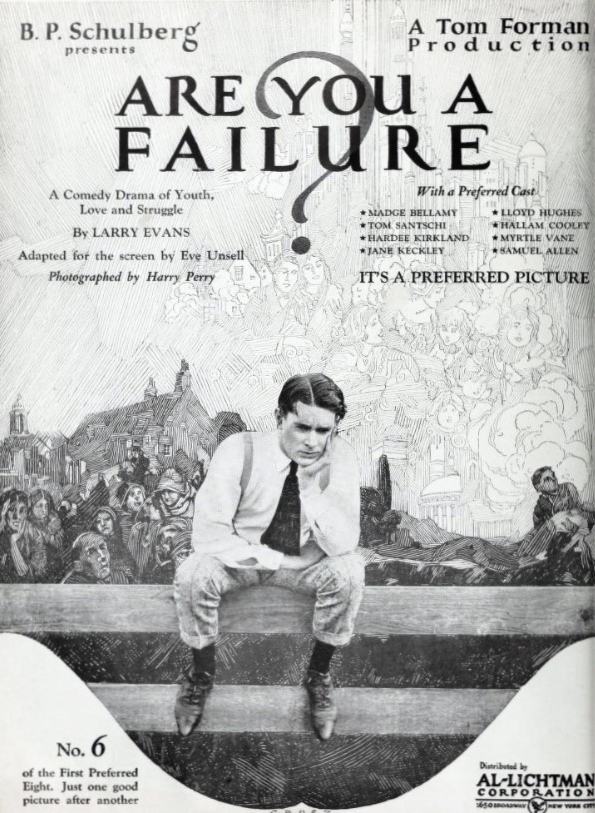
The 1920s represented a peculiar crossroads in the American psyche, a decade caught between the Victorian remnants of domestic restraint and the burgeoning roar of industrial self-assertion. James Cruze’s 1923 feature, Are You a Failure?, serves as a quintessential artifact of this era, capturing the anxieties of a generation of men who felt 'coddled' by the safety of the home and yearned for the rugged validation of the frontier—or, in this case, the lumber mill. The film is more than a simple rags-to-riches story; it is a psychological blueprint of the 'Success' culture that began to permeate the American middle class through mail-order brochures and prescriptive masculinity.
Lloyd Hughes portrays Oliver Wendell Blaine with a nuanced fragility that is rare for the silent screen's leading men. In the opening reels, we see him suffocated by the doting attentions of his maiden aunts, played with a delightful, if stifling, sincerity by Jane Keckley and Myrtle Vane. This domestic sphere is depicted as a place of stagnation—a velvet-lined trap that prevents Oliver from engaging with the world. The cinematography emphasizes this through tight, cluttered framing, making the house feel like a Victorian museum rather than a living space. This enervating atmosphere stands in stark contrast to the grit of Man's Woman, where gender roles are interrogated with a more aggressive hand.
Oliver’s decision to enroll in a mail-order course for 'Success' is treated by the film with a fascinating blend of earnestness and subtle satire. The course, a series of pamphlets that promise to turn a 'failure' into a 'leader of men,' acts as the catalyst for the second act. As Oliver begins to practice his 'strong man' poses in the mirror, the film flirts with comedy, yet never loses sight of the underlying pathos. He is a man desperately seeking a script for how to exist in a world that no longer values the quiet domesticity of his upbringing. This theme of social performance is also explored in The King's Game, though Cruze’s approach here is far more rooted in the everyday struggles of the American commoner.
The transition from the parlor to the riverbank marks the film's most significant tonal shift. The lumber mill, owned by the formidable Mr. Thorpe (Hardee Kirkland), represents the raw, unyielding power of the American economy. It is here that Oliver must test the theories he learned from his pamphlets. Unlike the moral dilemmas found in The Greater Profit, the stakes in Are You a Failure? are physical and immediate. The threat of a log jam—a recurring trope in silent cinema used to display technical prowess—becomes the ultimate test of Oliver’s mettle.
The log jam sequence is a triumph of location shooting and practical effects. The sheer scale of the timber, the rushing water, and the very real danger faced by the stunt performers (and likely the lead actors) provide a visceral thrill that modern CGI fails to replicate. It is in this chaos that Oliver finds his 'Success.' He is no longer reading from a pamphlet; he is reacting to the environment. The editing accelerates, mimicking the frantic energy of the breaking wood, and we see the transformation of a 'mollycoddle' into a 'river boss.' This sequence rivals the elemental fury depicted in The Storm, showcasing the 1920s obsession with man’s conquest over nature.
Madge Bellamy, as Phyllis Thorpe, provides more than just a romantic interest; she is the personification of the reward that awaits the successful man. However, Bellamy imbues the character with a certain degree of agency. She isn't merely a prize to be won; she is a witness to Oliver’s growth, and her belief in him often predates his belief in himself. Their chemistry is grounded in a shared understanding of the town’s social hierarchy. While films like Wounded Hearts and Wedding Rings lean into the melodrama of courtship, Cruze keeps the romance tied to Oliver’s professional ascension. In the world of this film, love is the byproduct of utility and courage.
The supporting cast, particularly Tom Santschi, adds a layer of ruggedness that balances the softer elements of the first act. Santschi, known for his more aggressive roles, serves as the foil to Oliver’s early indecision. He represents the natural-born leader, the man who never needed a mail-order course to know how to shout orders. The friction between Santschi’s character and Hughes’ Oliver creates a compelling dynamic that highlights the film’s central question: Can success be learned, or is it an innate quality? The film ultimately suggests a middle ground—the course provided the spark, but the river provided the fuel.
To truly appreciate the nuances of Are You a Failure?, one must look at how contemporary cinema handled the concept of the social outcast. In The Absentee, failure is often a matter of moral negligence or social dislocation. In contrast, Oliver’s failure is purely a lack of self-assertion. He is a 'good boy' who has been too good for too long. The film’s preoccupation with 'Success' manuals reflects a society moving away from the spiritual guidance of the church and toward the secular guidance of the self-help guru, a theme also touched upon in Easy Money, though with a much more cynical edge.
Furthermore, the film’s portrayal of the aunts’ domestic sphere can be seen as a critique of the 'old world' values that were being swept away by the jazz age and industrial expansion. This tension between the old and the new is a hallmark of international silent cinema as well, seen in the social critiques of Das neue Paradies or the identity shifts in Aus eines Mannes Mädchenjahren. Oliver is a bridge between these two worlds—he retains the kindness of his upbringing but adopts the armor of the modern industrialist.
The direction by James Cruze is characteristically efficient and visually literate. Cruze, who would go on to direct massive epics, shows a keen eye for the geometry of the lumber yard. The way he uses the verticality of the trees and the horizontal flow of the river creates a sense of constant movement and impending danger. The lighting in the indoor scenes is soft and diffused, emphasizing the 'coddled' nature of Oliver’s life, while the outdoor scenes utilize harsh, high-contrast lighting that makes the characters look as though they are being forged in the sun. This visual storytelling is far more effective than any intertitle could be.
We also see an interesting use of space in the final act. The river boss’s office is positioned high above the mill, a literal representation of the 'Success' Oliver has achieved. It is a perch from which he can survey the world he has finally mastered. This use of architectural hierarchy is reminiscent of the set designs in Milady or the symbolic descent in Through Dante's Flames. In Are You a Failure?, the climb is literal and figurative, a ladder of logs and social expectations.
While often categorized as a light drama or a social comedy, Are You a Failure? is a profound document of its time. It speaks to the universal desire to reinvent oneself, to shed the skin of past insecurities and emerge as someone 'worthy.' The film’s resolution—the marriage, the promotion, the community’s respect—is the ultimate 1920s fantasy. It suggests that the American Dream is not just about wealth, but about the transition from being a spectator of one’s life to being its protagonist.
In the broader context of silent film history, this work stands alongside others that explored the pursuit of happiness and the pitfalls of ambition, such as Jagd nach dem Glück or the whimsical escapism of Alice's Wonderland. However, Cruze’s film remains grounded in a specific American reality. It eschews the fantastic for the industrial, finding its magic in the sound of a whistle and the breaking of a log jam. It is a film that asks its audience, even today, to look in the mirror and ask the same titular question, offering a hopeful, if perhaps simplistic, answer: that success is merely a matter of following the right instructions and having the courage to act when the river rises.
Ultimately, Are You a Failure? is a testament to the power of the narrative arc. Oliver’s journey is satisfying because it is earned, not just through luck, but through a conscious, often awkward, effort to change. It is a reminder that even in the silent era, cinema was deeply concerned with the internal lives of its characters, proving that a man’s struggle with his own shadow is just as compelling as any high-seas adventure or slapstick chase. For those seeking a quiet moment of reflection on the nature of ambition, this film provides a perfect counterpoint to the more frenetic offerings of its time, such as Peace and Quiet or the smoldering drama of Embers. It is a solid, well-crafted piece of Americana that still resonates with anyone who has ever felt like they were waiting for their life to begin.
IMDb 5.7
1927
Community
Log in to comment.