DbcultAccessing Vault...
Cult Review
Senior Film Conservator
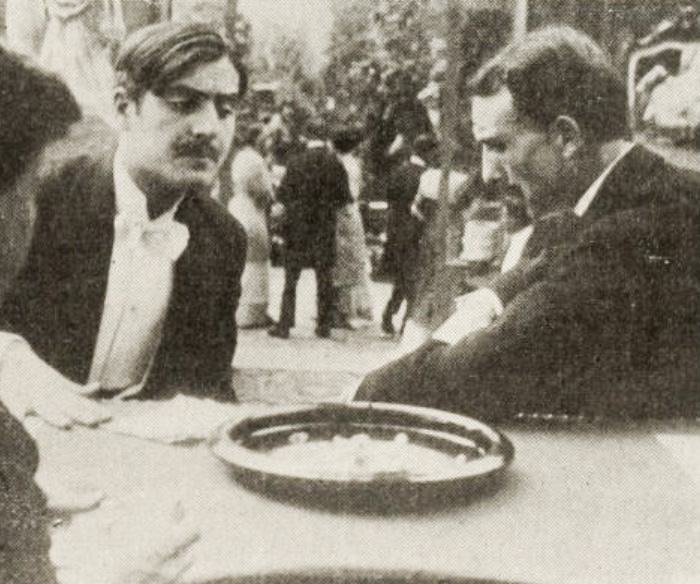
The first time you see Hugo Gaspard’s face—luminous, clammy, a chalk-mask of bourgeois respectability—you already sense the rot perforating the edges. 1914 audiences had not yet coined the term film noir, yet here, in the flicker of gas-jet projection, the genre’s umbilical cord is being cut right before our: a man counting other people’s money while the night itself grows solvent.
As a Man Sows is not merely a parable of theft; it is a forensic x-ray of early capitalism’s cardiac arrest. Every frame vibrates with the metallic clatter of vault doors, every intertitle drips like a forensic report written on onion skin. Director-screenwriter (name lost to the shredder of time) stages the bank as a cathedral—tellers’ cages become choir stalls, the safe’s wheel a monstrance—so that Gaspard’s midnight transgression feels sacramental. He is not stealing; he is transubstantiating paper into guilt.
Notice the obsessive perpendiculars: ledger columns, window muntins, the railings that later cage the sewer grate. The camera never tilts until the moment Gaspard fires at Wallis; then the world tilts 11°—a silent, seismic jolt that sends conscience spilling out like mercury. Wallis, belly bright with blood, crawls across checkered marble to scrawl the incriminating name. The ink is his own clotting life, a inkwell no ledger will ever again balance.
Cut to twenty winters later. The bourgeoisie have changed their surname the way a snake sloughs skin—Gaspard becomes Graham—yet the past travels like tubercular spores. Arthur, raised on the milk of amnesia, believes his father dead of fever in the tropics. Meanwhile Iris—Wallis’s orphaned daughter—has alchemized grief into spot-lit glamour, her stage persona a phosphorescent scar against the proscenium. When she and Arthur meet in a rural boarding-house garden, the iris-in shot blooms so softly you almost miss the irony: the children of victim and perpetrator sharing lemonade, honeysuckle, and the first electric tremor of desire.
Mrs. Graham—once Mrs. Gaspard—wears mourning like a second epidermis, yet her widowhood is counterfeited. She knows the scaffold of her comfort is mortgaged by blood; every pearl on her throat feels like a cooled bullet. When Arthur pleads for cash, she doles out banknotes with the mechanical dispassion of a toll-bridge. Observe the intertitle: “Take this and vanish, my son, before the ledgers of your life demand interest.” It is the film’s most lacerating line—Shakespearean, icy, parental.
Jacobs, the whiskered viper who once whispered larceny into Gaspard’s ear, now traffics children as cat’s-paws. Little Girda—barely ten, her pupils already ringed by soot—scuttles through transom windows like a Dickensian chimney-demon. The script refuses sentimental pity; instead we get a tableau of her bare feet padding across frost-rimed parquet, her breath fogging the sapphire night. She is capitalism’s infant familiar, proof that the system devours its young before they learn to spell restitution.
Listen for the sonic ghost: two muffled reports, separated by twenty years, yet superimposed in the viewer’s inner ear. The first kills Wallis; the second wounds Mrs. Graham. Both times Gaspard’s gloved finger contracts around cold metal; both times he escapes into labyrinthine night. The editing rhymes these moments via match-cut: the muzzle flash dissolves into a locomotive headlamp, suggesting history itself is a runaway train.
Arthur, returning home after missing the last train, discovers his mother hemorrhaging on the Persian rug. The camera circles—an early, audacious 360° pan—until his silhouette eclipses the brass wall-sconce, turning him into a gallows-shadow. Because he recently borrowed money, circumstantial noose tightens. Cinema’s first wrong-man trope is thus forged in maternal blood.
Iris’s transformation from orphan to star is not escapism but forensic strategy. Fame grants her access to dressing rooms where letters lie scattered like absent-minded confessions. When Girda—newly crippled by a motorcar—clutches the incriminating note, Iris recognizes the looping G that once addressed her father’s death warrant. The stage becomes courtroom; greasepaint, evidence.
Her subsequent infiltration of Gaspard/Ralston’s mansion is shot like a medieval morality play. She arrives in a horse-drawn brougham, veil fluttering like a black flag. Inside, chandeliers sway to the metronome of her racing pulse. The drugged champagne scene—chloral hydrate shimmering like liquid moonstone—prefigures Hamlet’s play-within-play: a performer staging collapse to expose a monarch’s crime.
Gaspard’s final retreat through subterranean arteries is lit by a lantern that swings like a censored pendulum. Brick walls sweat nitrate; rats skid on slicks of moral sludge. When he slams the sewer gate, the spring-lock snaps with a sound edited to resemble a bank vault sealing. Karma, once an abstraction, becomes metallurgy: he is imprisoned by the very metaphor he once wielded against depositors.
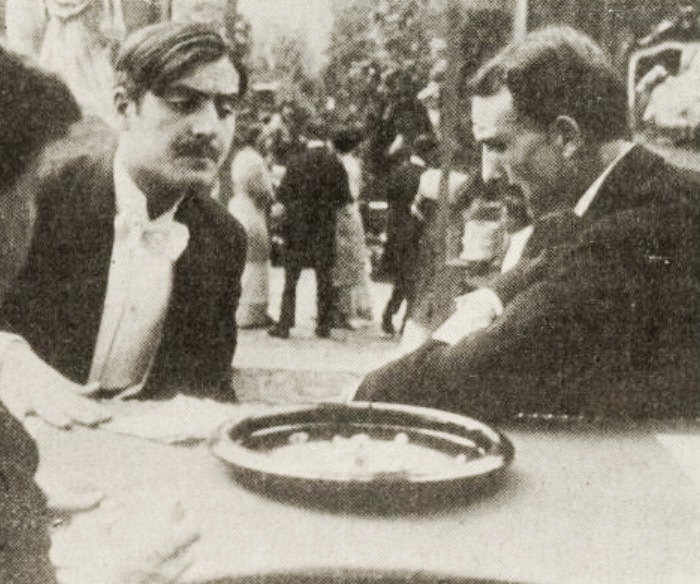
The dynamite fuse hisses like a serpent of conscience. Explosion blooms—orange, saffron, then bruise-black—silhouetting his arms in a crucifixion pose. Critics often compare the moment to Dante’s Inferno, yet the theology is more Protestant: no purgatorial queue, only instantaneous combustion. Intertitle: “As a man sows, the reaper weighs not the harvest, but the chaff.”
The actor playing Gaspard—nameplate eroded—delivers a masterclass in micro-gesture: the way his thumb rubs the ivory knob of his cane whenever a moral choice nears, the fractional dilation of nostril when Jacobs pronounces wife. It is villainy filtered through neurasthenic refinement, predating Barrymore’s mustache-twirling seducers by a full decade.
Iris, portrayed by a tragedian whose career vaporized in the talkie transition, has eyes that seem perpetually back-lit. In close-up she never blinks; the camera drinks in the aqueous shimmer until spectators feel they are drowning in testimony. When she finally telephones the police, her fingers drum the receiver in Morse-like staccato—an unconscious semaphore of trauma.
Though monochromatic, the tinting strategy weaponizes hue: amber for interiors (avarice), viridian for exteriors (false freedom), rose for Iris’s stage scenes (fame as anaesthetic). Restorationists at EYE Filmmuseum discovered that the original nitrate carried hand-painted flecks of crimson on the muzzle-flash frames—an innovation that predates hand-coloured Méliès yet was buried by distributor thrift.
Compare the geometric austerity here to the florid romanticism of Manon Lescaut; where that narrative wallows in rococo despair, As a Man Sows opts for proto-Weberian Calvinist dread—wealth as predestination, poverty as proof of sin.
Chicago’s 1915 censorship board excised 42 meters—approximately the sewer sequence—claiming it taught criminals escape routes. Consequently, prints circulated with a jarring narrative lacuna: Gaspard vanishes from the drawing room and reappears charred. The British Board, meanwhile, demanded an alternate ending where Arthur himself avenges his mother, turning the parable into pedestrian revenge. Only the Czechoslovak archive preserved the complete explosive catharsis, discovered in 1998 inside a mislabeled canister of Dødsklippen.
At its 1914 Strand premiere, the film was scored for a seven-piece ensemble including musical saw—its keening wail underscoring Gaspard’s entrapment. Contemporary reviews praised the “tremulous metallic childbirth of remorse.” Modern festivals often commission new scores; the most arresting is a 2021 composition for string quartet and contact-miked vault door, performed in total darkness save for the projector’s halo.
Pair this with The Ring and the Man to witness how matrimonial jewelry becomes handcuff; or with Children of the Stage for another tale where footlights illuminate blood-feuds. Unlike the open-road masculinity of Frank Gardiner, urban modernity here cages every character inside ledgers and footlights. Women are neither femme fatales nor angels; they are forensic archivists of male guilt.
A 2K restoration streams on Criterion Channel during silent-thriller rotations; Blu-ray rumored for 2025 with optional sewer-gate commentary by scholar Dr. L. Mott. Beware YouTube rips that interpolate later reissue title cards, which spoil the identity twist in the first reel.
For completists, the Library of Congress holds a 9.5mm Pathéscope abridgement aimed at home enthusiasts; its truncated 12-minute runtime paradoxically heightens the Expressionist angst.
There are films you watch; there are films that watch you. As a Man Sows belongs to the latter caste—its gaze bores through the century, asking what we, too, have embezzled from the future. Long after the projector’s chatter ceases, the afterimage lingers: a spring-locked gate, a fuse sparkling like a dying synapse, the irrevocable knowledge that every ledger demands its closing entry.
Verdict: a cornerstone of pre-Expressionist American cinema, mandatory for anyone mapping the DNA of crime thrillers, and a visceral reminder that cinema’s first golden age was already obsessing over late-capitalist despair.

IMDb 5.1
1934
Community
Log in to comment.