DbcultAccessing Vault...
6.3/10
Senior Film Conservator
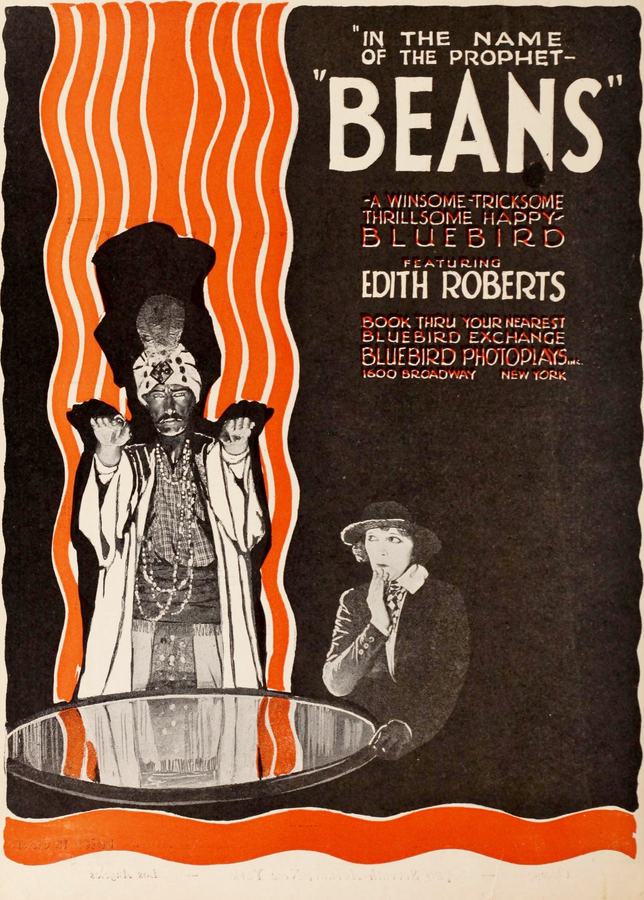
A definitive 6.3/10 rating for a film that redefined the boundaries of cult cinema. Beans remains a cornerstone of transgressive art.
In the pantheon of silent cinema, Beans (1920) stands as a peculiarly sprightful artifact, a film that masks its moralizing in the garb of farcical courtroom shenanigans. Directed by Rex Taylor and John B. Clymer, this early talkie-era flick (though entirely silent) is a curious blend of high-stakes corporate drama and the gentle satire of human folly. With a cast led by W.E. Lawrence as Brewster and Edith Roberts as Betty, the film unfolds like a chess match, where every pawn’s move is both deliberate and absurd.
The narrative hinges on the antagonism between Brewster, a monied industrialist, and Ellis, whose canning plant is the fulcrum of contention. Ellis’s refusal to renew his lease with Brewster sets in motion a chain of events that reads like a Victorian farce transplanted into the modern age. Wingate, the archetypal ‘shyster lawyer’ (a role that could have been lifted from That Sort), is the catalyst for the film’s moral ambiguities. His manipulation of Betty—a character whose innocence is both her strength and her naivety—creates a tension that is as comical as it is poignant.
Betty’s journey is the film’s emotional core. Portrayed by Edith Roberts with a mix of wide-eyed earnestness and steely resolve, she is the embodiment of the ‘good girl gone to town’ trope, albeit with a twist. Unlike the archetypal damsels in distress of The Perils of Pauline, Betty’s salvation comes not from a suitor or a heroic intervention but from her own unassailable integrity. Her duping by Ellis’s man is a masterstroke of narrative misdirection, setting up a climax where her innocence becomes a weapon against the schemers.
The film’s structure is a masterclass in escalating tension. Plots and counterplots spiral into a maelstrom of legal loopholes and ethical quandaries, yet the resolution feels inevitable, as if the script is a coiled spring releasing into a sigh of relief. Brewster’s reliance on his daughter to navigate this labyrinth is a nod to the era’s shifting gender dynamics; Betty is not merely a figurehead but a protagonist whose agency drives the narrative. Her triumph is not born of guile but of steadfastness—a theme that resonates deeply in a post-Chernaya Lyubov world weary of romanticized scheming.
Technically, Beans is a marvel of early 20th-century cinema. The cinematography, though rudimentary by today’s standards, employs shadow and light with a painterly economy. Scenes of the canning plant are rendered with a stark realism that contrasts with the operatic flourishes of the courtroom sequences. The use of intertitle cards is particularly noteworthy; they are not mere exposition but performative elements, their bold typography and rhythmic cadence echoing the stylized dialogue of Bettina Loved a Soldier.
The cast, led by W.E. Lawrence’s commanding presence as Brewster, delivers performances that straddle the line between melodrama and realism. Lawrence’s portrayal of Brewster is a study in controlled intensity, his every gesture a calculated rebuke to Ellis’s pettiness. Edith Roberts, meanwhile, imbues Betty with a vulnerability that never tips into caricature. Her interactions with Harry Carter’s Wingate are particularly charged; their exchanges are a duel of wits where the audience is never sure who holds the upper hand.
Thematically, Beans is a meditation on the moral cost of ambition. Ellis, portrayed with a smug malevolence by John Cossar, is a archetype of the unscrupulous capitalist, a figure that would later be immortalized in Hell Morgan’s Girl. Yet, unlike those later villains, Ellis is not a caricature but a man whose greed is as mundane as it is corrosive. The film’s moralizing is subtle; it does not sermonize but illustrates. The triumph of Betty is not a rebuke to Ellis’s cynicism but a quiet dismantling of it, a reminder that integrity, however unglamorous, is its own reward.
Comparatively, Beans holds up surprisingly well against its contemporaries. It lacks the operatic grandeur of Frank Gardiner, the King of the Road, but makes up for it in narrative economy. The pacing is brisk, with little fat on the bone, a quality that modern audiences might find refreshing. Its themes of corporate malfeasance and the redemptive power of individual virtue echo through The Planter, though Beans is far more restrained in its moralizing.
What elevates Beans beyond a mere relic of the silent era is its prescience. The film’s critique of unchecked capitalism and the role of personal ethics in corporate culture feels strikingly modern. Brewster’s dilemma—whether to outmaneuver Ellis through legal subterfuge or to uphold a higher moral standard—resonates in an age where boardroom ethics are under constant scrutiny. Betty’s triumph is not just a personal victory but a societal one, a reminder that the smallest acts of integrity can have seismic consequences.
In conclusion, Beans is a film that defies easy categorization. It is part comedy, part moral fable, and wholly a product of its time. Its charm lies in its ability to balance high-concept plotting with human-scale drama, a feat that few silent films achieve. For cinephiles and historians alike, it is a fascinating artifact—a window into the early 20th-century psyche, where the line between business and morality was as thin as the paper on which its intertitles were printed.
IMDb 6.9
1916
Community
Log in to comment.