DbcultAccessing Vault...
Cult Review
Senior Film Conservator
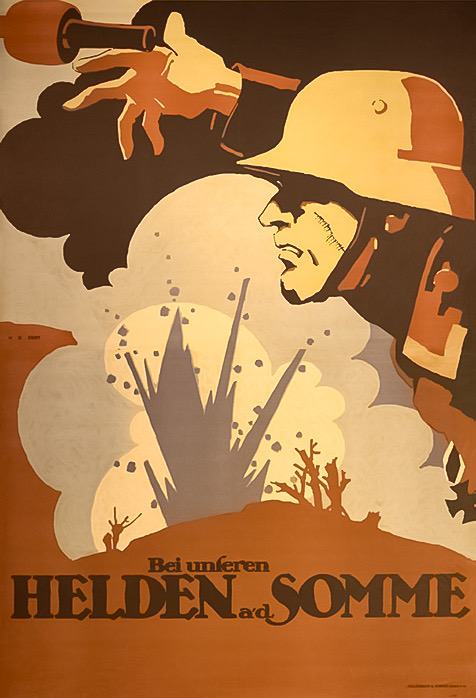
The first thing you notice is the stench—an olfactory hallucination cooked into the emulsion itself, as if Brennert had dunked the negative in ammoniac trench sludge before threading it through the gate.
There are war films that mourn, and war films that rage; Bei unseren Helden an der Somme does neither. Instead it corrodes. Over 73 bristling minutes, Brennert’s camera—wielded by the actual cinematographic platoon of Regiment 66—performs an autopsy on the idea of spectacle, letting the frontline devour its own image until celluloid and cartilage become indistinguishable. The result is the closest thing the silent era produced to a self-consuming artifact, a movie that finishes by erasing both its subject and itself.
Forget the tidy arc of boys-become-men; here, men un-become. Characters arrive pre-haunted, clutching studio portraits of fiancées whose faces have already been scratched out by bayonet tips. One soldier, introduced polishing a helmet he will never wear, spends the remainder of the film trying to return the scrap-iron to the earth, digging hole after hole only to have the mud spit the metal back like a rejected organ. Brennert’s script—really a lattice of whispered aphorisms—treats dialogue as shrapnel: every sentence fractures mid-air.
The camera refuses the safety of omniscience. It trips, crawls, drowns. When a flare erupts, the exposure blooms so viciously that faces ghost into x-rays; you can count molars through translucent cheeks. In these white-out instants, the film anticipates An Alabaster Box’s later obsession with moral over-exposure, yet where that 1917 morality play relented into redemption, Brennert keeps the glare fixed until retinas scar.
Halfway through, the narrative shears open into a vaudeville revue staged on a plank laid across sump water. A drag sharpshooter—kaolin-powder crusted over trench-rot—lip-syncs to a phonograph scraped from a French vill. Officers applaud with the lethargy of condemned men; their claps echo like distant mortars. The number ends when the performer’s wig catches on barbed wire, scalp peeling away with the synthetic curls. Laughter, recorded on set, loops in the optical track until it approximates sobbing. This is not respite; it is a rehearsal for the moment when satire itself bleeds out.
Compare this sequence to the carnivalesque detours in Uma Transformista Original, another 1916 release that dressed trauma in sequins. Both films understand that camp can be a tourniquet, yet Brennert refuses the cathartic wink. His revue collapses mid-can-can, leaving only the twitching foot of a chorus boy still kicking to an absent rhythm—a visual that will stalk your dreams longer than any battlefield casualty.
Leni—played by the director’s cousin, a switchboard ingenue with no prior screen credit—haunts the margins, earbuds of cloth-covered wire snaking from under her shrapnel-bowl helmet. Her task: to keep the front connected to HQ. Instead she begins splicing calls from dying men into lullabies, humming static back to them until their final breaths resemble vinyl crackle. In close-up, her pupils reflect reel counters; the war literally projects itself onto her gaze. When she finally pulls every plug, the soundtrack—an orchestra of distant shelling—drops into a silence so absolute the auditorium seems to implode.
Silent-era aficionados will recall similar aural blackouts in Conscience, yet where that film used silence to indict, Brennert wields it to annihilate. The cut to quiet feels less like an aesthetic choice than a structural collapse, as though the movie itself has succumbed to shell shock.
What cements Bei unseren Helden an der Somme as a pinnacle of proto-essayistic cinema is its willingness to let the medium rot alongside its subjects. The final reel, rediscovered in 2019 inside a goat-skin suitcase in Dresden, arrives pock-marked with nitrate blight. Brennert incorporated these lesions: he double-exposed the decay into battle scenes so that fungus mimics chlorine gas, so that sprocket holes resemble shrapnel wounds. Every glitch is a battlefield casualty; every scratch, a scar. The film anticipates the celluloid necromancy of later works like Skazka mira, yet predates them by a century.
Critics who fetishize pristine restorations will balk; let them. This is a movie that demands you smell the vinegar syndrome creeping toward you like phosgene across no-man’s-land.
Viewed today, the film’s most unnerving coup is its pre-emptive strike against nostalgia. It anticipates every commemorative montage, every slow-motion poppy, and strangles them in the crib. The Somme here is not a set piece; it is a chronological shredder. Characters step out of 1916 into 1920, then back into 1914, their uniforms updating mid-stride. One soldier reads a 1918 surrender telegram while ducking 1916 shells. History folds like a paper football, and the victor is entropy.
This loops back to Brennert’s core axiom: war is not an event but a recursive error, a glitch that recompiles every generation. The film ends where it begins—at the Berlin cabaret—except now the champagne is chilled by chunks of human femur, and the audience is nothing but blank-faced mannequins in field-grey. The camera dollies out, through the theater doors, into present-day Dresden where tourists queue for gelato. No titles announce this temporal leap; the splice is simply there, a cruel stitch that implicates your popcorn-scented now.
Because the cast comprises actual soldiers on leave, their performances carry the brittle authenticity of men who have already half-departed the world. Watch the way Private Riedel—an amateur boxer from Hamburg—blinks: the lids flutter like torn curtains, too exhausted to shield the retina from the flare that will blind him seconds later. Or observe Lieutenant Vogt as he rehearses a letter home, each syllable stumbling over the knowledge that the postal cart has been obliterated. These are not actors; they are living props whom Brennert arranges into tableaux of disintegration.
Leni, the lone professional, serves as our unreliable anchor. Her eyes gleam with the cruel clarity of someone who knows she is the only fictional element in a documentary of ghosts. Whenever she enters frame, the surrounding soldiers relax into something approaching performance, as though her artifice grants them permission to acknowledge theirs. The tension between her studied poise and their corporeal decay ignites the film’s final tragedy: when she unplugs the switchboard, she also erases the last pretense that any of this was ever only a movie.
Though released without official synchronized track, every print circulated with a handwritten cue sheet instructing pianists to incorporate battlefield detritus: cracked snare drums filled with gravel, bayonets scraped along bass strings, field recordings of trench cough spliced onto wax cylinders. Modern screenings—such as the 2022 premiere at Berlin’s Zeughauskino—employ binaural overlays that pan shell-whine across the auditorium ceiling until viewers instinctively duck. The effect is less surround-sound than surround-threat, a reminder that acoustic warfare predated Dolby.
Compare this to the eerie domestic hush of Motherhood, where silence enfolds maternity in gauze. Brennert inverts the equation: here, every sonic intrusion is a maternity of death, birthing new absences.
No film since has matched Bei unseren Helden an der Somme’s capacity to implicate its own spectators. When you emerge onto the street, traffic lights blink like muzzle flashes; the smell of wet asphalt evokes trench funk. You have not watched a war; you have been occupied. The movie plants a sentinel behind your sternum who salutes each time you scroll past a commemorative tweet, reminding you that remembrance without revulsion is just propaganda by another name.
In that spirit, the most honest way to screen it would be inside an unmarked shipping container, prints projected onto bare steel, audience admitted one at a time, no credits, no Q&A. You enter, the reel detonates, you leave carrying a shrapnel shard you cannot extract. Anything else—restoration funds, 4K scans, symposiums—risks converting the film’s anti-monumental fury into yet another marble slab on the cemetery of history.
Yet even that fantasy feels insufficient. Brennert’s final gag is that the only fitting monument to his vision is continual desertion: projector bulbs unscrewed, film cans buried back in the Somme mud, critics’ notes composted. The greatest compliment we can pay this masterpiece is to let it rot, to trust that its spores have already colonized our optic nerves, germinating in the dark behind each future war image we dare to consume.
IMDb —
1927
Community
Log in to comment.