DbcultAccessing Vault...
Cult Review
Senior Film Conservator
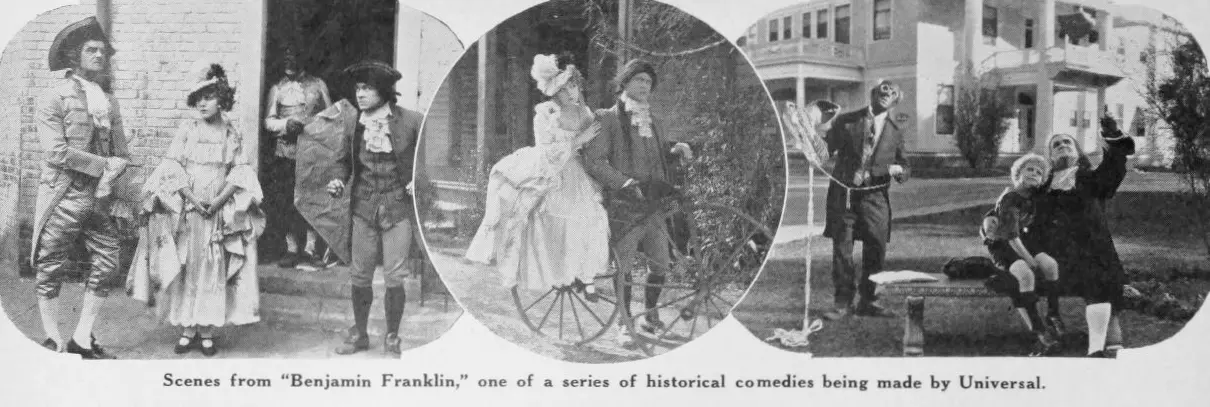
The year 1924 was a period of profound cinematic experimentation, a time when the language of film was still being forged in the fires of vaudeville and the burgeoning avant-garde. Among the more eccentric artifacts of this era is the short comedy Benjamin Franklin, a film that treats the sacrosanct history of the American Revolution with the irreverent playfulness of a carnival barker. To watch this film today is to witness the birth of the historical parody, a genre that would eventually evolve into the biting satire of the modern age, yet here it remains firmly rooted in the physical anarchy of the silent era.
While many films of the early 1920s sought to elevate the medium through grand historical epics—think of the sweeping drama in The White Sister (1923)—this production takes the opposite trajectory. It engages in 'burlesque' in the most traditional sense: the comic imitation of a serious subject. The kite experiment, often depicted as a moment of serene intellectual triumph, is reimagined as a catalyst for a domestic riot. Lewis Sargent, stepping into the buckle-shoes of Franklin, eschews the gravitas of the statesman for the frantic energy of a man who has accidentally summoned a demon.
The narrative structure is deceptively simple, yet its execution reveals a sophisticated understanding of early trick photography. The lightning is not merely a spark; it is a character. Once Franklin 'captures' it, the film abandons all pretense of historical accuracy to embrace a proto-sci-fi aesthetic. The lightning chases the protagonists through the house, a sequence that requires a rhythmic editing style more common in the frantic chases of The High Horse than in typical period pieces. The visual representation of the electricity—likely achieved through scratching the negative or double exposure—provides a jagged, visceral texture that contrasts sharply with the static, stage-like sets.
Lewis Sargent’s performance is a revelation of kinetic comedy. Best known for his portrayal of Huckleberry Finn, Sargent brings a youthful, almost mischievous agility to the role of Franklin. He doesn't play the man on the hundred-dollar bill; he plays a tinkerer obsessed with the impossible. His interactions with Billy Franey, who plays the servant, are choreographed with a precision that rivals the contemporary work of Buster Keaton. The two actors move in a synchronized panic, their bodies contorting to avoid the 'living' lightning in a way that highlights the era's fascination with the dangers of new technology.
This dynamic is notably different from the more grounded performances found in The Heart of Youth or the romantic tensions of Marooned Hearts. In Benjamin Franklin, the human element is secondary to the gag. The characters are archetypes caught in a mechanical whirlwind. The servant, while portrayed through the regrettable racial lens of the 1920s, is nonetheless integral to the film's mechanical humor, acting as the primary pilot of the lightning-powered bicycle that serves as the film's climactic invention.
The 'lightning in a box' concept is a masterstroke of early cinematic imagination. It suggests a world where the laws of physics are subject to the whims of the director. When the servant uses this bottled energy to propel an old-fashioned bicycle, the film enters the realm of the absurd. The chase that follows—involving a 'doubting rival'—is a tour de force of location shooting and speed-ramping. This sequence echoes the frantic energy of The Spitfire, where the environment itself becomes an obstacle for the protagonist.
The use of the bicycle as a high-speed vehicle, powered by literal heavenly fire, serves as a metaphor for the rapid industrialization of the 1920s. Franklin, the inventor, is not just discovering electricity; he is commodifying it for the sake of a petty rivalry. This subtext, whether intentional or a byproduct of the slapstick format, adds a layer of irony that is often missing from more earnest silent films like The Reed Case or the somber Pieces of Silver: A Story of Hearts and Souls.
To understand the impact of Benjamin Franklin, one must look at the diverse output of 1924. While international cinema was exploring psychological depths in films like Kärlek och hypnotism or the adventurous grit of Die Jagd nach dem Tode, the American short comedy was perfecting the 'burlesque.' This film shares more DNA with the frantic pacing of The Eleventh Hour than with the romanticism of La gitana blanca.
The film’s reliance on trick photography places it in a lineage of cinematic magicians. Unlike the documentary realism of Fishing for Tarpon, Benjamin Franklin revels in the artificial. The lightning effects, while primitive, possess a hand-crafted charm that modern CGI cannot replicate. There is a tangible sense of the filmmaker’s hand—the literal scratching of the film strip to create the illusion of light. This tactile quality makes the supernatural elements feel more integrated into the physical world of the actors.
The 'doubting rival' provides the necessary narrative friction. In silent comedy, the rival is often a figure of rigid authority or unearned confidence, making their eventual defeat by a lightning-powered bicycle all the more satisfying. This trope is a staple of the genre, seen in various forms in Up or Down? and The Night Hawk. However, the sheer absurdity of the technological 'deus ex machina' here sets it apart. The bicycle doesn't just win the race; it obliterates the competition through sheer, chaotic energy.
The resolution, where Franklin finally tames the element he sought to understand, feels less like a scientific victory and more like a tamer finishing a circus act. The box, holding the captured lightning, becomes a symbol of the era’s desire to harness the uncontrollable. While a film like Byl první máj might focus on the seasonal shifts of the human heart, Benjamin Franklin is obsessed with the mechanical shifts of the modern world.
Ultimately, Benjamin Franklin (1924) is a fascinating document of how early cinema processed history. It suggests that the past is not a static museum to be respected, but a playground for the imagination. By stripping Franklin of his diplomatic dignity and placing him in a slapstick chase, the filmmakers humanized a myth—albeit through the lens of the ridiculous. The film stands as a testament to the power of trick photography to create wonder out of thin air, or in this case, out of a kite string and a key.
For the modern viewer, the film offers a double-layered experience: it is both a window into the 18th-century mythos and a time capsule of 20th-century comedic sensibilities. It lacks the narrative complexity of modern biopics, but it possesses a raw, uninhibited joy that is often lost in more 'serious' historical dramas. It reminds us that at the heart of every great discovery is a bit of madness, a lot of movement, and perhaps, a lightning-powered bicycle waiting to chase down the doubters.
IMDb —
1930
Community
Log in to comment.