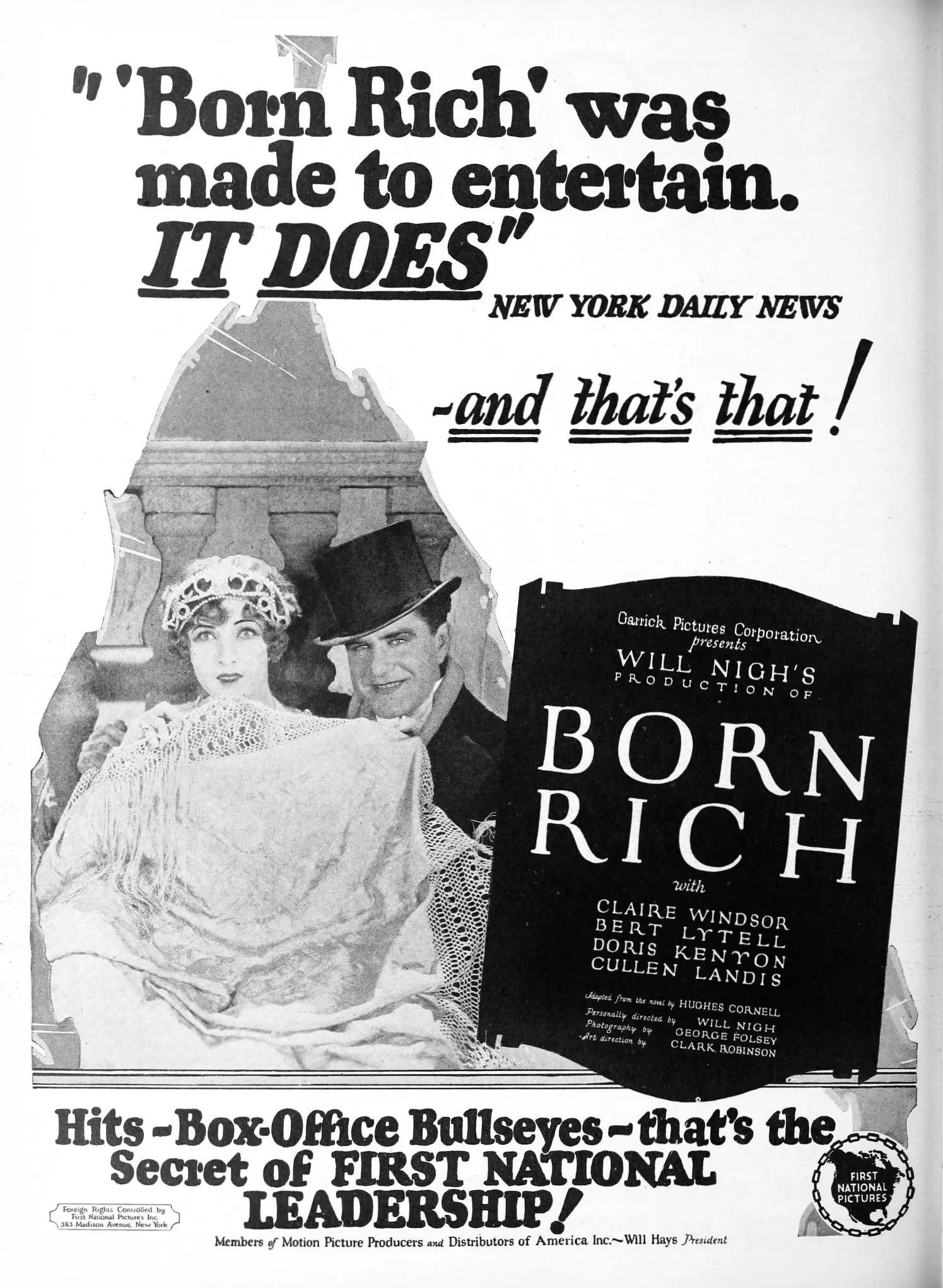
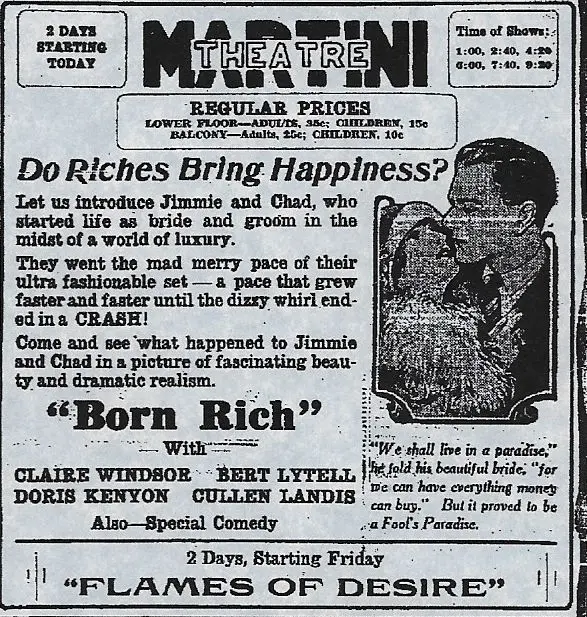
In the pantheon of silent-era domestic dramas, William Nigh’s 1924 effort, Born Rich, stands as a hauntingly prescient indictment of the sybaritic lifestyle that defined the American elite during the interwar period. While many films of the era sought to glamorize the burgeoning 'flapper' culture, Nigh, alongside writers Hughes Cornell and Walter DeLeon, peels back the gilded veneer to reveal a rot of emotional stagnation and moral vacuity. This isn't merely a story of a husband wandering; it is a clinical observation of how wealth acts as a solvent for character.
Scene from Born Rich
Cinematic perspective: Exploring the visual vocabulary of Born Rich (1924) through its definitive frames.
The narrative machinery is set in motion when a young socialite (portrayed with a luminous yet tragic fragility by Doris Kenyon) departs for the Continent. Her destination is France—a recurring motif in 1920s cinema representing both ancestral roots and a dangerous liberation from American Puritanism. However, the irony lies in the fact that while she seeks the comfort of family, her husband (a nuanced, pre-Wizard of Oz Frank Morgan) finds solace in the arms of a flapper. This 'new woman,' played with predatory grace by Claire Windsor, represents the antithesis of the domestic ideal. Unlike the protagonists in The Delicious Little Devil, where the flapper persona is often a mask for virtue, Windsor’s character is the catalyst for a genuine existential collapse.
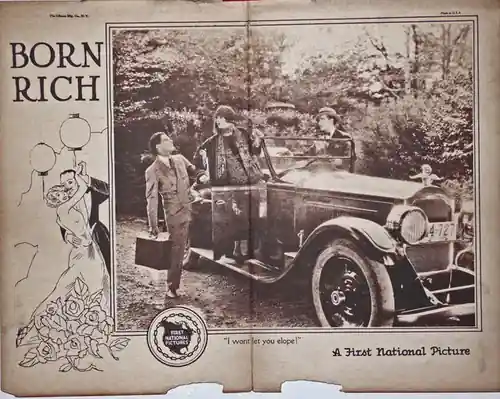
Scene from Born Rich
Cinematic perspective: Exploring the visual vocabulary of Born Rich (1924) through its definitive frames.
The Performative Jealousy and the Jazz Inflection
Upon the wife's return, the film shifts from a standard infidelity drama into a psychological chess match. Kenyon’s character, realizing the depth of her husband’s estrangement, decides to fight fire with fire—or rather, to fight the saxophone with the double bass. She feigns an infatuation with a jazz musician, a role that serves as a fascinating cultural signifier. In 1924, jazz was the sonic manifestation of rebellion, a 'low-brow' intrusion into the 'high-brow' parlors of the wealthy. By aligning herself with this musical 'other,' she isn't just trying to make her husband jealous; she is threatening to desecrate their social standing. It is a desperate, high-stakes gamble that mirrors the thematic intensity found in Das Laster, though Nigh’s approach is distinctly American in its focus on the transactional nature of affection.
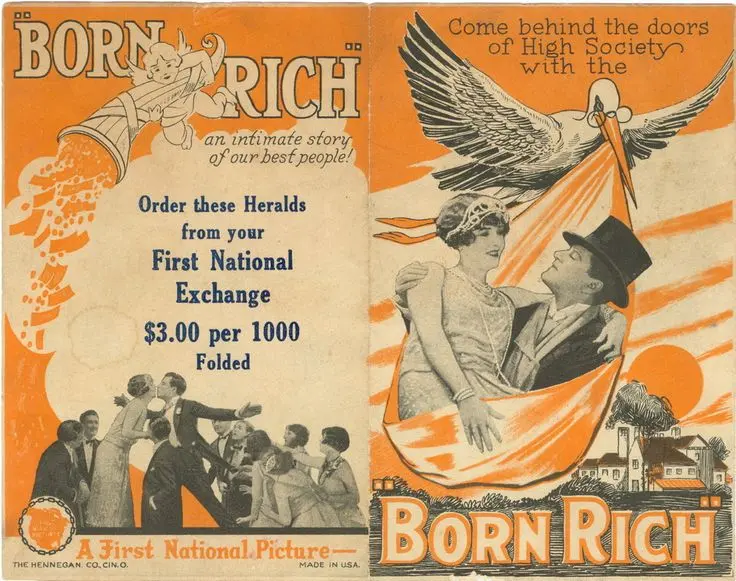
Scene from Born Rich
Cinematic perspective: Exploring the visual vocabulary of Born Rich (1924) through its definitive frames.
"The tragedy of 'Born Rich' is not that the characters lose their money, but that their money has rendered them incapable of feeling anything that isn't mediated by performance."
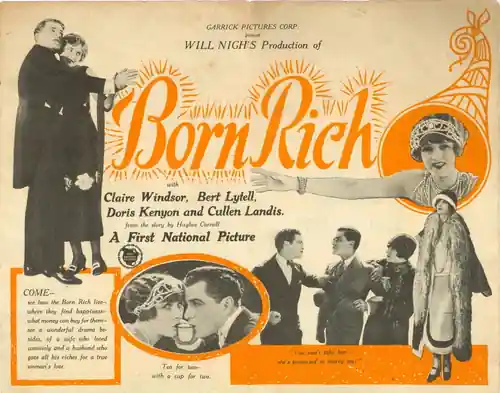
Scene from Born Rich
Cinematic perspective: Exploring the visual vocabulary of Born Rich (1924) through its definitive frames.
As the plot unfolds, the expected payoff—a husband’s realization and subsequent repentance—is subverted in a way that must have been jarring for contemporary audiences. Instead of the jealous rage that might lead to a cinematic reconciliation, Morgan’s character sinks into a profound, alcohol-fueled depression. This is where Born Rich diverges from more lighthearted fare like Up in Mary's Attic or the situational comedy of Cold Feet. The husband’s retreat into 'booze and even more affairs' is a harrowing depiction of what we would now call a clinical depressive spiral, fueled by the very resources that were supposed to make him happy.
Scene from Born Rich
Cinematic perspective: Exploring the visual vocabulary of Born Rich (1924) through its definitive frames.
Cinematographic Language and the Shadow of Excess
William Nigh’s direction is surprisingly sophisticated for the mid-twenties. He uses the architecture of the wealthy—the cavernous hallways, the over-stuffed drawing rooms—to emphasize the isolation of the individuals within them. There is a sense of 'horror vacui' in the set design; every frame is filled with objects, yet the characters remain spiritually empty. This visual density stands in stark contrast to the minimalist, kinetic energy of A Zuni Kicking Race, where the movement is purposeful and grounded in tradition. In Born Rich, the movement is aimless, a frantic dance on the edge of a precipice.
The supporting cast, including the likes of J. Barney Sherry and Maude Turner Gordon, provides a solid foundation of 'old money' respectability that serves to highlight the instability of the younger generation. Cullen Landis and Bert Lytell also deliver performances that anchor the film’s more melodramatic tendencies. However, it is the writing of Harriete Underhill and Walter DeLeon that truly shines. They manage to imbue the intertitles with a sharp, almost cynical wit that feels like a precursor to the screwball comedies of the next decade, yet they never lose sight of the central tragedy. The dialogue—or the silent equivalent—captures the malaise of a generation that has everything and values nothing.
When comparing this to other films of the period, such as Little Miss Fortune or Overalls, the class distinctions become even more apparent. While those films often deal with the struggle for upward mobility, Born Rich is obsessed with the inertia of downward mobility within the upper class. It shares a certain thematic DNA with The Offenders, but where that film looks at the societal impact of crime, Nigh’s film looks at the personal impact of moral apathy.
The Dipsomaniac Descent: A Portent of the Great Depression
The final act of the film is a masterclass in tension. The husband’s descent into alcoholism is handled with a realism that is rare for the era. Frank Morgan avoids the 'funny drunk' tropes that would later become a staple of his career, instead opting for a performance of quiet desperation. His refuge in booze is not an escape, but a prison. This portrayal of addiction as a symptom of a deeper spiritual malaise is far more sophisticated than the moralizing found in Fresh Paint. Here, the 'paint' is the veneer of wealth, and it is peeling away to reveal something quite ugly.
Even the presence of child actor Jackie Ott serves a purpose beyond mere sentimentality. The child becomes a silent witness to the destruction of the family unit, a motif that Nigh uses to ground the high-society drama in a more universal human context. It reminds one of the innocence lost in Little Robinson Crusoe, though the island here is one of isolation within a crowded city. The film’s refusal to provide a clean, happy ending is perhaps its greatest strength. It acknowledges that some fractures are too deep to be mended by a simple apology or a change of heart.
In the broader context of 1924, a year that gave us the 1915 World's Championship Series retrospectives and the mythological grandeur of Behula, Born Rich stands out for its contemporary bite. It doesn't look to the past or to myth for its themes; it looks directly into the mirrored ball of the local speakeasy and sees the distorted reflection of its audience. It is a film that demands to be rediscovered, not just as a piece of silent cinema history, but as a timeless exploration of the human capacity for self-destruction in the face of abundance. Whether compared to the historical weight of Rebecca the Jewess or the physical drama of Pedrucho, Nigh’s work remains a singular, biting critique of the American Dream gone sour.