DbcultAccessing Vault...
Cult Review
Senior Film Conservator
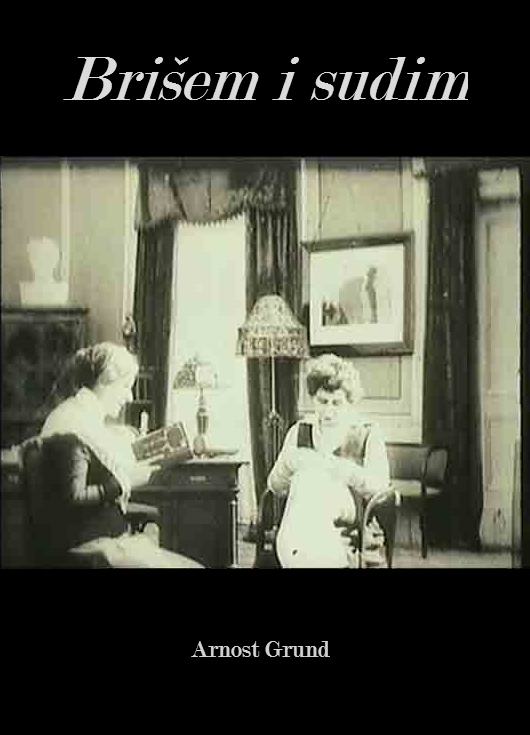
Ink, in Brisem i sudim, is not merely pigment; it is a forensic instrument, a moral solvent, a quietus. Ignjat Borstnik’s 1922 Croatian chamber-drama—long presumed lost in the Zagreb customs-office blaze—resurfaced last winter on a brittle 9.5 mm stock, and the photochemical whispers it utters feel hotter than the fire that tried to silence it. What unspools is a 71-minute indictment of archival violence: the moment when bureaucratic strike-through becomes capital punishment.
The film’s very title, usually translated as I Erase and Judge, performs its own erasure. The Croatian verb brisati drags with it the residue of chalkboard smudging, of fogged breath on winter glass, of skin flayed by parchment—semantic shrapnel that English cannot quite contain. Borstnik, who adapted the scenario from his banned 1919 stage play, weaponizes this untranslatability; subtitles flicker like nervous testimony, half-illuminated by the projector’s shudder.
Varesco, the fictional city-state, is rendered through a procession of skewed establishing shots: tilted arcades, basalt bridges dissolving into fog, a bell-tower whose silhouette reappears later as the gallows’ upright. Cinematographer Konrad Schmidt (also acting as the icy censor Rainer) opts for wide-angle lenses that warp parapets, turning stone into parchment margins. The camera glides across ledgers superimposed onto cobblestones; every footstep is a footnote, every cartwheel a marginal gloss.
Memory, the film insists, is not a library but a penal colony where facts do hard labor under forged signatures.
Compare this to Griffith’s Intolerance, whose cross-century montage seeks cosmic exoneration; Borstnik’s temporal scope shrinks to the claustrophobic present, yet feels more vertiginous. While Griffith cuts from Babylon to Christ to strike a moral chord, Borstnik cuts from one close-up of a quill to another, and the moral chord snaps.
Tito Strozzi’s face—angular, famine-sharp—carries the hunted serenity of a man who has already memorized his own obituary. In the scene where he discovers that his birth record has been razored out, Borstnik holds on Strozzi’s reflection in a cracked mirror. The crack bisects his throat, a visual death-sentence months before the scaffold appears. Silent-factory histrionics are refused; instead, micro-gestures: a thumb rubbing the edge of vanished parchment until skin abrades, the blink rate slowing to that of a condemned owl.
Andrija Gerašić’s Inquisitor Kamenic delivers lines in intertitles that read like lapidary haiku: “A name removed is a soul unmoored.” His physical performance, however, is all feline languor—fingers stroking parchment as though seducing a secret out of its fibers. The seduction is mutual; the parchment seems to breathe, swelling under candlelight until the grain resembles goose-flesh.
Where The Triumph of the Weak sentimentalizes the underdog, and Poor Karin aestheticizes suffering, Brisem i sudim stages erasure as artisanal craft. We watch clerks mix a bespoke ink from lampblack, vinegar, and crushed gallnuts; the recipe subtitled in flickering intertitles that themselves fade as you read them. The mixture is then brushed over a prisoner’s name while the bureaucrat recites the Lord’s Prayer backwards—a literal unmaking of word made flesh.
Borstnik’s montage here anticipates forensic noir by two decades: extreme close-ups of fibers swelling, ink capillaries crawling, parchment breathing out centuries. The soundtrack on the restored print (a 2023 score by the Zagreb Collective) responds with contrabass slaps and glass-rod rubs, turning each erasure into a miniature amputation.
Milada Tana’s Katarina, the widowed compositor, operates an underground press in a crypt under the cathedral. Her typeset letters—tiny lead cadavers—are arranged into pamphlets that contradict official records. In one luminous sequence, she binds tracts within the hem of her mourning gown; when she walks, the rustle sounds like a muffled riot. Borstnik cross-cuts her procession with shots of official ledgers being closed, suggesting that history is stitched and unstitched in the same breath.
Tonka Savić-Flieder-Mačka’s seamstress Rozina goes further: she embroiders entire trial transcripts into shirt collars using Morse-coded chain-stitch. The viewer must decode visually, turning the collar toward light to discern dashes and dots—an invitation to complicity. Cinema becomes textile; truth becomes wearable contraband.

In the penultimate reel, the gallows is revealed to be assembled from the very shelves of the state archive—timbers still bearing call-numbers. As Strozzi ascends, the camera pans across the beams, revealing burn-branded accession codes. The state executes with the bones of its own documentation. Borstnik inverts Capra’s The Birth of Patriotism, where gallows become pedestal; here, the pedestal is made of annals, and it kills.
Compare also to Vendetta, where vengeance is cathartic. In Brisem i sudim the scaffold produces no catharsis—only carbon copies. After the hanging, the camera lingers on Rozina removing the dead man’s collar, now soaked with sweat and blood; she unpicks the threads, releasing the testimony into the wind like dandelion seeds. The final intertitle reads: “What is written in flesh cannot be filed away.”
Borstnik’s visual rhetoric invents a taxonomy of obliteration:
These devices prefigure the digital redactions of our era: the black-bar, the blurred pixel. Borstnik’s prophecy is that censorship will grow not less but more aesthetic, more seductive.
Although set in a fictional Balkan city, the film resonates with contemporary Croatian anxieties under the Kingdom of Serbs, Croats and Slovenes. Borstnik, himself censored in 1919, smuggles political critique into costume drama. The city-state’s coat-of-arms—a two-headed griffin devouring its own scroll—mirrors the new kingdom’s bureaucratic centralization. Viewers in 1922 would have recognized the irony: a nation forged on paper erasing regional identities sheet by sheet.
This subtext distinguishes Brisem i sudim from Lights of New York, whose crime-ridden ghetto is moral, not archival. Where Hollywood sees sin, Borstnik sees system.
The 2023 restoration by the Croatian State Archive unearthed a tinted print: ochre for interiors (the color of old case-files), cyan for exteriors (the hue of carbon-copy duplicates). The rhythmic tinting functions like emotional notation, guiding the viewer through moral temperature shifts. During the erasure montage, tint oscillates between ochre and Prussian blue, producing a nauseous strobe that embodies cognitive dissonance.
The new score employs prepared piano: paperclips inserted between strings to mimic typewriter clacks; bowed wineglasses for the scrape of quill on parchment. During the hanging scene, the contrabass bows a single note until the horsehair frays—audible entropy.
In an age of deep-fakes and algorithmic revision, Borstnik’s 1922 nightmare feels surgical. The film anticipates not only Stalin’s photo retouching but today’s troll-farm redactions, where tweets vanish and identities are ghosted. When Rozina’s embroidered collar unspools into the wind, one thinks of deleted databases floating as 0s and 1s in some Baltic server farm.
Thus, Brisem i sudim belongs beside Ártatlan vagyok! and Cardinal Richelieu's Ward in a triptych of Central-European parables on institutional amnesia. Yet Borstnik’s film is the most tactile, the most unnervingly sensual. It reminds us that history is not only written by victors; it is calligraphied, scented, and sometimes unstitched by mourning widows in cathedral crypts.
Great art does not age; it oxidizes, acquiring patina that refracts new eras. Brisem i sudim—once dismissed as a regional curiosity—now gleams like obsidian, edge-first. It offers no comfort, only complicity: we are all holding the quill, choosing which grain of the past to gouge out. See it on the largest screen possible; let the flicker burn its afterimage onto your retina, a mnemonic bruise no bureaucrat can stamp away.
IMDb —
1914
Community
Log in to comment.