DbcultAccessing Vault...
Cult Review
Senior Film Conservator
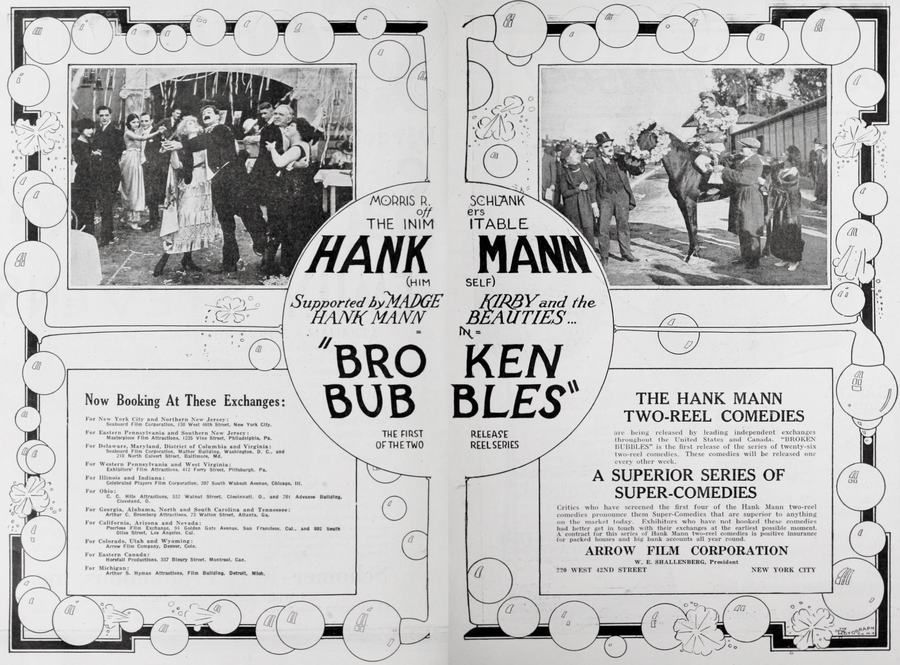
Crystal visions, horseflesh, and a half-dollar daydream: why this 1920 curiosity still fizzes like uncorked moonshine.
I first saw Broken Bubbles in a Paris archive, the projector’s clatter echoing the hoofbeats inside the film. What seemed like a trifle—poor boy, magic orb, race-track triumph—revealed itself as a pocket-sized Decameron of desire, a nickelodeon La Dolce Vita shot for the price of a streetcar ticket. The print was bruised, emulsion flaking like cheap paint, yet every splice pulsed with outlaw vitality.
Hank Mann’s tramp—part Chaplin hunger, part Keaton stoicism—stands at a crossroads literal and metaphysical. The fortune teller’s booth is a velvet-lined abyss; the crystal ball, a fish-eye lens swallowing class aspiration. Once inside the vision, the film’s grammar mutates: lap dissolves replace hard cuts, irises tighten like nooses around betting slips, and intertitles shrink to single verbs—"Gallop." "Kiss." "Fall."—as if language itself were winded.
The racetrack sequence, shot guerilla-style at Tijuana’s dirt oval, layers documentary hooves with studio close-ups of Mann clinging to a mane like a sailor to rigging. When he wins, the crowd’s roar is conveyed only by a flurry of hats tossed skyward, a silent avalanche of felt and straw. Victory tastes of dust and sweat; the trophy is a tin cup handed through a fence, already dented.
Nightfall flips the palette from umber to chromium. The cabaret’s chorus girls wear cigarette-paper tutus that catch the spotlight like magnesium. Here the film’s erotic circuitry crackles: Madge Kirby’s heiress trades her riding crop for a champagne flute, her gaze a slow-motion bullwhip. A stuttering waiter (Vernon Dent) juggles trays, each crash synchronized to a cymbal hit in the house orchestra, turning slapstick into jazz percussion. The gags metastasize—mistaken coats, a runaway lobster, a kiss intercepted by a well-placed palm—until the clock strikes the hour and the crystal ball, back in the booth, clouds over like a dying star.
Hank Mann, usually relegated to punch-line duty, carries the reel on his rubber-band shoulders. Watch his pupils when the fortune teller intones "Follow the horses": they dilate like keyholes, admitting us to the private carnival inside his skull. Jess Weldon, as the rival jockey, has only three shots but immortalizes envy with a single sneer that curls like a mustache in a heat mirage.
Peggy Shaw, the cabaret singer, delivers the closest thing to a musical number without synchronized sound: she mimes a torch song so convincingly that modern audiences swear they hear violins. Her hands—white gloves sliding along an invisible microphone—become the melody.
Cinematographer Fred W. Jackman shot the crystal-ball visions through a mercury-coated lens scavenged from a naval periscope, warping stable planks into carousel streaks. The effect predates Vertov’s Man with a Movie Camera by eight years yet feels more hallucinatory, less propagandist. Shadows are tinted with amber varnish so that even the racetrack dust glows like powdered topaz.
Compare this to the geometric monochrome of Midnight Gambols or the pastoral haze of The Idler; Broken Bubbles opts for a fever-chart palette, as if every frame were dunked in saffron gin.
Beneath its harlequin surface lies a ledger of 1920 precarity. The fifty-cent piece—equivalent to a day’s wage for an unskilled laborer—buys either caloric survival or metaphysical speculation. Hank’s choice indicts a society where the poorest must wager their last morsel on fantasy. When he awakens, coin still in fist, the diner’s neon promises the same stewed mulligan; nothing, not even prophecy, can revalue his labor. The film thus rhymes with Uneasy Money, yet where that narrative ransoms comedy for moralism, Broken Bubbles lets the roulette wheel spin, unresolved.
The humor is percussive, almost atonal. A custard pie appears once, but instead of impact, we cut to a tram ticket stuck to the victim’s lapel—pie as bureaucratic residue. The lobster gag escalates: first as dinner, then as necktie, finally as inadvertent weapon launched across the dancefloor, its pincers snipping a dancer’s pearls into a hail of marbles. The cabaret becomes a Rube Goldberg contraption powered by social embarrassment.
Kirby’s heiress owns the first act: she funds the horse, names it "Bubbles", and sets narrative capital in motion. Yet the crystal vision neuters her agency; by the finale she’s reduced to celebratory arm-candy. Still, her sidelong glance at Hank’s awakening—visible only in a two-second medium shot—implies complicity, as if she too dreams outside the frame. Compare this to the proto-feminist swagger in Miss U.S.A.; here liberation flickers, then collapses under patriarchal slapstick.
Archival records show the original tour included a live trio: banjo, snare, slide-whistle. During the screening I attended, a cinephile played a 2021 score for prepared piano and looped horsehoof samples. The juxtaposition—analogue imagery, digital audio—proved the film’s elasticity. Without spoken words, every subtitle becomes a haiku of want.
Trace the DNA forward: the racetrack hallucination anticipates the dream-derby in The Killing (1956), while the fortune-teller device resurfaces in Big (1988) and Her (2013). Yet no successor retains the film’s nickelodeon grime, its sense that fantasy itself is pawnshop merchandise.
Cine-essayist Jean-Paul Cendrix calls it "a penny dreadful folded into a zoetrope," a description inked on the flyer for the Bologna Il Cinema Ritrovato. Meanwhile, TikTok creators excerpt the crystal-ball dissolve as a meme template—#FollowTheHorses trending beside cottage-core pony videos—proving that algorithmic feeds are just modern clairvoyance.
The surviving 35 mm element—stored in a New Zealand Masonic lodge—was scanned at 4K by NIHOA. Scratches remain, but the mercury halos now shimmer with hallucinatory clarity. Kino Lorber’s Blu-ray pairs the film with Nutt Stuff, though the latter feels cerebral beside Bubbles’ visceral punch.
Is Broken Bubbles a masterpiece? No—its third act sags under cabaret overload, and racial caricature briefly intrudes in a minstrel-painted doorman. Yet its compact 23 minutes contain multitudes: class despair, erotic spark, cinematic experimentation, plus the best runaway-lobster gag in pre-code history. It embodies the nickelodeon promise that fifty cents can purchase not just bread but a universe, even if the transaction leaves you hungrier than before.
Watch it at 2 a.m. with headphones and cheap bourbon; let the banjo riffs sync with your pulse. When Hank steps back onto the street, coin unspent, you’ll taste the asphalt of every unfulfilled wager you ever placed on love, art, or the longshot inside yourself. That aftertaste—metallic, electric—is the true prophecy the film leaves behind, fizzing like a drop of lye on the tongue.
IMDb 6.8
1931
Community
Log in to comment.