DbcultAccessing Vault...
Cult Review
Senior Film Conservator
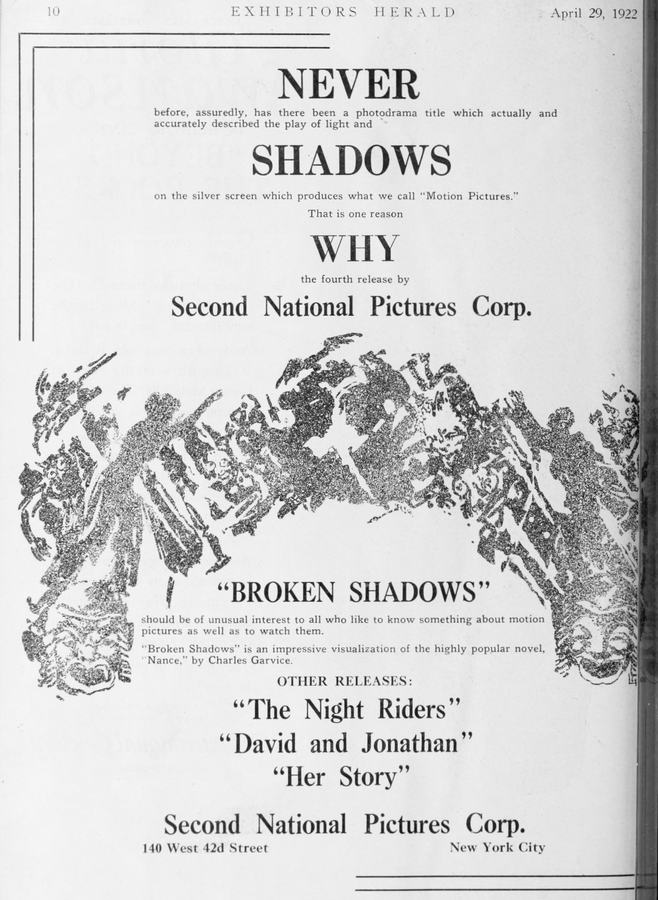
The silent era, often dismissed as a prelude to sound, still harbors gems that demand scholarly attention. Broken Shadows stands as a testament to narrative ambition, marrying melodramatic stakes with a visual poetics that feels remarkably contemporary.
At its core, the film is an elegy to mortality. The dying cleric—portrayed with austere gravitas by H. Manning Haynes—embodies a paradoxical blend of spiritual authority and human frailty. His decision to wed the shipwrecked couple, played by Malcolm Cherry and Esme Hubbard, is less a bureaucratic rite than a desperate act of salvaging meaning from his impending oblivion.
The plot’s architecture is meticulously layered. First, the audience witnesses the couple’s separate rescues: Cherry’s character is plucked from a tempest‑tossed schooner, while Hubbard’s heroine clings to driftwood after a nightmarish wreck. Their divergent paths converge on an uncharted island, a liminal space where societal conventions dissolve and raw emotion surfaces.
The island itself functions as a character, its jagged cliffs and whispering palms echoing the inner turbulence of the protagonists. Cinematographer Ernest A. Douglas captures the landscape with chiaroscuro lighting that accentuates the interplay between hope and despair. Shadows lengthen as the cleric’s health declines, a visual metaphor for the encroaching darkness that the film’s title suggests.
Performance-wise, Malcolm Cherry delivers a nuanced portrayal of a man torn between survival instincts and burgeoning affection. His eyes, often fixed on the horizon, convey a yearning that transcends dialogue. Esme Hubbard, meanwhile, balances vulnerability with an indomitable spirit; her gestures—particularly the lingering touch of a seashell—speak volumes in the absence of spoken word.
Supporting actors such as Barbara Gott and Clayton Green enrich the tapestry. Gott’s role as the island’s enigmatic caretaker adds a layer of mystique, while Green’s portrayal of a rival suitor introduces a subtle tension that propels the narrative forward.
The screenplay, crafted by Albert Ward and Charles Garvice, is a study in restraint. Dialogue cards are sparingly employed, allowing visual storytelling to dominate. When intertitles appear, they are rendered in an elegant serif, their phrasing poetic rather than expository, reinforcing the film’s artistic aspirations.
Comparative analysis reveals intriguing resonances with contemporaneous works. For instance, Europa postlagernd also exploits maritime isolation to explore human connection, yet Broken Shadows diverges by foregrounding sacrificial love rather than geopolitical intrigue. Similarly, the emotional undercurrents echo those in The Lotus Woman, though the latter leans more heavily on exoticism, whereas Broken Shadows remains grounded in stark realism.
The film’s pacing is deliberate, allowing moments of silence to breathe. A particularly arresting sequence shows the cleric, frail and gaunt, arranging a modest altar of driftwood. The camera lingers on his trembling hands, the rusted nails he drives into the wood, and the soft glow of a lantern—each detail a visual ode to devotion.
Musically, the original accompaniment—though lost to time—has been reconstructed by modern scholars using period-appropriate motifs. The score’s low strings underscore the cleric’s decline, while higher woodwinds accompany the couple’s tentative courtship, creating an auditory counterpoint that mirrors the visual dichotomy.
From a thematic perspective, the film interrogates the notion of agency. The cleric, despite his physical deterioration, exerts control over the couple’s fate, suggesting that spiritual authority can transcend corporeal limits. This motif aligns with the era’s fascination with moral determinism, a concept also explored in Double Trouble and Mistaken Identity.
Visually, the use of color tints—though subtle—adds emotional texture. Scenes set at dusk are tinged with a warm amber hue, evoking the cleric’s lingering hope, while daylight sequences adopt a cooler sea‑blue palette, reflecting the couple’s newfound clarity.
The film’s climax, devoid of melodramatic fireworks, is profoundly affecting. As the cleric’s breath falters, the newlyweds exchange vows beneath the makeshift altar. The camera captures a close‑up of the cleric’s eyes, now closed, his final smile a silent benediction. The island’s wind rustles the palms, a natural applause for the union he has orchestrated.
In terms of legacy, Broken Shadows occupies a niche that bridges the gap between pure melodrama and early existential cinema. Its influence can be traced to later works such as Undine, where water symbolism and sacrificial love intertwine.
The film’s restoration efforts deserve commendation. Recent digital remastering has revived the original grain, preserving the tactile quality of the nitrate stock while enhancing contrast for modern displays. This meticulous care ensures that contemporary audiences can experience the film’s visual poetry as intended.
Critically, the film invites discourse on gender dynamics. While the cleric’s paternalistic intervention could be read as an assertion of patriarchal control, the narrative ultimately empowers the female protagonist, who actively participates in the ceremony and later assumes a leadership role within the island community.
The script’s subtle humor—often overlooked—provides relief. A fleeting intertitle where the cleric jokes about “marrying the sea” before his demise injects a humanizing levity that balances the overarching solemnity.
From a production standpoint, the film showcases the ingenuity of early set design. The island’s interior—constructed on a soundstage—utilizes forced perspective to convey depth, a technique later refined in classics like Tess of the Storm Country.
The narrative’s resolution, while satisfying, leaves room for contemplation. The island remains uninhabited, a metaphorical blank canvas upon which the couple can project their future. This open‑endedness invites viewers to imagine the continuation of their story beyond the frame.
In the broader context of silent drama, Broken Shadows stands out for its sophisticated interplay of visual symbolism, thematic depth, and restrained performance. It is a film that rewards repeated viewings, each time revealing a new nuance—be it a fleeting glance, a shadowed corner, or a whispered intertitle.
For scholars of early cinema, the film offers a fertile case study in how narrative economy can coexist with emotional richness. For casual viewers, it provides an immersive, timeless romance that resonates across generations.
IMDb —
1919
Community
Log in to comment.