DbcultAccessing Vault...
Cult Review
Senior Film Conservator
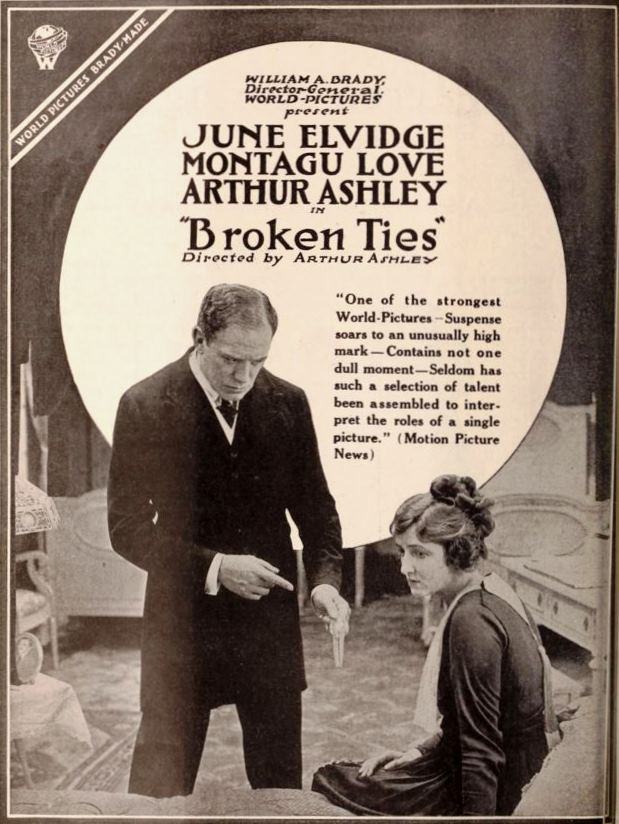
The year 1918 remains an enigmatic waypoint in the evolution of the moving image—a period where the primitive energy of early shorts began to coalesce into the sophisticated, often heavy-handed moral epics of the silent era. Among these artifacts, Broken Ties emerges not merely as a relic of forgotten studio systems, but as a searing, if uncomfortable, exploration of identity, bloodlines, and the crushing weight of societal expectation. It is a film that breathes through its shadows, utilizing the stark chiaroscuro of early cinematography to mirror the fractured psyche of its protagonist, Corinne La Force.
Pinna Nesbit, an actress whose screen presence often bordered on the ethereal, delivers a performance in Broken Ties that demands a modern re-evaluation. As Corinne, she is tasked with embodying the 'tragic mulatto' trope—a narrative device that, while problematic by contemporary standards, provided silent cinema with some of its most potent dramatic tension. The film opens not in the sterile parlors of New York, but in the humid, chaotic aftermath of a West Indian shipwreck. This prologue establishes a visceral sense of displacement. Corinne is a creature of the periphery, neither fully anchored to the colonial structures of her father’s world nor the island society that birthed her.
Unlike the more whimsical explorations of heritage found in Poor Little Peppina, where identity is a costume to be swapped, Broken Ties treats race as an inescapable gravity. When Corinne is brought to the United States following her father’s demise, the film transitions into a claustrophobic domestic drama. The sets, designed with an almost oppressive Victorian density, serve as a cage. The camera lingers on Nesbit’s face, capturing the minute flickers of alienation as she moves through the Hasbrook estate—a space where she is ostensibly 'family' but fundamentally 'other.'
Montagu Love, an actor of formidable gravitas, portrays Henry Hasbrook with a chilling, paternalistic rigidity. His opposition to the union between Corinne and his nephew, Arnold Curtis (played with a certain weak-willed charm by Arthur Ashley), is framed not merely as a personal preference but as a defense of the 'purity' of the Hasbrook line. This conflict elevates the film from a standard romance to a sociological battleground. The tension is far more psychological than the overt adventure seen in The Adventures of Kathlyn; here, the monsters are not in the jungle, but in the drawing-room.
The murder of Hasbrook is the film’s pivot point. It is a scene handled with surprising restraint, focusing on the internal collapse of Corinne’s restraint rather than the mechanics of the act itself. In many ways, the killing is an act of reclamation—a desperate, violent attempt to sever the 'ties' that bind her to a man who views her as a genetic error. The fallout of this act introduces a secondary narrative layer: the illicit affair between Arnold and the married Marcia Fleming (June Elvidge). This subplot provides a stark contrast to Corinne’s earnest, if doomed, love. While Corinne fights for a place in the light, Marcia and Arnold skulk in the shadows of infidelity, a theme explored with perhaps less nuance in The Purple Lady.
The second act of Broken Ties transforms into a precursor to the modern legal thriller. When Arnold is arrested for the murder, the film enters a world of courtroom histrionics and moral paradoxes. John Fleming, Marcia’s husband and a man of unyielding principle, is ironically tasked with defending the man who has cuckolded him. This creates a fascinating triangle of suppressed guilt. Alec B. Francis, as John Fleming, provides a grounded, stoic counterpoint to the heightened emotions surrounding him. His discovery of his wife’s involvement is a masterclass in silent-era subtlety; the collapse of his domestic ideal is conveyed through the slump of his shoulders and the hollow stare of a man who has lost his compass.
The suspense here is palpable, echoing the tension of Kiss of Death. We are presented with a scenario where multiple characters are willing to sacrifice themselves for different versions of the 'truth.' Marcia is willing to let Arnold hang to save her reputation, while Arnold is willing to hang to save Marcia’s. It is a cynical, almost nihilistic view of the upper class—a group so obsessed with the appearance of virtue that they are willing to facilitate a literal execution to maintain it. This stands in sharp contrast to the blue-collar struggles depicted in Strejken, where the stakes are survival rather than social standing.
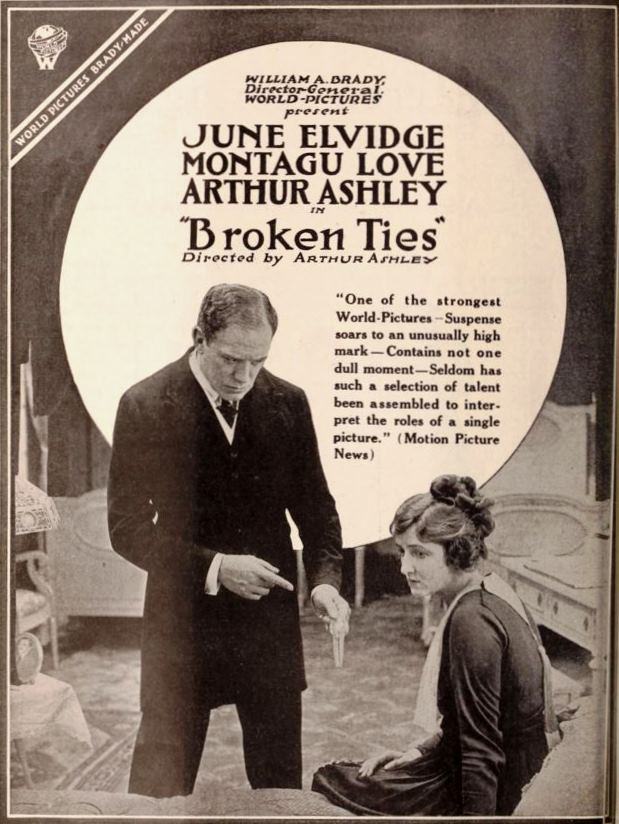
The climax of Broken Ties is both inevitable and devastating. Corinne, seeing the man she loves on the precipice of destruction, chooses to reveal her culpability. However, the film doesn't allow her a path to redemption through the law. Her confession is immediately followed by her suicide—a narrative choice that reinforces the era's belief that characters of mixed heritage could not be integrated into the social fabric, but must instead be 'purged' through tragedy. While this conclusion feels archaic and cruel to a modern viewer, Pinna Nesbit plays the moment with a haunting dignity. Her self-inflicted end is portrayed as an act of ultimate agency; she lived by others' rules, but she chooses to die by her own hand.
The final reconciliation between John and Marcia Fleming is perhaps the most unsettling aspect of the film. After the trauma of murder, infidelity, and the death of Corinne, the couple simply 'decides to pay more attention' to each other. It is a jarring return to the status quo that highlights the expendability of Corinne’s character. In the world of Broken Ties, the 'correct' social order is restored only after the 'disruptive' element—Corinne—is removed. This ending shares a certain thematic DNA with Chains of the Past, where the weight of history eventually crushes the possibility of a radical new future.
When comparing Broken Ties to its contemporaries, its unique blend of racial melodrama and legal thriller becomes evident. While Kennedy Square offers a more nostalgic, idealized view of Southern honor, Broken Ties is far more interested in the rot beneath the floorboards of respectable society. It lacks the whimsical escapism of Jack and the Beanstalk or the overt political messaging of Power, opting instead for a localized, intimate tragedy that reflects the anxieties of an America on the cusp of the Roaring Twenties.
The film also benefits from the stylistic flourishes of the World Film Corporation, a studio known for its 'Continental' influence. The lighting in the scene where Corinne admits her guilt has a proto-Expressionist quality that wouldn't look out of place in Az utolsó hajnal. There is a deliberate use of space to indicate power dynamics—Hasbrook is always filmed from low angles to emphasize his dominance, while Corinne is often framed against windows or doorways, suggesting her liminal status between the interior and the exterior worlds.
To watch Broken Ties today is to engage with a ghost. It is a film that captures the prejudices of its time with startling clarity, yet it also provides a platform for a powerhouse performance by Pinna Nesbit. It avoids the humdrum domesticity of Humdrum Brown and the stiff military formality of Brother Officers, choosing instead to wallow in the messy, violent intersections of love and identity. It is as much a cautionary tale about the dangers of societal rigidity as it is a melodrama about a murder.
Ultimately, the film serves as a reminder of the power of silent cinema to tackle complex themes through visual metaphor. The 'ties' of the title are not just the familial bonds of the Hasbrooks or the marital bonds of the Flemings; they are the invisible, suffocating threads of history and heritage that dictate who is allowed to love, who is allowed to live, and who is destined to be sacrificed at the altar of social cohesion. Like the tragic figures in Rainha Depois de Morta Inês de Castro, Corinne is a victim of a system that cannot reconcile her existence with its own survival. It is a bleak, beautiful, and deeply evocative piece of cinema history that deserves to be viewed not just as a museum piece, but as a living document of our collective cultural evolution.
For those interested in the darker corners of early 20th-century drama, Broken Ties remains an essential, if harrowing, watch. It is a film that refuses to offer easy answers, leaving the viewer to ponder the true cost of 'reconciliation' in a world built on exclusion.
IMDb 5.2
1924
Community
Log in to comment.