DbcultAccessing Vault...
Cult Review
Senior Film Conservator
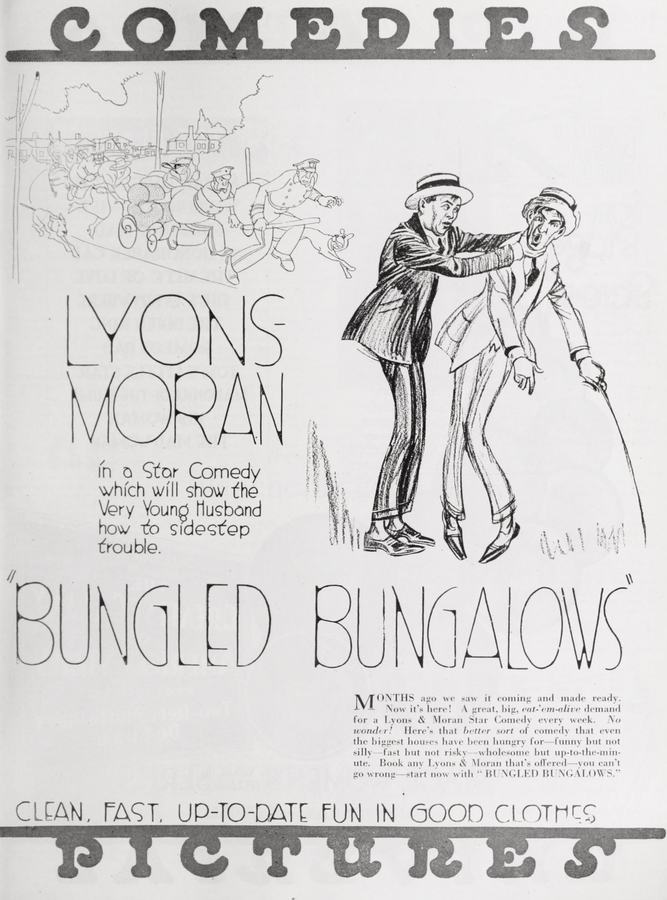
Jealousy, observed Proust, is a detective convinced the universe commits adultery; Bungled Bungalows lets that detective run amok with a magnifying glass made of celluloid and laughs.
The picture clocks in at a brisk two reels—barely time for popcorn to cool—yet its architects Eddie Lyons and Lee Moran cram enough emotional whiplash to fill a Lubitsch box-set. Lyons, rubber-faced and perennially beleaguered, plays the distrustful husband Lang with the twitchy volatility of a man who hears cuckoo clocks in every heartbeat. Moran, lankier and fond of pince-nez spectacles that glint like courtroom evidence, doubles as scripter and co-star, gifting himself the role of the real-estate pup whose eagerness to close the sale is rivaled only by his obliviousness to social nuance.
Charlotte Merriam, all bobbed curls and furtive dimples, embodies the wife whose altruistic surprise curdles into nightmare. Note how she clutches her purse: knuckles whitening in direct proportion to her moral certainty, a silent barometer of trust eroding. Grace Marvin, as the realtor’s own neglected spouse, drifts through the narrative like a minor-key leitmotif—her eyelids half-lowered in perpetual disappointment, the living embodiment of a marriage reheated once too often.
Director Lyons stages the bulk of the mayhem inside a California bungalow whose floorboards sigh under the weight of suspicion. The camera seldom moves; instead, the walls appear to inch inward, a claustrophobic vice echoing Lang’s paranoia. Japanese folding screens serve as improvised veils, swinging doors become slapstick guillotines, and a rogue Murphy bed erupts like a Jack-in-the-box testimony to marital distrust. The spatial economy rivals that of My Lady Incog yet achieves greater comic compression: every entrance is mistimed, every exit cue missed by half a beat, so the comic rhythm resembles a syncopated Charleston.
Though monochromatic, the film’s tinting strategy deserves cinephile exegesis. Exterior scenes flicker in amber, as though the sun itself titters at human folly. Interiors alternate between cerulean and rose, a dialectic suggesting cold dread colliding with feverish ardor. The palette anticipates the emotional temperature shifts later refined in The Strongest, yet here the effect is more guerrilla, achieved by hand-cranked shutters and gels that flutter like nervous eyelids.
Beneath the pratfalls lies a brittle sociology of post-war property lust. The bungalow, priced “within reach of the clerk and his bride,” tantalizes the upwardly mobile with the promise of domestic sovereignty. Yet the very threshold of ownership triggers a psychosexional meltdown; the house becomes a dollhouse prison where patriarchy patrols hallways. In that sense, the film shares DNA with The Better Wife, though without that feature’s didactic moralizing. Instead, Bungled Bungalows weaponizes farce to expose how consumer aspiration curdles into surveillance culture.
Silent cinema demands gestural literacy; these players deliver a lexicon. Lyons’ eyebrows semaphore jealousy—one arch higher, a seesaw of disbelief. Merriam’s gait modulates from sprightly house-hunter to fugitive wife, her calves speaking the language of second thoughts. Moran, expert in double-takes, lets his Adam’s apple bob like a Morse key transmitting panic. Marvin, meanwhile, practices minimalist mummery: a slight tilt of the cloche hat equals entire paragraphs of recrimination. Together they weave a comic counterpoint reminiscent of a chamber ensemble sight-reading Ravel—precise, breathless, on the brink of cacophony yet resolving into harmony.
Observe the establishing shots: a streetcar rattling along unpaved roads, pepper trees tossing lace shadows, real-estate placards promising “California Living—$10 Down.” The film preserves a metropolis still wearing the awkward grin of adolescence, decades away from noir’s shadows. That historical inadvertence becomes part of the joke: we chuckle at the characters’ provincial jitters, yet recognize our own suburban rituals—open-house wine, Pinterest boards of domestic bliss—reflected in sepia.
Modern viewers may flinch at the husband’s possessiveness, yet the narrative refuses to vindicate him. His comeuppance arrives not via fisticuffs but through public embarrassment—a parade of neighbors witnessing his meltdown. The camera sides with the women, lingering on their exasperated glances as if to ask: “Must we forever soothe male vanity with reassurances?” In that subtle partisanship, the film feels proto-feminist, closer in spirit to Miss Ambition than to An Innocent Adventuress’s damsels.
Unlike the Keystone avalanche of pies, the humor here is situational, predicated on crossed wires and class etiquette. Doors, not custards, slam; words (via intertitles) misfire like misplaced valentines. The strategy anticipates the verbal jousts of 1930s screwball, yet remains rooted in the physical grammar of the teens. The hybridization is delicious: imagine a high-speed trolley whose passengers quote Oscar Wilde while ducking collapsing scaffolding.
Archival notes suggest the original tour-de-force accompaniment featured a medley of “Ain’t We Got Fun” juxtaposed with Mendelssohn’s Midsummer Night’s Dream scherzo. Such incongruity mirrors the tonal whiplash onscreen: domestic comedy married to fairy delirium. Contemporary restorations often opt for jaunty Wurlitzer; the enlightened choice is a small jazz combo improvising around a tango motif, letting the piano’s left hand throb like the husband’s headache.
The same year saw Lucrezia Borgia’s historical pageantry and Civilization’s pacifist grandeur—both bloated epics drunk on their own importance. Weighing a few hundred feet of nitrate, Bungled Bungalows skewers such bloat through brevity. Its only peer in compact satire might be The Laugh on Dad, yet that short fixates on rural clowning whereas Lyons and Moran train their lens on urban matrimony’s fault-lines.
The lone surviving 35 mm element, housed at the Library of Congress, arrives pockmarked like a confetti of freckles. Some cinephiles demand pixel-polished perfection; I cherish these blemishes. Each scratch is a scar of exhibition history, a reminder that every print once traveled small-town circuits, jostling in the bellies of Model-T trucks, projecting hope onto brick walls. To erase them would be to sand off the wrinkles of memory.
Absolutely. The picture’s fleet tempo, spatial ingenuity, and emotional acuity transcend its era. Modern streaming audiences, raised on TikTok’s ten-second punchlines, will recognize a kindred attention span. Yet beneath the pratfalls lurks a timeless cautionary tale: that the most lethal burglar is not the thief at the window but the suspicion at the bedroom door.
Seek it out at specialty festivals, preferably on 16 mm with a live accompanist who understands tango tempo. Let the bungalow’s doors slam, let the intertitles flicker like gossip, let Eddie Lyons’ eyebrows conduct their frantic symphony. And when the lights rise, ask yourself: how many of your own domestic arguments hinge on a door that closed five seconds too early, a text left on read—a bungalow of the heart, bungled by reflexive mistrust? That, ultimately, is why this forgotten bauble deserves resurrection: it laughs not merely at the follies of 1923 but at the ongoing comedy of our surveilled intimacies, the slapstick of love in the age of perpetual notification pings.
IMDb 6.2
1930
Community
Log in to comment.