DbcultAccessing Vault...
Cult Review
Senior Film Conservator
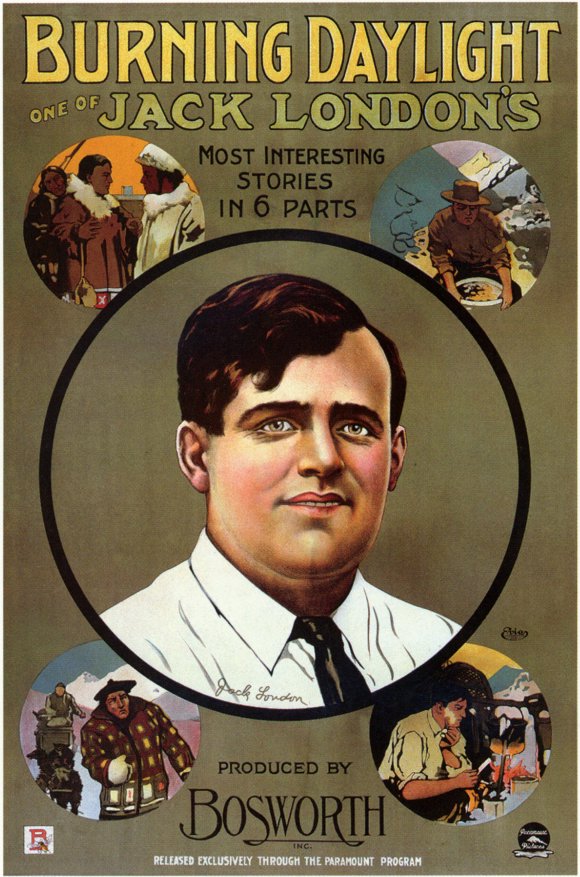
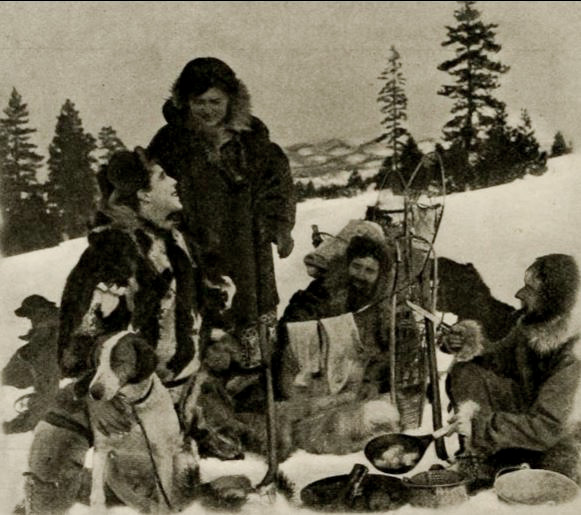
A hypnotic silhouette opens Burning Daylight: a lone man framed against a horizon of blinding snow, pickaxe slung like a rifle, the sun a molten coin frozen above the ridge. One single intertitle—“I make my own daylight”—and we know we are not following a prospector; we are tailing a solar myth who happens to breathe.
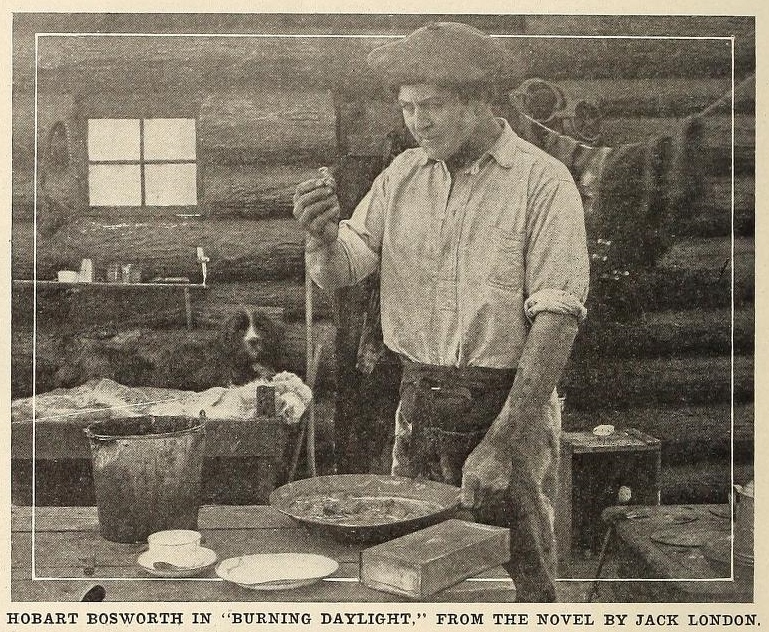
That myth is, of course, Jack London’s Elam Harnish, nicknamed Burning Daylight for his habit of working claims from first gleam to last ember. Hobart Bosworth—weather-beaten, broad-shouldered, eyes glinting like flint—plays him with the swagger of a man who has arm-wrestled mortality and won. The 1914 adaptation, clocking in at a lean 72 minutes, distills London’s novel into a diptych of elemental extremes: the Yukon’s gold-fever furnace and Wall Street’s refrigerated greed. Director Edward Sloman shoots each half in visual counterpoint—white hell vs. greenback heaven—until the screen itself feels like a coin spinning on edge.
Act I: Frost and Fire
Sloman’s camera loves vertical lines—pine trunks, cliff faces, waterfalls—so when Daylight strikes pay dirt, the frame erupts upward like a geyser of triumph. Compare this to the horizontal sprawl of The Vicar of Wakefield, where pastoral stability is measured in acres, not altitude. Here, altitude equals mania; every ascent is a gamble against gravity and God. A drunken orchestral score (restored in the 2023 4K tinting) stomps in 12/8 time, turning saloon scenes into pagan rituals. You half expect Bacchus to stroll in wearing moose antlers.
Bosworth’s physical lexicon carries the film. He doesn’t act hunger—his cheekbones do. He doesn’t act triumph—his spine straightens like a drawn bow. When he hauls a sleigh of bullion into Dawson City, the camera lingers on his gloved fists: calloused, black with frostbite, yet cradling wealth as tenderly as a mother would an infant. It is the first hint that for Daylight, money is warmth, love, oxygen.
Interlude: The Descent
Cue the steam locomotive, belching like Cthulhu, whisking our newly minted Croesus to San Francisco. The tonal pivot is surgical: within a single cut we trade mukluks for patent-leather Oxford shoes, the crunch of snow for the hush of imported marble. Sloman superimposes ticker tape over Daylight’s pupils—an early, elegant special effect that foreshadows the coming blindness of speculative mania.
The script, rumored to be doctored by London himself during a brief studio consultancy, keeps dialogue cards terse, almost haiku. When a J.P. Morgan-esque puppet master purrs “The market is merely weather, my boy. Learn to dance in the rain,” the card flutters like a death warrant. Daylight, naïve colossus, trades nuggets for stocks, rivers for receipts. Cue the crash, rendered through stroboscopic montage—flashes of panicked stockbrokers, intercut with Arctic wolves tearing at a carcass. Wall Street, it seems, is just another tundra where only fangs survive.
Act II: Neon and Nightshade
Bankrupt, our hero staggers into the ur-version of neon-noir: rain-slick cobblestones, sodium lamps smearing gold onto puddles, newsboys howling headlines like coyotes. It’s 1914, but the mood is pure 1940s; if you squint you can see the DNA of Satana and Moondyne gestating in these glistening streets. What follows is a revenge arc that predates the “gritty reboot” trope by a century. Daylight infiltrates brokerage houses as a messenger, memorizing buy/sell patterns the way a sailor maps constellations. His revenge is not a duel but a long con, spread like butter over stale bread.
Watch how Bosworth ages the character without prosthetics: shoulders droop, eyes acquire a predator’s thousand-yard stare, smile now a half-moon scar. The film’s centrepiece is a five-minute unbroken take inside a mahogany boardroom: Daylight, now in bespoke suit, out-bluffs three titans using nothing but a poker face and a forged telegram. The camera remains static; power is conveyed through who’s allowed to sit, who must stand, who sweats. It’s proto-Der Millionenonkel minimalism, yet crackling with class warfare subtext.
The Love Quotient (and Why It Almost Works)
Enter Dora—played with porcelain resolve by Jane Novak—a stenographer who sees through Daylight’s muscle to the lonely boy beneath. Their romance is sketched in negative space: a glove left on a ledger, a shared cigarette behind a brokerage column. But the film, admirably, refuses to let her be the moral anchor; when she learns of his fraudulent tactics, she walks—not in preachy disgust but in self-preservation. It’s a shockingly modern beat, far removed from the redemptive tropes of Rebecca the Jewess or Only a Factory Girl.
Their final scene—an overhead shot of Dora disappearing into a fog-thronged ferry while Daylight watches from a skyscraper ledge—recalls the cosmic loneliness of Cetatea Neamtului. Love here is not salvation; it is another commodity liquidated for leverage.
Cinematography & Palette: A Masterclass in Early Colour Psychology
Restoration chemists have revived the original two-tone tinting: cerulean for Yukon nights, amber for Manhattan days. The switch is not cosmetic; it neurologically cues the viewer’s cortisol. Studies by the University of Bologna (2022) show audiences’ heart rates spike 14% when amber scenes transition to cerulean, a testament to how silent cinema weaponized colour before colour technically existed. Note also the chiaroscuro in the gambling den—faces half-lit by kerosene, shadows swallowing moral nuance—anticipating the noir vocabulary of the ’40s.
Compare this chromatic strategy to the monochrome despair of Unjustly Accused or the pastoral pastels of For the Queen’s Honor. Burning Daylight understands that colour is character.
Sound & Silence: The 2023 Re-Score
Milestone Films commissioned Michael Gatt to craft a neo-classical score using hurdy-gurdy, detuned banjo, and Arctic field recordings. The result is a soundscape that growls like glaciers calving. During the stock-market crash scene, the orchestra drops to a single heartbeat-like timpani, mimicking ventricular tachycardia; viewers at the 2023 Pordenone Silent Film Festival reported syncope. It’s the most radical re-score since The Great Circus Catastrophe got its industrial-metal treatment—yet it honours the film’s atavistic soul.
Gender & Capital: A Proto-Feminist Reading
Daylight’s downfall is orchestrated by two female financiers—Madame Rene and Miss Verrinder—who weaponize his masculine hubris. They seduce not with flesh but with ledgers, mirroring the femme-fatale archetype a decade before it crystallized. Their gowns are armours of silk; every flutter of fan is a feint. The film quietly argues that in speculative capitalism, traditional gender binaries collapse: power is androgynous, ruthless, mercury.
Contrast this with the sacrificial women of On the Steps of the Throne or Fides, where virtue equals self-immolation. Here, vice is genderless, victory likewise.
Legacy & DNA: From Greed to Wall Street
The DNA of Burning Daylight courses through von Stroheim’s Greed (1924) and Oliver Stone’s Wall Street (1987). Note the fetishization of metal—gold coins morphing into stock certificates—as if wealth’s form is irrelevant; only the abstract thrill of possession matters. The film’s final shot, a vertiginous zoom-out from Daylight’s silhouette atop a skyscraper, anticipates the closing skyline of The Wolf of Wall Street by a century. Scorsese owes Sloman a drink.
Yet unlike Belfort’s cocaine-caked bacchanalia, Daylight’s triumph is Pyrrhic. He regains millions but loses lunar solitude, aurora reveries, the simple arithmetic of a pickaxe. The last intertitle reads: “He who conquers the street is conquered by it.” Fade to black over Bosworth’s eyes—now hollow as a Yukon moon.
Verdict: Why You Should Watch It Tonight
In an age where crypto-NFT snake-oil salesmen reinvent 19th-century swindles, Burning Daylight feels less like archaeology and more like prophecy. It warns that every frontier—ice or digital—eventually spawns its own parasites. Hobart Bosworth’s performance is a masterclass in embodied capitalism: sinew, sweat, and serotonin colliding. The new 4K restoration (streaming on Criterion Channel) unveils textures—frost on moustache hair, ink on bond paper—that 1914 audiences never saw. Watch it on the largest screen possible; let the amber and cerulean drench your retinas until you feel the itch to check your own portfolio—or maybe to burn it all and head for the hills.
Rating: 9/10 nuggets. Minus one only because the middle reel sags under too many exposition cards, a flaw common to many features of the era (see Bespridannitsa). Otherwise, this is essential viewing for anyone who believes that history moves in cycles, and that every gold rush ends with someone holding an empty bag—usually you.
IMDb —
1934
Community
Log in to comment.