DbcultAccessing Vault...
6.6/10
Senior Film Conservator
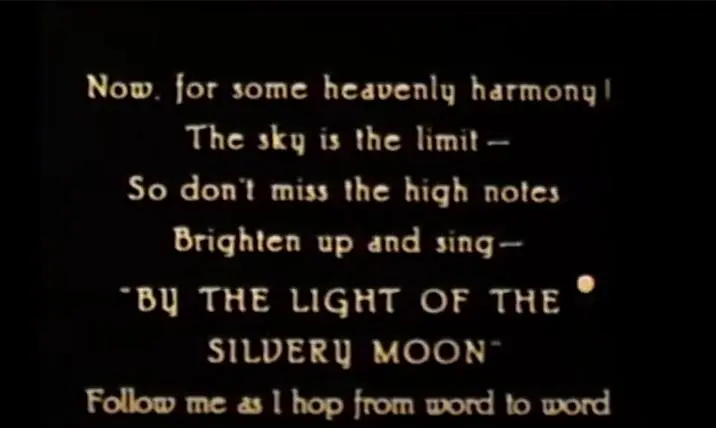
A definitive 6.6/10 rating for a film that redefined the boundaries of cult cinema. By the Light of the Silvery Moon remains a cornerstone of transgressive art.
Does a century-old, minute-long sing-along short hold any relevance for today’s discerning viewer? Short answer: yes, but only for a very specific audience. This relic of early cinema is less a film to be watched and more an experience to be understood, a fascinating historical footnote that offers a unique window into the past.
It’s a peculiar offering, one that will deeply resonate with film historians, animation enthusiasts, and those with a keen interest in the evolution of audience participation in media. However, it is decidedly not for those seeking traditional narrative, character development, or high-octane entertainment.
To properly review "By the Light of the Silvery Moon" is to grapple with its very nature. It’s a tool, an artifact, an invitation. Its success isn't measured by plot twists or character arcs, but by its capacity to evoke a shared, ephemeral moment.
This film works because it is a perfect snapshot of a bygone era's entertainment. Its simplicity is its strength, serving as an unfiltered conduit for communal joy. It fails because, by modern cinematic standards, it offers no narrative, no visual spectacle beyond its functional bouncing ball, and no emotional depth. You should watch it if you are fascinated by the origins of media interactivity, the history of popular culture, or the evolution of audience engagement in cinema.
In the early decades of the 20th century, cinema was an evolving beast, constantly experimenting with how to captivate and engage an audience. Before the widespread adoption of synchronized sound, and even after, the communal experience of the movie theater remained paramount. Enter the sing-along short, a brilliant, deceptively simple innovation designed to foster participation and a sense of collective joy.
"By the Light of the Silvery Moon" is a prime example of this genre, a direct descendant of vaudeville and music hall traditions where audience participation was not just encouraged but expected. Dave Fleischer, a name synonymous with early animation ingenuity, particularly the innovative Rotoscoping technique, is credited here. While his more famous works, like the Popeye and Betty Boop cartoons, showcased complex character animation, this short exemplifies a different facet of his studio’s output: utility animation.
The bouncing ball itself was a technological marvel of its time, a simple yet effective visual cue that transformed a static screen of lyrics into a dynamic, rhythmic guide. It wasn't about stunning visuals or intricate storytelling, but about timing, clarity, and the universal appeal of popular song. It’s hard for a modern viewer, accustomed to sophisticated CGI and immersive soundscapes, to fully grasp the novelty and excitement this simple bouncing ball once generated. It was a shared experience, a collective breath taken by hundreds in a darkened room.
“The genius of the bouncing ball wasn't its animation, but its ability to animate an entire audience.”
This short, therefore, isn't just a film; it's a social document. It reflects a time when entertainment was often a shared, loud, and interactive affair, predating the more passive, individualistic viewing habits of later generations. It's a stark contrast to narrative-driven films of the era, like Parisette or Le capitaine Rascasse, which aimed to transport audiences through story. This short aimed to unite them through song.
To analyze the "direction" of "By the Light of the Silvery Moon" requires a recalibration of critical lenses. There are no actors to guide, no complex mise-en-scène to compose. Instead, Dave Fleischer’s directorial hand is evident in the precise pacing of the bouncing ball and the legibility of the text. The "cinematography" is remarkably functional, almost minimalist.
The frame is static, entirely focused on presenting the lyrics clearly against a simple, unassuming background. There's no camera movement, no elaborate lighting – nor is there a need for it. The visual information is stripped down to its bare essentials: words and a guide. This intentional lack of distraction ensures the audience's focus remains solely on the task at hand: singing along.
The pacing of the ball's bounce is the heartbeat of the short. It dictates the rhythm of the communal performance, ensuring everyone, regardless of their musical ability, can keep time. This wasn't a trivial feat; misjudging the tempo could easily derail the entire experience. Fleischer, or his animators, demonstrate an innate understanding of musicality and audience psychology in setting this tempo.
Consider the choice of font: clear, bold, and easily readable from a distance. The transitions between lines and verses are seamless, an early form of "editing" that prioritizes flow and uninterrupted participation. There’s a subtle artistry in making something so utilitarian feel so effortless. It works. But it’s flawed.
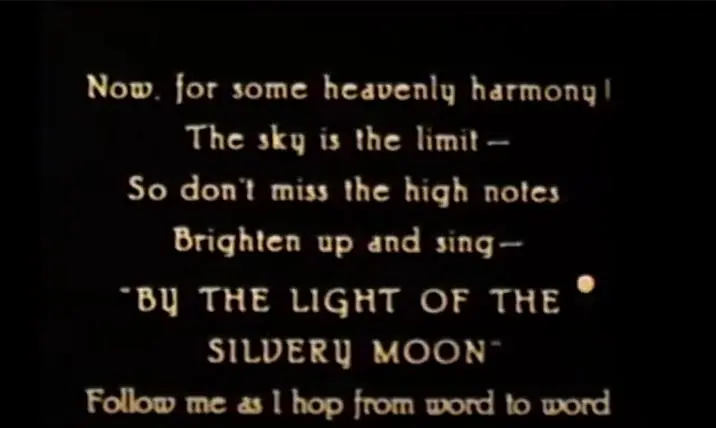
The flaw, if one can call it that, lies in its utter single-mindedness. It achieves its goal perfectly, but offers nothing beyond it. Unlike more complex animated shorts or even the instructional How Not to Dress, which offered visual gags alongside its lessons, this short is pure, unadulterated function.
In a traditional film review, one would discuss the acting, the nuanced performances that bring characters to life. Here, the "acting" is entirely off-screen, residing within the audience itself. The short's success hinges on its ability to cajole, encourage, and ultimately direct hundreds of individual voices into a single, albeit often cacophonous, choir.
Dave Fleischer's "direction" of this unseen cast is masterful in its subtlety. The bouncing ball doesn't command; it invites. It provides a clear, unambiguous visual cue that transcends language barriers and musical skill levels. The simplicity of the animation is key here; a more complex visual might distract from the primary goal of vocal participation.
The tone of the short is one of unpretentious invitation. There's no grandiosity, no pretense. It's a straightforward presentation of a popular song, assuming a shared cultural context and a willingness to join in. This assumption speaks volumes about the communal spirit of early 20th-century entertainment. It's a stark contrast to the more passive consumption often associated with modern media, where the audience is rarely asked to perform.
“The true stars of this film are not on screen, but in the seats, their voices the soundtrack.”
This communal aspect is perhaps its most surprising observation. In an age of personalized playlists and individual headphones, the idea of an entire cinema spontaneously bursting into song feels almost alien. "By the Light of the Silvery Moon" serves as a poignant reminder of a time when entertainment was a shared, active, and often vocal event, much like the collective experience of watching a sporting event today, but for music.
For the casual viewer seeking entertainment, no. This film is a historical artifact, not a narrative experience. It offers no character development, no plot, no visual flair to speak of beyond its simple, functional animation.
However, for those with an academic or historical interest in cinema, animation, or popular culture, it is absolutely worth watching. It provides invaluable insight into the evolution of audience engagement, the ingenuity of early filmmakers, and the cultural context of entertainment a century ago.
It serves as a tangible link to a bygone era of communal performance. It reminds us that cinema wasn't always about silence and awe; sometimes, it was about loud, collective joy.
One could argue that "By the Light of the Silvery Moon" is, in its own peculiar way, a work of art. Not in the grand, expressive sense of a narrative feature, but as a piece of functional, interactive design. Its elegance lies in its absolute efficiency. Every element serves a singular purpose: to facilitate singing.
This is a strong, debatable opinion, for sure. Many would dismiss it as mere utility, a tool, not art. But I contend that any creation that so perfectly achieves its intended effect, while also reflecting a unique cultural moment and influencing future forms of media (think karaoke), possesses an artistic merit. It's minimalist art, if you will, where the canvas is the screen and the medium is the audience's voice.
Its influence, though subtle, is undeniable. The bouncing ball became an iconic symbol, instantly recognizable even today, a testament to its effective design. It's a surprising observation to realize how deeply embedded such a simple visual cue became in the collective cultural consciousness, paving the way for everything from children's educational programs to modern karaoke bars.
It's a testament to the ingenuity of pioneers like Dave Fleischer that they could take such a simple concept and turn it into a widespread phenomenon. It wasn't about making a "film" in the traditional sense, but about creating an experience. And in that, it succeeded spectacularly.
"By the Light of the Silvery Moon" is not a film to be judged by conventional metrics. It is not a narrative masterpiece, nor a visual feast. Instead, it is a fascinating, almost anthropological artifact, a direct portal to a time when cinema was still finding its voice, and discovering its power to unite. Its value lies not in what it shows, but in what it allowed audiences to do. It is essential viewing for anyone serious about understanding the complete tapestry of cinematic history, yet entirely dispensable for those merely seeking a good story. Approach it with an open mind and a historian's curiosity, and you'll find a surprising amount to appreciate in its elegant simplicity and profound cultural impact.
IMDb 6.7
1923
Community
Log in to comment.