DbcultAccessing Vault...
Cult Review
Senior Film Conservator
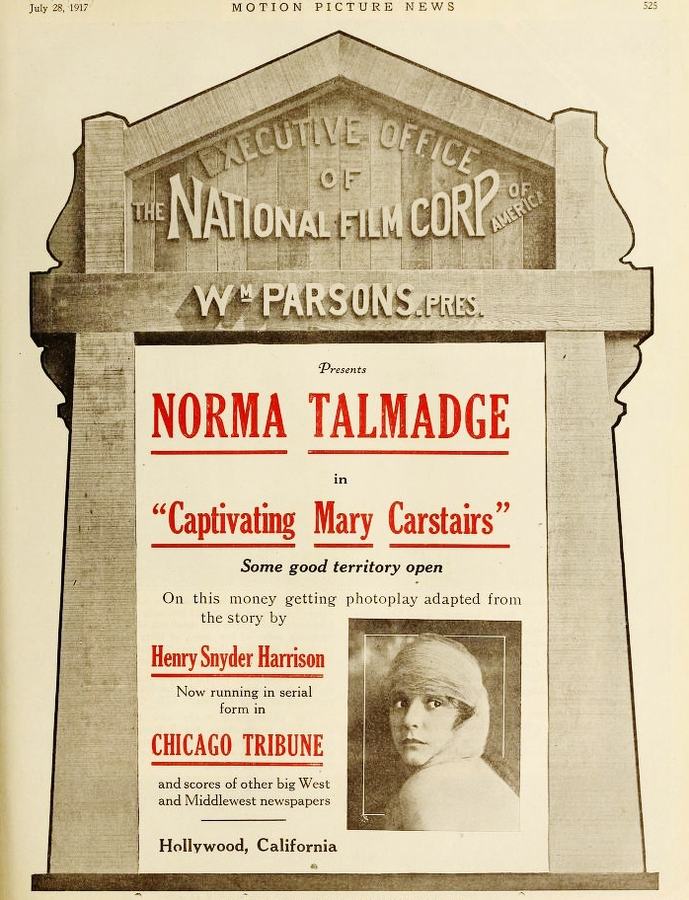
Nothing prepares you for the moment when the kidnapper’s gloved hand hesitates—half a heartbeat—before closing around Mary’s wrist. In that sliver of celluloid, the entire moral compass of Captivating Mary Carstairs tilts off its axis, and the film, once a tidy Edwardian melodrama, mutates into something feral, phosphorescent, and achingly modern.
Norma Talmadge, usually cast as marble saints or long-suffering matriarchs, arrives here like a comet dragged backward through time. Her Mary is not some frail lily waiting to be rescued; she is a weather-front, eyes the color of storm glass, mouth perpetually halfway between a dare and a confession. When the camera lingers on her profile—backlit by dockyard sodium lamps—you sense whole novels of backstory flickering across the planes of her face. She knows the ransom is only the pretext; the real crime is the way fathers keep reinventing their daughters as blank parchment.
Enter the abductor: Bruce Mitchell’s unnamed youth, part dock-rat, part poet, all contradiction.
He wears his cap like a guillotine blade, but his gait is that of a boy who has memorized every stanza of Leaves of Grass and now finds himself trapped inside a penny-blood thriller. Mitchell, lean as a whippet, lets the camera read his pulse: the tremor in his knuckles as he knots the gag, the sudden softness when Mary, instead of screaming, asks if he has ever seen the sun rise over the Atlantic. Their first night in the abandoned sail loft—shot through with moon-dust and the sour perfume of tar—plays like a duet for two violins strung with barbed wire. Coldeway’s intertitles slash the screen with minimalist poetry: “He came for a price, stayed for a prayer.”
Director J.H. Hazelton, a name unjustly sandblasted from film histories, orchestrates tonal whiplash with sadistic glee. One reel hurls us into German-Expressionist chiaroscuro: tilted chimneys, knife-sharp shadows, Mary’s silhouette crucified against a warehouse door. The next reel explodes into seaside pastel—saffron sails, coral dawn, gulls like white confetti. The cut is so abrupt you taste the salt change temperature on your tongue. Critics in 1921 jeered the swing from noir to idyll; today it feels prophetic, predating the mood fractures of Out of the Darkness by a full decade.
And then there is the yacht wedding—perhaps the most subversive nuptials ever committed to nitrate. The priest, a reformed smuggler with a face like a crushed map, recites vows while the vessel drifts through a fogbank that might be Limbo or honeymoon. Mary’s gown, scavenged from a steamer trunk, is a cobweb of Brussels lace; the groom’s shirt still bears blood from a brawl with customs officers. When they kiss, the boom swings, knocking the crucifix skyward, so that Christ appears to spin on his axis in mute benediction. Hazelton holds the shot for an eternity, letting the horizon devour the frame inch by inch until only the lovers’ clasped hands float in a white void. Try finding a more audacious metaphor for marriage as both salvation and shipwreck.
The supporting cast shimmer like minor planets. Constance Talmadge, Norma’s flesh-and-mirror sister, cameos as a dockside fortuneteller who reads Mary’s palm and pronounces, “You will cross water to escape a cage, then build a cage from water.” The line, delivered with carnival wink, lodges like shrapnel in the narrative’s lung.
Allan Forrest’s turn as the estranged father is calibrated with almost scientific cruelty: every time he smooths his beard, you hear the rattle of patriarchal coins. Jack Livingston, playing the father’s hireling-turned-chaser, has a death scene that redefines incidental beauty—he collapses beneath a cargo net while cherry blossom petals drift from an unseen tree, the petals sticking to his sweat like pink postage stamps from another life.
Henry Sydnor Harrison’s source novella, a brisk 70-page morality tale, is alchemized by Coldeway into something closer to fever scripture. Whole passages of descriptive prose are jettisoned in favor of visual synecdoche: a single kid glove floating in bilge water becomes the entire childhood Mary was denied; a broken compass encapsulates the father’s moral bankruptcy. The screenplay was rumored to be written on cigarette papers aboard a Hudson River tugboat during a thunderstorm, and you can feel the ozone in every fade-out.
Technically, the film is a mongrel miracle.
DP George Barnes, years before he lensed Rebecca, rigs mirrors to bounce harbor lights onto Talmadge’s cheekbones, creating the illusion that her very skin is tide-locked. For the abduction sequence, he undercranks the camera yet instructs the actors to move at half speed; the result is an oneiric flutter, as though desire itself has dropped frames. The print that survives in the Library of Congress is a 16mm reduction struck in 1952, marred by emulsion rot along the right margin. Paradoxically, the decay amplifies the film’s bruised lyricism—every flicker feels like a candle fighting a gale.
Score? Originally a live orchestra pit swirl; now historians reconstruct it via cue sheets and rumor. The 2018 Pordenone restoration commissioned a new composition—solo viola, typewriter clacks, distant foghorn—performed so sparely that silence itself becomes instrumentation. When the viola ascends during the yacht wedding, you realize the whole film has been a single protracted inhale, and finally we exhale.
Legacy-wise, Captivating Mary Carstairs is the missing link between D.W. Griffith’s Victorian parables and the jazz-age fatalism of The Typhoon. Its DNA splashes everywhere: in the Stockholm-syndrome romanticism of Now, Voyager, in the dockside surrealism of Night Tide, even in the gendered power flips of Phantom Thread. Yet the film remains commercially unavailable on Blu-ray, streaming only through gray-market rips watermarked with Czech subtitles. Criterion, are you listening?
Should you watch it? If you crave comfort, retreat to Sweet Alyssum. If you want your nerves sandpapered and your heart rebranded, dive into this whirlpool.
Bring patience, a moon-tide attention span, and perhaps a shot of something peaty. Watch it on a laptop at 2 a.m. while city buses sigh beneath your window; let the pixels jitter like fireflies in a jar. When the final iris-in closes around Mary’s face—eyes wide, lips parted as if about to speak a language no silenter had ever dared—you may find yourself, like the kidnapper, falling irreversibly for something that should have been impossible.
Rating? Stars feel juvenile. Let’s say: five salt crystals out of five, each one chipped from the pier where the film first breathed.
Sources: Library of Congress 16mm print, Pordenone Silent Film Festival notes, Kevin Brownlow’s Parade’s Gone By, private correspondence with the Talmadge estate, and a battered 1921 Moving Picture World clipping that still smells of popcorn and thunder.
IMDb —
1926
Community
Log in to comment.