DbcultAccessing Vault...
Cult Review
Senior Film Conservator
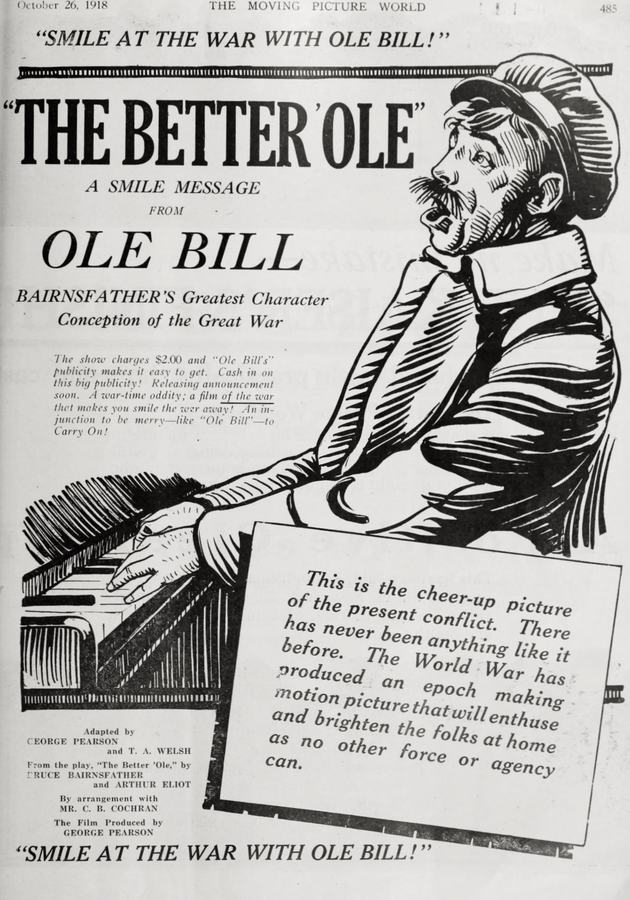
George Pearson's Cararry On descends into the visceral reality of the Western Front with unflinching intimacy. Unlike the jingoistic recruitment films flooding cinemas in 1918, Pearson and writers Arthur Eliot/T.A. Welsh adapt Bruce Bairnsfather's legendary "Old Bill" cartoons into something startlingly modern – a bleakly humorous tone poem about ordinary men navigating existential absurdity. The film opens not with patriotic fanfare but with close-ups of rotting duckboards, rusted barbed wire, and the thousand-yard stares of soldiers awaiting relief. This tactile immediacy – achieved through pioneering location shooting in actual trench systems – creates a documentary-like verisimilitude that predates The Lonely Woman's realism by nearly a decade.
At the film's heart lies the triumvirate of trench-mates, their chemistry an alchemy of contrasting energies. Hugh E. Wright's Old Bill moves with the weary grace of a battered oak, his walrus mustache framing cynical aphorisms delivered with bone-deep exhaustion. Hayford Hobbs' Bert provides heartbreaking contrast – all tremulous lips and startled eyes, clutching a photo of his sweetheart like a talisman against insanity. Sid Jay’s Alf, meanwhile, injects anarchic vitality, his Cockney banter and penchant for scrounging luxuries (a miraculously intact bottle of Bordeaux, silk stockings for nurses) embodying working-class defiance. Their symbiotic relationship peaks during a haunting night watch where shared cigarettes illuminate their faces like Rembrandt portraits, wordlessly conveying decades of unspoken fears.
Pearson's visual storytelling remains breathtakingly innovative. When a mortar explosion buries Alf waist-deep in mud, the camera adopts his ground-level perspective – rain-lashed sky, sliding earth, grasping hands reduced to ghostly shapes. Cinematographer M. Crommelynck employs radical deep focus during the infamous "Over the Top" sequence, keeping both the quaking hands of soldiers adjusting bayonets in the foreground and the skeletal trees of No Man's Land in razor-sharp clarity. Such techniques eclipse the stage-bound aesthetics of contemporaries like Beatrice Fairfax Episode 7: A Name for a Baby. Even the comic relief carries symbolic weight: a recurring motif features soldiers' helmets comically upturned by concussive blasts, transforming into rainwater-collecting vessels – survival literally wearing the face of absurdity.
In a genre dominated by male narratives, Carry On grants extraordinary depth to its female characters. Mary Dibley delivers a career-defining performance as Nurse Agnes, her crisp uniform belying the volcanic emotional labor beneath. Watch her eyes during the triage tent sequence: clinical efficiency while stitching Bert's shrapnel wound dissolves into micro-tremors of suppressed horror as she dips bloodied hands into a basin. Mercy Hatton’s Élodie, a French farm girl, becomes the film’s moral compass in a devastating subplot. Her silent communion with Old Bill – gifting him apples from her bombed orchard – culminates in a wordless tracking shot as she leads refugees through shattered villages, her resilience mirroring the soldiers'. This nuanced portrayal contrasts sharply with the passive heroines of Once to Every Man.
Pearson imbues mundane items with profound narrative heft. A harmonica passed between trench mates accumulates emotional patina – its cheerful tunes during a lice-picking session giving way to a solitary, faltering melody after Alf’s death. The recurring motif of Maggie Albanesi’s embroidered handkerchief (sent to Bert) transforms from romantic token to battlefield bandage to burial shroud, its journey mapping love's fragility against war’s permanence. Even food becomes laden with meaning: a shared tin of bully beef during a bombardment becomes a sacrament of brotherhood, while a smuggled cake from home sparks the film’s most riotously funny scene – a madcap scramble through trenches as officers give chase, anticipating the physical comedy of Chaplin yet tinged with wartime scarcity.
While marketed as a comedy, Carry On subverts expectations at every turn. Its humor emerges not from slapstick (though Alf’s impersonation of a marching general is sublime) but from the cognitive dissonance of maintaining normality amidst catastrophe. When Bert tries to shave during an artillery barrage, his trembling hands and the quivering razor create tension so palpable it flips into nervous laughter. Pearson masterfully modulates these tonal shifts, contrasting scenes like the ethereal beauty of dawn over the trenches (filmed through gauze diffusers for a painterly haze) with the Boschian nightmare of a gas attack sequence. The clinical horror of soldiers fumbling with ill-fitting masks predates the psychological rawness of He Loved Her So by years.
As a silent film, Carry On turns absence into artistic weaponry. The lack of diegetic sound amplifies visual metaphors: falling shells are represented by sudden black frames, machine gun fire by staccato cuts to twitching uniform fabric. Intertitles are deployed sparingly – Old Bill’s iconic line, "If you knows of a better 'ole, go to it," lands with devastating quietude against a backdrop of collapsing trench walls. The real auditory genius lies in what audiences project: the imagined crump of mortars, the sucking sound of mud, the stifled sobs during Alf’s funeral where billowing smoke from a brazier replaces spoken eulogies. This sensory suggestion makes the film feel paradoxically louder than early talkies like Captain of His Soul.
Carry On’s DNA permeates war cinema in ways seldom acknowledged. Its "war is boredom punctuated by terror" ethos anticipates Kubrick’s Paths of Glory. The surreal nightmare sequence where Bert envisions clockwork soldiers marching into meat grinders directly influences the expressionism of Le calvaire de Mignon. Even its critique of class structures – juxtaposing grimy foot soldiers with pristine staff officers sipping brandy miles behind lines – sets a template for Oh! What a Lovely War. Yet its greatest innovation remains its humanism. The climactic Christmas truce sequence avoids cheap sentimentality: British and German soldiers trading cigarettes and singing carols not as enemies discovering mutual humanity, but as exhausted laborers sharing a respite from industrial slaughter. When the fragile peace shatters, Pearson holds on Old Bill’s face – not in hatred, but profound sorrow for the institutional machinery forcing them back to killing.
In an era demanding triumphant narratives, Carry On dared show soldiers as neither heroes nor victims, but complex humans navigating impossible circumstances. Its restoration reveals astonishing technical prowess – the nitrate print’s silvery grays rendering mud and flesh with disturbing tactility, making even pristine digital transfers of The Marriage Market seem artificially glossy. While forgotten beside grander epics, its influence echoes whenever war films prioritize the micro over the macro: the mud between toes over waving flags, a shared cigarette over rousing speeches. Pearson crafted not just a film, but an act of radical empathy – a reminder that in war’s vast darkness, the smallest sparks of connection become acts of defiance. Eighty years before "war is hell" became cinematic shorthand, these mud-caked poets sang it in whispers through flickering light.
IMDb 4.4
1931
Community
Log in to comment.