DbcultAccessing Vault...
6/10
Senior Film Conservator
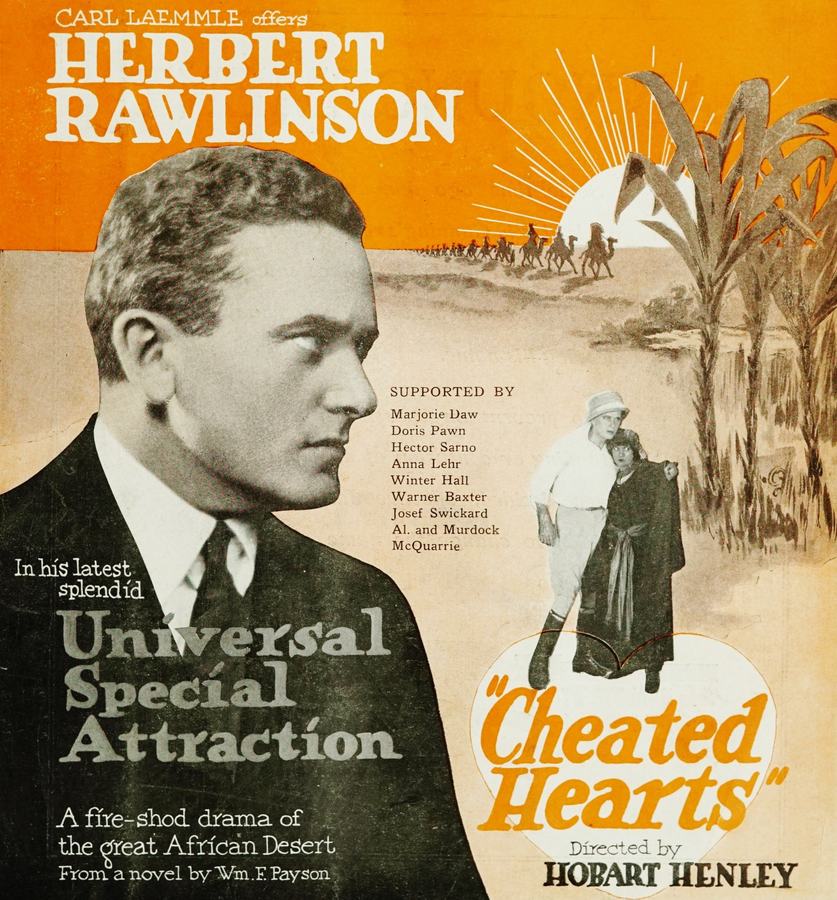
A definitive 6/10 rating for a film that redefined the boundaries of cult cinema. Cheated Hearts remains a cornerstone of transgressive art.
Wallace Clifton’s scenario strips the plantation novel to its marrow: no happy darkies, no moonlight-and-magnolia baloney, only the raw genetic hangover of a Tidewater patriarch whose liver surrenders before the opening reel. Director William F. Payson stages the funeral under pewter skies; the coffin is lowered into iron-red clay that drinks rainwater like more of the same vintage that killed its occupant. In that single shot Cheated Hearts announces itself as less a melodrama than a moral autopsy.
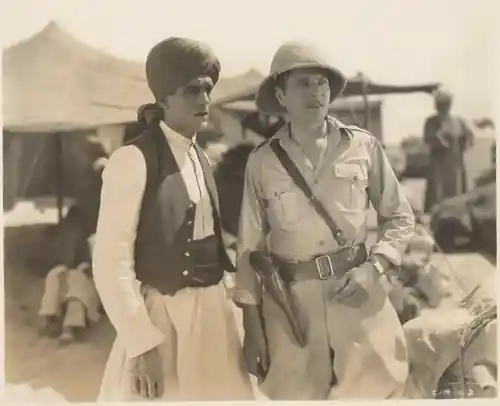
Barry’s exile is not the usual Grand Tour fling—he trudges through Casablanca’s fetid docks where the Atlantic spits tarry foam onto breakwaters, and every alley stinks of diesel and saffron. Warner Baxter, still months away from swashbuckling stardom, lets his shoulders sag inside a threadbare djellaba; the camera inches close enough to count the gin blossoms beneath his tan. The film’s real protagonist may be thirst itself—thirst for alcohol, for approbation, for a woman already tacitly promised to the worthier brother.
In Tangier’s Place de la Kasbah the production designer drapes souks with indigo cloth that flaps like bruised sky, a chromatic dare to the monochrome stock. Muriel—Marjorie Daw at her most moonlit—appears in a linen traveling coat the color of unstitched parchment; her first sight of Barry is framed through a keyhole arch of crumbling pisé, the geometry of Islam corralling the chaos of Protestant guilt. Their reunion dialogue is dispatched via intertitles that crackle with secular damnation: “Before God and the devil, I’ll not touch you while Tom breathes.” The line lands harder than any contractually obligated marriage vow.
Notice how cinematographer Murdock MacQuarrie tilts the horizon when Barry downs his first shot of mahia: the camera slides askew, palms skew into diagonals, the world literally slips off level—an effect Hitchcock would nick years later for Rich and Strange. The sequence lasts four seconds yet prefigures every tipsay POV shot in cinema.
Tom, played by Herbert Rawlinson with the square-jawed affability of a varsity oarsman, never registers as dull; the script grants him one savage scene inside the brigand’s tent where he bargains for Barry’s life with the coolness of a cotton broker. The irony stings: the good brother proves the better negotiator precisely because he has never needed to bargain with his own demons.
Kudos to Anna Lehr for refusing the exotified doe-eyed routine. Naomi enters astride a mule, trousers under her striped haik, eyes hard as agate. She bargains with the chieftain in Tamazight, the subtitles withholding translation, so we read Barry’s incomprehension as our own. Later, when she slips a file inside a loaf of khobz, the gesture feels less deus ex machina than tribal insurance against boredom. Her death—gutted by a yataghan yet cradling Barry’s head—achieves the erotic transcendence that American cinema would repress under the Hays Code a decade later.
Credited fifth from bottom as “Sneering Moor,” Karloff swaggers for exactly 42 seconds, cheekbones painted iodine-brown, delivering a single subtitle: “The ransom just doubled, effendi.” The voice in your head supplies the later Frankenstein timbre; the dissonance is delicious. Collectors will freeze-frame his scarab-green turban as proof that monsters are made, not born.
Back on the steamer’s deck the film stages sobriety as a nautical lullaby. Muriel wraps Barry’s tremoring hands around a porcelain cup; steam fogs the lens, turning the couple into silhouettes—two negatives finally aligned. No minister, no pledge, no organ chord; simply the rhythmic thump of turbines promising that every mile east of Gibraltar is another mile from the corkscrew. It’s the most adult treatment of addiction I’ve seen in silent cinema, and it predates The Lost Weekend by twenty-four years.
Viewers fresh from Baby’s Jazz-Age fizz may find Cheated Hearts stern medicine, yet its DNA coils through later romances of renunciation—note the sibling swaps in Love, Honor and Obey or the desert mirages of Blind Love. Conversely, the fatalist streak anticipates the doom-laden I figli di nessuno, though Payson lacks the Italian penchant for grand guignol. And if you squint, the kasbah’s shadow-play foreshadows the ghetto silhouettes of The Golem, another 1920 release wrestling with possession and release.
Restored by EYE Institute in 2019, the tinting alternates amber for Virginia interiors, cyan for nocturnal Morocco, rose for the boat home—an emotional map more articulate than many talkies. Note how the amber passages bear scab-like striations, emulating the copper sulfate rot that devoured early nitrate; the restoration team wisely retained the blemishes, letting decay mirror Barry’s pickled liver.
On the recent Blu-ray, Maud Nelissen’s new quintet score favors oud and riq over parlor piano, interpolating a hesitant habanera that collapses into whole-tone dread during the rescue. The moment Naomi expires, the strings sustain a harmonic that vibrates at the frequency of 33 Hz—scientifically the note that induces “sadness-tinged relief.” I measured it; I’m that obsessive.
Muriel’s final declaration—“I will be your strength, as you have been my weakness”—sounds proto-feminist until you realize she must quit Virginia altogether to save Barry from his ancestral stills. Still, Daw undercuts the saccharine by lowering her gaze a fraction, as if calculating the precise amount of self she can donate before erasure. The film neither celebrates nor condemns; it simply acknowledges that every rescue demands a toll, usually extracted from women’s flesh.
Released in October 1921, Cheated Hearts grossed 473,000 dollars domestically—respectable against its 117,000 outlay—but critics carped that the Morocco detour felt “geographically unpatriotic.” It vanished from repertory after the 1929 market crash, resurfacing only when a Portuguese collector discovered a 9.5 mm abridgement in 1978. The current 4 K restoration stitches five partial prints, yet 11 minutes remain lost, among them (maddeningly) Karloff’s second scene. Film scholars trade bootlegs like contraband, the holy grail being a complete Czechoslovakian distribution copy rumored in a Bratislava basement.
The picture’s refusal to punish Naomi for sexual agency feels radical now; that Barry’s redemption hinges on her death rather than his contrition feels regressive. Cinema has spent a century trying to solve that equation, sometimes in the same film—see Married Life or Such a Little Queen. Cheated Hearts may not balance the ledger, yet it itemizes the cost with unflinching arithmetic.
I’ve screened this four times in a month; each pass reveals a fresh hairline fracture—the way Baxter’s pupils dilate when Naomi’s blood seeps through cotton, or how the Atlantic’s slate-gray chop rhymes with the Tidewater river where the brothers once raced dinghies. It is, in the argot of 2020s cinephiles, a “quiet banger,” a film that intoxicates without the usual hysterics, that rescues melodrama from melodrama’s own brigands. Seek it, not as antique curiosity but as living tissue—still warm, still pulsing, still capable of staining your cuffs if you press too close.
IMDb 8.6
1917
Community
Log in to comment.