DbcultAccessing Vault...
Cult Review
Senior Film Conservator
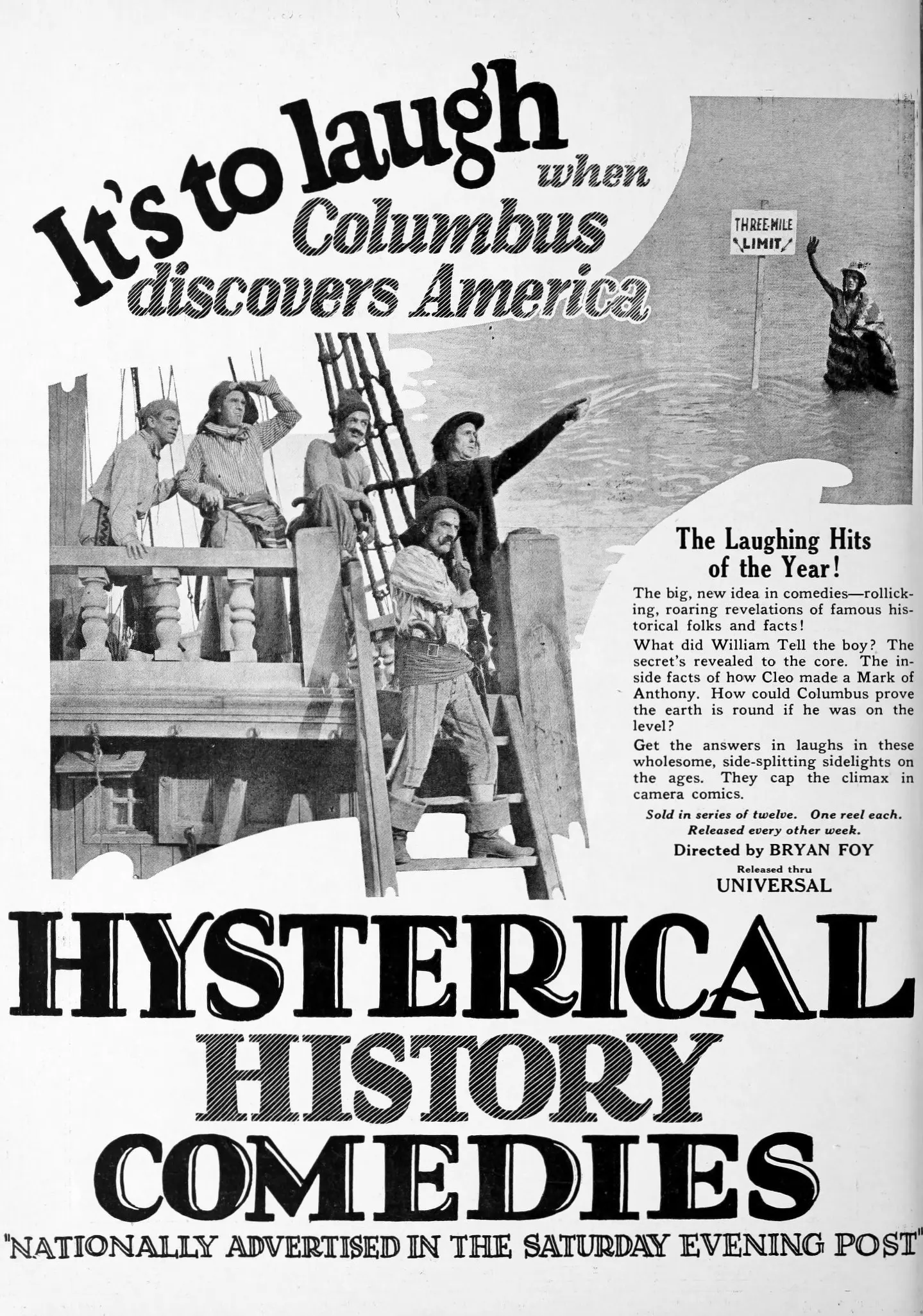
To witness Columbus and Isabella is to step into a time capsule where the gravity of historical myth-making is punctured by the needle of vaudevillian irreverence. Released in 1920, a year defined by the burgeoning social experiments of Prohibition and the rapid expansion of cinematic language, this film serves as a brilliant example of how early comedy used anachronism to critique contemporary mores. Unlike the more somber historical reconstructions seen in films like Brigadier Gerard, this production chooses the path of the clown, utilizing Billy Franey’s rubber-limbed physicality to redefine the Great Explorer as a harried Everyman.
The film opens not with the majestic vistas of the Atlantic, but with the claustrophobic domesticity of the Spanish court. Here, the struggle for patronage is less about the geometry of the globe and more about the fragile egos of the monarchy. Ethel Teare’s Isabella is a revelation of silent-era comic timing, balancing the dignity of a sovereign with the exasperation of a woman married to a man—Ferdinand—whose jealousy is as expansive as the oceans Columbus wishes to cross. This dynamic creates a tension that feels surprisingly modern, echoing the domestic frictions found in The Good Provider, albeit within a far more surrealist framework.
As the voyage commences, the film shifts its focus to the shipboard antics that define the second act. The 'revolt of the crew' is not a gritty depiction of maritime hardship but a masterclass in chase-sequence choreography. Franey is pursued throughout the vessel, utilizing the ship’s architecture as a vertical playground. The cinematography, though restricted by the technology of 1920, captures the frantic energy of the chase with a clarity that rivals the work in From Gutter to Footlights. The crew’s grievances are never fully articulated, which only adds to the Kafkaesque absurdity of the pursuit—a man chased not for his ideas, but simply because the narrative demands movement.
One cannot discuss this film without highlighting the telescope gag. In a moment of pure visual brilliance, the 'land' sighted on the horizon is revealed to be the bald head of a crew member. This subversion of the 'Eureka' moment serves as a metaphor for the film’s entire ethos: the grand promises of history are often just optical illusions. This specific type of visual punning was a staple of the era, yet here it feels particularly poignant, stripping the discovery of America of its manifest destiny and replacing it with a punchline. It is a cynical, yet hilarious, deconstruction that one might expect from the later works of the silent era, such as The Fotygraft Gallery.
The final act of Columbus and Isabella takes a sharp turn into political satire. Upon reaching the shores of the Americas, the film abandons all pretense of 15th-century accuracy to skewer the 1920s Volstead Act. The arrival of an 'Indian cop' to enforce the three-mile limit is a stroke of genius. It reframes the indigenous population not as the 'discovered' but as the sophisticated enforcers of a bizarre moral code. The 'hooch' becomes the MacGuffin, and Columbus’s subsequent attempts to sneak his bottle ashore provide some of the most inventive physical comedy of Franey’s career.
This sequence serves as a biting commentary on the futility of Prohibition. By showing the legendary founder of Western civilization reduced to a common smuggler, the film suggests that the 'American Dream' was, from its very inception, a struggle against arbitrary authority. The sea blue hues of the coastal shots contrast sharply with the dark orange urgency of Columbus's movements as he evades the law. It is a thematic complexity rarely seen in short-form comedies of the time, perhaps only rivaled by the social critiques in The Clean-Up.
The chemistry between Billy Franey and Ethel Teare is the engine that drives this production. Franey, often overshadowed in historical retrospectives by Chaplin or Keaton, displays a unique brand of kinetic vulnerability. His Columbus is not a hero, but a survivor. Teare, conversely, provides the necessary groundedness. Her Isabella is not merely a plot device; she is the catalyst for the entire endeavor. While films like Tess of the D'Urbervilles focus on the tragic weight of female agency, Teare finds the comedic power in it.
The supporting cast, particularly those playing the mutinous crew, perform with a synchronized chaos that suggests extensive rehearsal. The way they move in unison, a wave of human frustration crashing against the mast, creates a visual rhythm that is almost musical. This rhythmic approach to comedy was a hallmark of the era, yet in Columbus and Isabella, it feels more intentional, more integrated into the thematic exploration of collective madness vs. individual obsession.
From a technical standpoint, the film utilizes lighting to emphasize the isolation of the sea. The interior shots of the ship are intentionally shadowy, creating a sense of claustrophobia that heightens the comedy of the chase. This use of light and shadow—chiaroscuro for the sake of a laugh—prefigures the more dramatic applications found in Passing Night. The costume design, while clearly low-budget, leans into the artifice. The exaggerated feathers in the hats and the oversized buckles on the shoes remind the viewer that this is a stage play captured on celluloid, a farce that knows its own boundaries.
The editing is surprisingly tight for a 1920 production. The cuts between the telescope’s 'view' and the actual deck of the ship are seamless, ensuring the gag lands with maximum impact. There is a palpable sense of pace here; the film never lingers too long on a single joke, a discipline that many of its contemporaries, like The Ouija Board, lacked. The transition from the Spanish court to the open ocean, and finally to the American shore, feels like a descent into deeper and deeper levels of absurdity.
Why does Columbus and Isabella remain relevant to the modern cinephile? It is because the film refuses to respect the 'sanctity' of history. In an age where we are constantly re-evaluating our past, this 1920 comedy shows that the impulse to mock the powerful and the legendary is a timeless human trait. It shares a certain DNA with Kærlighedsspekulanten in its willingness to look at human ambition through the lens of greed and folly.
The final image of Columbus successfully landing his bottle of hooch, a small victory against a vast system of maritime and moral law, is a perfect distillation of the American spirit as seen through the eyes of a 1920s satirist. It is a film that rewards multiple viewings, as the background gags and the subtle facial expressions of the cast reveal new layers of wit. While it may not have the sweeping romanticism of The Girl I Loved or the intense melodrama of Chains of the Past, it possesses a vitality that is infectious.
In conclusion, Columbus and Isabella is a triumph of the low-brow. It takes the grandest of narratives—the 'discovery' of a world—and shrinks it down to the size of a whiskey bottle and a bald man’s head. It is a reminder that in the hands of a skilled comedian like Billy Franey, history is not a static record of facts, but a playground for the imagination. For those looking to understand the evolution of American satire, or for those who simply wish to see a queen, a king, and an explorer engage in a high-stakes game of hide-and-seek, this film is an essential piece of cinematic ephemera. It stands alongside Silk Stockings and Rose o' Paradise as a testament to the diversity of the silent era—a time when the screen was a blank canvas for every possible human folly.
Final Verdict: A riotous deconstruction of history that remains as sharp as a cutlass and as intoxicating as the contraband it celebrates.
IMDb 5.4
1933
Community
Log in to comment.